


Page 9 - Demo
P. 9
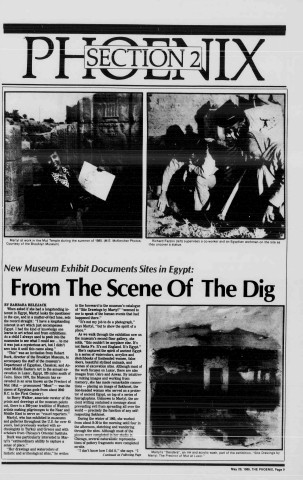
N e w M u s e u m E x h i b i t D o c u m e n t s S i t e s i n E g y p t :From The Scene Of The DigWartyl's \Martyl: The Precinct of M ut at Luxor.%u201dBY BARBARA BELEJACK When asked if she had a longstanding interest in Egypt, Martyl looks the questioner in the eye, and in a matter-of-fact tone, sets the record straight: %u201cI have a longstanding interest in art which just encompasses Egypt. I had the kind of knowledge one learns in art school and from exhibitions.As a child I always used to peek into the mummies to see what I could see ... to me it was just a mysterious art, but I didn%u2019t zero into it until this came along.%u201d%u201cThis%u201d was an invitation from Robert Buck, director of the Brooklyn Museum, to accompany the staff of the museum%u2019s Department of Egyptian, Classical, and Ancient Middle Eastern Art in the annual excavation in Luxor, Egypt, 325 miles south of Cairo. Since 1976, the Museum has excavated in an area known as the Precinct of Mut (Mut %u2014 pronounced %u201cMoot%u201d %u2014 was the queen of Egyptian gods from about 2040 B.C. to the First Century).As Barry Walker, associate curator of the prints and drawings at the museum points out, there is a 200-year tradition of Western artists making pilgrimages to the Near and Middle East to serve as %u201cvisual reporters.%u201d Martyl, who has exhibited in museums and galleries throughout the U.S. for over 45 years, had previously worked with archeologists in Turkey and Greece and with scholars from Chicago%u2019s Oriental Institute.Buck was particularly interested in Martyrs %u201cextraordinary ability to capture a sense of place.%u201d%u201cHer drawings and watercolors of historic and archeological sites,%u201d he writesin the foreward to the museum%u2019s catalogue of %u201cSite Drawings by Martyl%u201d %u201cseemed to me to speak of the human events that had happened there.%u201d%u201cIt%u2019s not my job to do a photograph,%u201d says Martyl, %u201cbut to show the spirit of a place.\As we walk through the exhibition now on the museum%u2019s second floor gallery, she adds, %u201cthis couldn%u2019t be anyplace else. It%u2019s not Santa Fe. It%u2019s not England. It%u2019s Egypt.%u201dShe%u2019s captured the spirit of ancient Egypt in a series of watercolors, acrylics and sketchbooks of lionheaded women, false doors, beautiful stylized animals, and scenes of excavation sites. Although most of the work focuses on Luxor, there are also images from Cairo and Aswan. By intuitively mixing images and working from memory, she has made remarkable connections %u2014 placing an image of Sakhmet, the lion-headed woman who served as a protector of ancient Egypt, on top of a series of hieroglyphics. Unknown to Martyl, the ancient writing contained a message about preventing evil from spreading all over the world %u2014 precisely the function of any selfrespecting Sakhmet.During the winter of 1985, she worked from about 8:30 in the morning until four in the afternoon, sketching and wandering through the sites. Although most of the/%u00bb/\\m r\\lftfflJ in Kav* o fn /lin inF tv v V M \%u201c %u2022Chicago, several naturalistic representations of pottery fragments were completed on-site.%u201cI don%u2019t know how I did it,%u201d she says. %u201cI Continued on Following PagemM artyl at work in the M ut Temple during the sum m er of 1985. (M E. M cK ercher PhotosCourtesy of the Brooklyn Museum)Richard Fazzini (left) supervises a co-worker and an Egyptian workman on the site asthey uncover a statue.May 29, 1986, THE PHOENIX, Page 9


