


Page 402 - Demo
P. 402
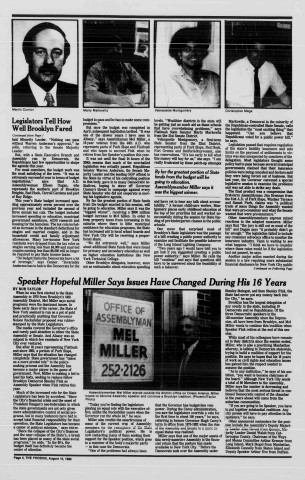
Martin ConnorLegislators Tell HowWell Brooklyn FaredContinued from Page Itant Minority Lender. %u201cNothing can passwithout Warren Anderson%u2019s approval,%u201d headds, referring to the Senate MajorityLeader.But, with a State Executive Branch andAssembly run by Democrats, theRepublicans had few opportunities to shapethe agenda this year.For most members, the budget work wasthe most satisfying of the term. %u201cIt was anextrem ely successful year in terms erf budgetnegotiations,%u201d says 52nd A.D.Assemblywoman Eileen Dugan, whorepresents the southern part of BrooklynHeights, Red Hook, Carroll Gardens and partof Bay Ridge.This year%u2019s State budget increased spending approximately seven percent over theprevious year and included the second ofthree annual tax cuts. The budget includedincreased spending on education, municipalgovernment assistance, AIDS research andhousing for the homeless. The tax cuts included an increase in the standard deductions forsingles and married couples, and in thehousehold credit and fam ily adjustmentallowances. Many low-income New Yorkresidents were dropped from the tax roles assingles earning less than $4,000 and marriedcouples earning less than $8,000 will no longerbe required to pay State income taxes.%u201cOn budget items the Democrats have a lotof leverage,%u201d says Connor. %u201cInvariablyAnderson has to look to the Democrats for theMarty Markowitzbudget to pass and he has to make some comprom ises.%u201dBut once the budget was completed inApril, subsequent legislation tardied. %u201cIt wasone of the slower years I have seen inAlbany,%u201d says Assemblyman Mel Miller, a16-year veteran from the 44th A.D. whorepresents parts of Park Slope and Flatbushand who hopes to succeed Fink when heretires from the Speaker%u2019s position this year.It was not until the final 24 hours of the209th session that much of the now-hailedlegislation was actually passed. RepublicanSenator Warren Anderson, the Senate Majority Leader and the leading GOP official inthe State by virtue of his controlling positionin this body, gave in to many Democratic initiatives, hoping to stave off GovernorCuomo%u2019s threat to campaign against everyState Senator who did not cooperate in moving his legislative agenda.By far the greatest portion of State fundsfrom the budget enacted in this session, willbe going to education. Miller says it was the%u201cbiggest winner%u201d, receiving a $600 millionbudget increase to $6.6 billion. In order tokeep property taxes from increasing in thesuburbs where there is little municipalassistance for education programs, the Statehas increased aid to local school boards andNew York City will be receiving a proportional share.%u201cWe did extremely well,%u201d says Millerabout additional State funds that were foundfor primary and secondary education as wellas higher education institutions like NewYork Technical College.Other Brooklyn delegates, however, werenot as enthusiastic about education spendingVelmanette Montgomerylevels. %u201cWealthier districts in the state willbe getting just as much aid as those schoolsthat have overwhelming problems,%u201d saysFlatbush State Senator Marty Markowitzfrom the 21st Senate District.Velmanette Montgomery, a first-termState Senator from the 22nd District,representing parts of Park Slope, Red Hook,Fort Greene and Bedford-Stuyvesant, alsohas reservations. %u201cIt%u2019s too early to tell what *this money will buy for us,%u201d she says. %u201cI amreally frustrated by these patch-up attemptsBy far the greatest portion of Statefunds from the budget will begoing to education.Assemblymember Miller says itwas the biggest winner.and have yet to hear any talk about accountability.%u201d A former child-care worker, Montgomery places early childhood education atthe top of her priorities list and worked unsuccessfully during the session for State funding of pre-kindergarten classes in the publicschools.One move that surprised most ofBrooklyn%u2019s State legislators was the passageof a bill creating a public power authority toexamine and facilitate the possible takeoverof the Long Island lighting Company.%u201cTwo years ago I would have told you toget lost if you suggested creating a publicSower authority,%u201d says Miller. He calls theill %u201ccautious%u201d and says that questions stillhave to be answered about the feasibility ofsuch a takeover.MegaMarkowitz, a Democrat in the minority ofthe Republican-controlled State Senate, callsthe legislation the %u201cmost exciting thing%u201d thathappened. %u201cCan you believe thatRepublicans voted for a public power bill,%u201dhe says.Legislation passed that requires regulationof the state%u2019s liability insurance and setslim its on the payment of settlem ents to victim s was also unexpected by members of thedelegation. Most legislators thought somepolicy had to pass because several municipalgovernments claimed that their insurancepolicies were being canceled and doctors saidthey were being forced out of business. Butlast year, the Governor convened a speciallegislative session to exam ine the problemsand was not able to strike any deals.The final product was a compromise thatfirst-term Assemblyman Jim Brennan fromtiie 51st A.D. of Park Slope, Windsor Terraceand Sunset Park, claim s was %u201ca politicaltrade of some things the Assembly wantedthat were pro-consumer and what the Senatewanted that were pro-insurance.%u201dOther Assemblymembers express mixedreactions to the adopted m easures. Millersays that %u201cthe jury is still out on most of thebill%u201d and Dugan says %u201cit probably didn%u2019t gofar enough.%u201d The legislation failed to includeany consumer advocacy office to monitor theinsurance industry. Vann is waiting to seewhat happens. %u201cI think we have to considerwhere those rates would be if the legislationhad not passed, he says.Another major action enacted during thesession is a law requiring more substantialfinancial disclosure by New York City publicContinued on Following PageS p e a k e r H o p e f u l M i l l e r S a y s I s s u e s H a v e C h a n g e d D u r i n g H i s 1 6 Y e a r sBY ROB TAYLORWhen he was first elected to the StateAssembly in 1970 from Brooklyn%u2019s 44thAssembly District, Mel Miller says socialprograms were the dominant issues. Inthose early days of his career, the State ofNew York seemed to run on a pot of goldand practically anything that GovernorNelson Rockefeller proposed was rubberstamped by the State Legislature.The media covered the Governor%u2019s officeand rarely paid attention to either the StateAssembly or Senate. And Albany was anoutpost to which few residents of New YorkCity ever ventured.But after 16 years representing Flatbushand since 1962, a portion of Park Slope,Miller says that the situation has changedcompletely. State government has %u201ctakenon a more pivotal role\making process and the Assembly hasbecome a major player in the game ofgovernment. Now, Miller is making a bid tolead his body, seeking to replace fellowBrooklyn Democrat Stanley Fink asAssembly Speaker when Fink retires thisyear.Much of the increased role for the StateLegislature has been by acccident. %u201cSincethe City%u2019s financial crisis and the onset ofPresident Reagan%u2019s neo-federalism in whichthe state governments are not only givenmore administrative control of social program s, but in many instances have had toaccept total financial responsibility for theiroperation, the State Legislature has becomea em ter of political attention,'' says Mirer.%u201cSince the collapse of the City%u2019s financesand the near-collapse of the State%u2019s, a breakhas been placed on many of the state socialprograms,%u201d he adds. %u201cIn the 80%u2019s, thebudget itself has definitely become thecenter of attention.Assemblymember Mel Miller stands outside his district office on Ocean Avenue. Millerhopes to become Assembly speaker and continue a Brooklyn tradition. (Phoenlx/TaylorPhoto)%u201cToday you%u2019re finding the legislatureplaying an equal role with the executive office, unlike the Rockefeller years when theGovernor ran the whole lo t\Miller also credits the assertiveness ofsome of the current crop of Assemblym e m o era for ure ic au ig c n cc w luc S tateLegislature%u2019s political power. He isnow contacting many of them seeking theirsupport for the Speaker position, which goesto a member of the body%u2019s majority party%u2014 in this case the Democrats.%u201cOne of the problems had always beenthat the Governor has budget-line vetopower. During the Carey administration,you saw the legislature override a veto fortiie first time in about 100 years,\referring to former Governor Hugh Carey%u2019sterm in office from 1975-1962 when the riseU i u re A a a c m lu jr %u00ab u u o c iia ic tv a u iv ic CC~equal status was realized.Miller says that one of the major assets ofthis newly-assertivi; Assembly is the financial return that the posture has madeavailable to New York City. %u201cBefore theDemocrats took over the Assembly underStanley Steingut, and then Stanley Fink, theState had never put any money back intothe City,%u201d he says.Brooklyn has the largest delegation ofany county in the state, including 19Democrats and no Republicans. Of thethree Democratic speakers in the150-member Assembly since the Depression, all have been from Brooklyn, and MelMiller wants to continue this tradition whenSpeaker Fink retires at the end of this session.While most of his colleagues have remained in their districts since the session ended,Miller, who is also a practicing Manhattanattorney, is talking to Democrats statewide,trying to build a coalition of support for theposition. He says he hopes that his 16 yearsof work on civil rights and education issueshas gained him the respect needed toassume the position.%u201cAs in any institution,%u201d he says of his ambition. %u201cyou want to become chairman ofthe board.%u201d Although New York City sendsa total of 60 Members to the Assembly,Miller says the number is decreasing andbelieves that the most serious threat to continued Democratic control of the chamberin the years ahead will come from thesuburban communities.%u201cIf you are going to be Speaker, you have; to put together substantial coalitions. Any| city person will have to pay attention to the; upstaters,%u201d he says.Other announced contenders for the posi-, tion include the Assembly%u2019s Deputy Majorit y i x n u u mailij c v c s m u u u i ^ u c c u a , m a -i jority Leader Daniel Walsh from Cattaraugus County, Chairman of the Waysand Means Committee Arthur Kremer fromLong Island, Mark Siegel from Manhattan,Elizabeth Connelly from Staten Island andDeputy Speaker Arthur Eve from Buffalo.Pago 4, THE PHOENIX, August 14,1966


