


Page 405 - Demo
P. 405
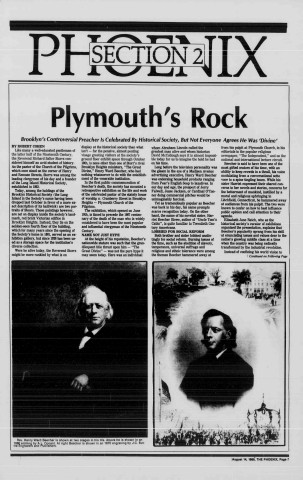
Plymouth's RockBrooklyn's Controversial Preacher Is Celebrated By Historical Society, But Not Everyone Agrees He Was 'Divine'BY ROBERT COHENLike many a well-educated gentleman ofthe latter half of the Nineteenth Century,the Reverend Richard Salter Storrs considered him self an avid student of history.As the pastor of the Church of the Pilgrim s,which once stood on the com er of Henryand Remsen Streets, Storrs was among theleading clergymen of his day and a founderof the Long Island Historical Society,established in 1863.Today, among the holdings of theBrooklyn Historical Society (the LongIsland in the Society%u2019s name having beendropped last October in favor of a more exact description of its bailiwick) are two portraits of Stoors. Those paintings however,are not on display inside the society%u2019s landmark, red brick Victorian edifice inBrooklyn Heights. Instead, they lie on theseldom-seen fourth floor of the building,which for many years since the opening ofthe Society%u2019s home in 1881, served as an exhibition gallery, but since 1926 has been used as a storage space for the institution%u2019sdiverse collection.Were he alive today, the Reverend Storrsmight be more rankled by what is ondisplay at the historical society than whatisn%u2019t %u2014 for the pensive, almost poutingvisage greeting visitors at the society%u2019sground floor exhibit space through OctoberlOth, is none other than one of Storr%u2019s rivalBrooklyn Heights m inisters, %u201cThe GreatDivine,%u201d Henry Ward Beecher, who hadnothing whatsoever to do with the establishment of the venerable institution.In the first public commemoration ofBeecher%u2019s death, the society has mounted aretrospective exhibition on the life and workof the celebrated pastor of the stately houseof worship %u00ab : Cranberry Street in BrooklynHeights %u2014 Plymouth Church of thePilgrims.The exhibition, which opened on June19th, is timed to precede the 1987 centennary of the death of the man who is widelyconsidered to have been the most popularand influential clergyman of the NineteenthCentury.NAME NOT JUST HYPEAt the height of his reputation, Beecher%u2019snationwide stature was such that the grandiloquent title thrust upon him %u2014 %u201cTheGreat Divine%u201d %u2014 was not the pure hype itmay seem today. Here was an individualwhom Abraham Lincoln called thegreatest man alive and whom historianDavid McCollough says it is almost impossible today for us to imagine the hold he hadon his time.Long before the television personality wasthe gleam in the eye of a Madison Avenueadvertising executive, Henry Ward Beecherwas endorsing household products rangingfrom Pear%u2019s English Soap to laxatives. Inour day and age, the prospect of JerryFalweU, Jesse Jackson, or Cardinal O%u2019Connor doing commercial pitches would beunimaginably farcical.Yet as tremendously popular as Beecherwas back in his day, his name promptsscarce recognition today. On the otherhand, the name of his novelist sister, Harriet Beecher Stowe, author of %u201cUncle Tom%u2019sCabin%u201d, is quite familiar to Twentieth Century Americans.LOBBIED FOR SOCIAL REFORMBoth brother and sister lobbied unstintingly for social reform. Burning issues ofthe tim e, such as the abolition of slavery,temperance, universal suffrage andreligious and ethnic tolerance were amongthe themes Beecher hammered away atfrom his pulpit at Plymouth Church, in hiseditorials in the popular religiousnewspaper, %u201cThe Independent,%u201d and on thenational and international lecture circuit.Beecher is said to have been (me of themost gifted orators of his tim e, with anability to keep crowds in a thrall, his voicemodulating from a conversational sottovoce to a spine tingling boom. While hissister Harriet expressed their shared concerns in her novels and stories, concerns forthe betterment of mankind, instilled by amoral and religious upbringing inLitchfield, Connecticut, he hammered awayat audiences from his pulpit. The two wereknown to confer on how to best influencepublic opinion and call attention to theiragenda.Elizabeth Jane Reich, who as thehistorical society%u2019s curator of exhibtionsorganized the presentation, explains thatBeecher%u2019s popularity sprang from his skillat enunciating issues and values dear to thenation%u2019s growing middle class at a timewhen the country was being radicallytransformed by the industrial revolution.Instead of confining his world vision to) Continued on Following PageRev. Henry Ward Beecher is shown at two stages in his life. Above he is shown in an1886 etching by A.L. Conant. At right Beecher is shown in an 1870 engraving by J.C. Buttre Engravers and Publishers.August 14,1986, THE PHOENIX, Page 7


