


Page 421 - Demo
P. 421
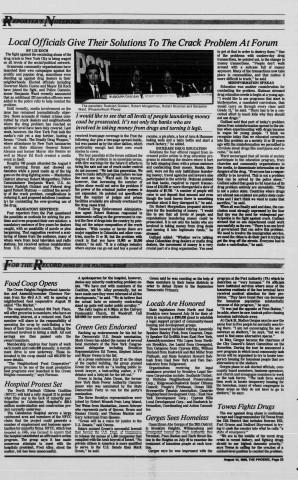
Local Officials Give Their Solutions To The Crack Problem A t ForumThe panelists: Rudolph Giuliani, Robert Morgenthau, Robert Stutman and BenjaminWard. (Phoenix/Koch Photo)/ would like to see that all levels of people laundering moneycoud be prosecuted. It's not only the banks who areinvolved in taking money from drugs and turning it legit.BY LIZ KOCHThe fight against the escalating abuse of thedrug crack in New York City is being wagedon all levels of the social/political network.Grassroots community organizations havelaunched their own campaigns against theprolific and popular drug, som etim es evenstanding up against drug dealers in theirneighborhoods. Elected officials includingGovernor Mario Cuomo and Mayor Ed Kochhave joined the fight, and Police Commissioner Benjamin Ward recently announcedthat an additional 222 narcotics officers wereadded to the police rolls to help combat theproblem.Until recently, media involvement on theissue has remained journalistically objective. News accounts of violent crim es committed by crack dealers and neighborhoodswhere the drug problem has reached anepidemic level have been duly covered. Lastweek, however, the New York Post took themedia%u2019s role yet a step further, hosting aforum: %u201cCrack: The Deadly Drug Weapon,%u201dwhere attendance by New York luminariessuch as State Attorney General RobertAbrams and former Mayor Abe Beame aswell as Mayor Ed Koch created a mediaevent in itself.Roughly 700 people attended the August 6early morning forum and chewed ondanishes while a panel made up of the bigguns on the drug-fighting scene %u2014 ManhattanDistrict Attorney Robert Morgenthau, PoliceCommissioner Benjamin Ward, U.S. Attorney Rudolph Giuliani and Federal drugagent Robert Stutman %u2014 outlined the severity of the crack problem, complications inreducing it, and proposed solutions (cautiously) for combatting the ever-growing use ofthe drug.MANDATORY SENTENCEFour reporters from the Post questionedthe panelists mi methods for solving the proMem and even proposed their own solution: amandatory sentence of five years for dealerscaught, with no possibility of parole or pleabargaining. That suggestion received a scattering of hisses from the audience, many ofwhom were from local television and radiostations, but received serious considerationfrom U.S. Attorney Guiliani. The eventreceived front-page coverage in the Post thefollowing day plus a two-page spread inside,but was passed up by the other dailies, whichpredictably enough had their own crackstories to cover.The four panelists at the forum outlined thedegree of the problem in no uncertain term s,with dire warnings for the future if efforts tobring the sale and use of crack under controldo not succeed. %u201cWe lost this generation. Weneed to make definite progress before we losethe next one too,%u201d Ward said. He warned,however, that increasing the number ofpolice alone would not solve the problem ifthe power of the crim inal justice system isnot expanded. He pointed out specificallythat the number of judges and prisonfacilities available are already overtaxed bythe drug cases tried.Federal Drug Enforcement Administration agent Robert Stutman responded tostatem ents calling on the government to control the flow of drugs into the country by pointing out the unique composition of the crackdealers. %u201cWith cocaine or heroin there aremajor suppliers in Colombia and other countries, maybe 15 or 20, but the problem withcrack is that you have 10,000 or 20,000dealers,%u201d he said. %u201cIt is a cottage industrywhere anyone can go out and buy a pound ofcocaine, a pie plate, a box of Arm & Hammerbaking soda and a baby bottle and start acrack factory,%u201d he added.INCREASE DRUG EDUCATIONSolutions the four offered ranged from increased police action to drug education programs to attacking the dealers where it hurtby both slapping them with a prison sentenceand confiscating their money. Banks, theysaid, were not the only institutions laundering money; travel agencies and lawyers alsoparticipated in the activity. Stutman pointedout that banks, required to report transactions of $10,000 or more disregarded a slew ofdeposits of $9,700. %u201cA number of people willcome in and deposit that amount and evenlike to see that all levels of people andorganizations laundering money could beprosecuted. It is not only the banks who areinvolved in taking money from drug dealsand turning it into legitim ate funds %u201d hestressed.Guiliani added: %u201cWhether we%u2019re talkingabout Colombian drug dealers or mafia drugdealers, the movement of money is a verycrucial part of a drug organization. You needto get at that in order to destroy tliem .%u201d Oneof the problems with modern-day drugtransactions, he pointed out, is the change inmoney transactions. %u201cPeople don%u2019t walkaround with a suitcase full of moneyanymore. Many of the transactions now takeplace in commodities, and that m akes itmore difficult to track,%u201d he said.MISINFORMATION SPREADEducation was another consideration forcombatting the problem. Stutman stresseddrug education needs to begin at a young age.%u201cI would like to see programs that start inkindergarten, a mandated curriculum, thatwould carry on through every class untilGrade 12,%u201d he said. %u201cThere has to be a concerted effort to teach kids why they shouldnot use drugs.%u201dGuiliani said that part of today%u2019s problemstem s from misinformation spread in the sixties when experimenting with drugs becamein vogue for young people. %u201cI think werecognize today that we educated ourselvesinto this problem as a society 15 or 20 yearsago with the misinformation we permitted tocirculate about drugs like marijuana and cocaine,%u201d he said.Ward encouraged that all levels of societyparticipate in the education program, fromchurches and community organizations tothe media, to disseminate information on thedangers of the drug. %u201cEveryone has a responsibility to be involved. This is not a problemthat can be solved by the police alone.%u201dGuiliani added that goals to rid America of itsdrug problem entirely are unrealistic. %u201cThisis not a police state. Countries where drugsare almost non-existent are police state counWhen all was finally said and done, the conclusion most strongly expressed by the fourthat day was the need for widespread participation in the fight against crack. Guilianistresed that no one department could worksuccessfully on its own, %u201cThere is no one levelof government that can solve this problem.We need to involve the immigration service,we need the cities to do their part in trying toget the drug off the streets. Everyone has tomake a contribution,%u201d he said.though the bank knows there is somethingpeculiar about it they disregard it,%u201d he said.DA Robert Morgenthau proposed stricterlaws for foe laundering of money. %u201cI wouldtries and I don%u2019t think we want to make thatsacrifice,%u201d he said.Food Coop OpensThe Crown Heights Neighborhood Association and Assembiymember Clarence Norman from the 43rd A.D. will be opening aneighborhood food cooperative August 23called %u201cThe Market.%u201dThe cooperative, located 824 Park Place,will offer groceries to members, who have anownership interest, at a reduced cost. Eachmember will share in the responsibility ofoperating the co-op by contributing a fewhours of their tim e each month, limiting theoverhead involved in hiring a staff. All costsavings are then passed onto theowner/members.Membership requires four hours of workeach month and costs $20 annually. A recruitment drive is now underway. Those interested in the co-op should call 493-3700 formore details.%u201cThe Neighborhood Food Cooperative%u201dpromises to be one of the most productivefood programs ever launched in the CrownHeights community,%u201d says Norman.Hospital Protest SetThe North Flatbush Citizens Coalition(NFCC) will hold a rally August 21 to protestwhat they say is the lack of minority participation in Caledonian Hospital%u2019s $28.5million modernization and construction project currently underway.The Caledonian Hospital serves a largecatchment area and members of the NFCCclaim that the project could generate anumber of employment and business opportunities for minority firm s. NFCC, which was- %u00ab - J i - ----------%u00bb------------------1 4. %u2014 ----------- %u2014 4 L - AIUU1IUCU U l AflW | n o o 1U1UUA1 w v u o t u v mici*the hospital established an affirmative actionprogram. The group says it has madenumerous attempts to m eet with thehospitals president, Fred Alley, about them atter, but has bear unsuccessful.A spokesperson for the hospital, however,denies any minority contracting problem exists. %u201cWe have met with members of theCoalition, not Mr. Alley personally, but wehave made sure they were informed of all thedevelopments,%u201d he said. %u201cWe do believe thatthe actual facts on minority contractingstand up quite well under public scrutiny.%u201dThe rally begins at 6:30pm at the CalvaryPentecostal Church, 151 Woodruff. Call8264)006 for more information.Green Gets EndorsedRacking up endorsements for his bid forthe Democratic U.S. Senate nomination,Mark Green has added the names of severallocal members of the New York Congressional delegation including BrooklynRepresentatives Ed Towns, Stephen Solarzand Major Owens to his list.At a press conference July 22 cm the stepsof the capitol building, the group praisedGreen for his work as %u201ca leading public interest lawyer, a best-selling author, a TVdebater and a lobbyist for the left-out.%u201dGreen is facing John Dyson, the formerNew York State Power Authority Commissioner who was nominated by the StateDemocratic Party to run for the party%u2019snomination.The three Brooklyn representatives werejoined by Robert Mrazek from Long Island,Ted Weiss from Manhattan, Jam es Scheuerwho represents parts of Queens, Bronx andNassau County, and Thomas Manton andGary Ackerman from Queens.%u201cGreen will be a voice for justice in dieU.S. Senate,%u201d said Owens.Solarz praised Green%u2019s successful lawsuit4.1---- 4. I ------------ I 4 k . YT O T W 4 - IU M I t 4 V 4 V V U w un, V 4 W U H M M V Vto release the names of 1,400 companies; thatcomplied with the Arab boycott of Israel %u201cNoprivate citizen in America is more qualifiedto serve in foe UJS. Senate than MarkGreen,%u201d be said.G reat said he was counting on the help ofthese members in their hone districts inorder to defeat Dyson in the SeptemberDemocratic Primary.Locals Are HonoredState legislators from North and EastBrooklyn were honored July 24 for their efforts in securing a $260,000 grant to establisha legal support project of community-basedhousing and development groups.Those honored included retiring AssemblySpeaker Stanley Fink, from Canarsie, Deputy Speaker Ed Griffith from East New Y ak,Assemblymembers Vito Lopez from Northern Brooklyn, Joe Lentol from Greenpoint,Tom Catapano from Cypress Hills, WilliamBoyland from Bush wick and Mel Miller fromFlatbush, and State Senators Howard Babbush from East New York and Tom Bartosiewicz from Ridgewood.Organizations receiving the legalassistance provided by Brooklyn Legal Services Corporation include: Southside United;St. Nicholas Neighborhood PreservationCorp.; Ridgewood-Bushwick Senior CitizensCouncil; People%u2019s Firehouse, Ocean HillBrownsville Tenants Association, CanarsieNeighborhood Development C op.; East NewYork Development Corp.; Cypress HillsLocal Development C op.; and Bushwick Information, Coordinating and Action Committee.program at the Port Authority (PA) which hedescribes as %u201cvery humane.%u201d PA officialshave instituted services where some of thehomeless residents of the bus terminal havereceived medical attention for their problem s. %u201cThey have found they can decreasethe homeless population substantiallybecause of this program,%u201d he says.%u201cIt was just Hie opposite at Penn Station,%u201dhe adds, where he saw Amtrak police chasingboneless individuals away.At Clark St. Station Gerges says he saw thesam e four to five people he normally sees living there. %u201cI am not encouraging the use ofsubways as shelters,%u201d he says, %u201cbut we doneed to find som e alternative spaces.%u201dIn May, Gerges became the chairman ofthe City Council%u2019s Select Committee on theHomeless. Dining the tour he announced anew program in which local community taskforces will be organized to try to locate temporary housing for boneless people that arealternatives to the shelters.Gerges plans to ask elected officials, community board members, business operators,and church and synagogue members to worko i the task forces. %u201cThe task force wouldthen work to locate temporary housing forthe homeless, many of whom congregate inthese areas so they do not have to go toshelters,%u201d he says.Towns Fights DrugsThe war against drag abuse Is continuingGerges Sees Homeless S K J f i S B B K E MCouncilman Abe Gerges of the 29th District Fort Greene and Bedford Stuyvesant is tryin Brooklyn Heights, Williamsburg and ing tn push the country into what he o%u00bbn%u00ab %u201caflmn iMumUini fk n Pw 4 A nfknrH v Him otttfft ai MnftriMmmr %u201dTerminal, Perm Station and d ark Street Sta- %u201cWe are is the middle of the worst dragtion in the Heights on July 30 to examine the crisis in recent history, and fighting drugstreatment of hom eless people at each loca- should be our highest domestic priority,%u201dtion. sa;rs Towns hi raffing for the creation of aGerges says he was impressed with the cabinet-level position to combat the problem.August 14. IMS, THE PHOENIX, Pag* 23


