


Page 425 - Demo
P. 425
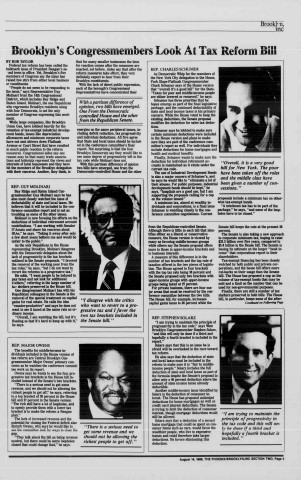
Brookl'/n, ____ incm i _________ i _ i _______ n ________________________________________ ___i - A i n r___ Tfc f - m i * i i D i u u i i i n i s ^ u iig r o s iiic iit u c r s ju u u it m i h a iv e iu im d u iBY ROB TAYLORFederal tax reform has been called thehallmark issue of President Reagan%u2019s se3nd term in office. Yet, Brooklyn%u2019s fivemembers of Congress say the issue hasraised few stirs from either local businessor constituents.%u201cPeople do not seem to be responding tothe issue,%u201d says Representative GuyMolinari from the 14th CongressionalDistrict, which includes Bay Ridge andStaten Island. Molinari, the one Republicanwho represents Brooklyn residents alongwith four Democrats, is not the onlymember of Congress expressing this sentiment.While large companies, like BrooklynUnion Gas, have lobbied heavily for theretention of tax-exempt industrial development bonds, issues like depreciationallowances and minimum corporate taxeshave not sent shivers down FlatbushAvenue or Court Street that have resultedin much public reaction to the reformm easures. Congressional aides say onereason may be that many trade associations and lobbyists represent the views andinterests of local businesses and they havehit the members of the Brooklyn delegationwith their concerns. Another, they think, isthat for many sm aller businesses the timefor reaction comes after the measures areenacted, not before. Aides say that after thereform measures take effect, they verydefinitely expect to hear from theirBrooklyn constituents.With the lack of direct public expression,each of the borough%u2019s CongressionalRepresentatives have concentrated theirWith a partisan difference ofopinion, two bills have emerged.One From the Democraticcontrolled House and the otherfrom the Republican Senate.energies on the sam e peripheral issues, including deficit reduction, tax progressivityand individual deductions. All five agreethat State and local taxes should be included in the conference committee%u2019s finalreport. Not surprising is that the fourBrooklyn Democrats say they would like tosee some degree of progressivity left in thetax code while Molinari does not.With this partisan difference of opiniontwo bills have emerged, one from theDemocratic-controlled House and the otherREP. GUY M OLINARIBay Ridge and Staten Island Congressmember Guy Molinari says he hasalso most closely watched the issue ofdeductability of state and local taxes. Hebelieves that it will be included in the conference committee report and is not astroubling as some of the other issues.Molinari is now focusing his efforts on thedeductions of individual retirement accountcontributions. %u201cI am working with SenatorD%u2019Amato and share his concerns aboutIRAs,%u201d he says. %u201cTaking it away after onlya few short years bothers m e and would beunfair to the public.%u201dAs the only Republican in the Houserepresenting Brooklyn, Molinari disagreeswith the Democratic delegates about thelack of progressivity in the tax bracketsoutlined in the Senate proposals. %u201cI favoredthe removal of the working poor from thetax roles,%u201d he says, %u201cbut I do not want torevert the reforms to a progressive tax.%u201dHe adds, %u201cI want people to be induced topay taxes and not look for additionalshelters,%u201d referring to the large number ofta / shelters preserved in the House bill.(hie disagreement Molinari has with hisRepublican colleagues in the Senate is theremoval of the special treatment on capitalgains for real estate. He calls the idea%u201ccounter-productive%u201d and says he does notwant to see it taxed at the sam e rate as ordinary income.%u201cOverall, I am watching the bill, but it%u2019sfloating so fast it%u2019s hard to keep up with it,%u201dhe says.%u201c / disagree with the criticswho want to revert to a progressive tax and I favor thetwo tax brackets included inthe Senate bill. %u201d%u201c There is a serious need toREP. MAJOR OWENSThe benefits for middle-income individuals included in the House version oftax reform are Central Brooklyn Congressmember Major Owens%u2019 primary concerns as he watches the conference committee work on its report.Owens says he wants to see the four progressive tax brackets in the House bill included instead of the Senate%u2019s two brackets.%u201cThere is a serious need to get somerevenue, and we should not be allowing therichest people to get off,%u201d he says, referringto a top bracket of 38 percent in the Housebill and 27 percent in the Senate version.%u201cThe rich still have a lot of loopholes, andto openly provide them with a lower taxbracket is to make the reform a Reaganplan.%u201dThe lack of increased revenue and thepotential for closing the Federal deficit alsodisturb Owens, who says he would like tov%u2014 %u2014 'v w %u2018'*u~ get some revenue and we%u201cThey talk about the bill as being revenue should not be allowing theneutral, but there could be some loopholes richest people to get off. %u201dclosed that could change that,%u201d he says. _ _ _ _ _ _ _ _ _ _ _ _ _ _ _ _ _ _ _ _ _ _ _REP. CHARLES SCHUMERAs Democratic Whip for the members ofthe New York City delegation to the House,Park Slope-Flatbush CongressmemberChuck Schumer says of the House versionthat %u201coverall it%u2019s a good bill%u201d for the State.%u201cTaxes for poor and middle-income peopleare either lowered or removed,%u201d he says.Schumer has three priorities that hehopes em erge as part of the final legislativepackage, and the continued deductability ofstate and local income taxes is his primaryconcern. While the House voted to keep theexisting deductions, the Senate proposalmodifies the deduction for sales tax deductions.Schumer says he lobbied to make surecertain minimum deductions were includedin the House version and plans to makesure they are part of the conference comm ittee%u2019s report as well. For individuals theyinclude deductions for home mortgages andhealth and medical benefits.Finally, Schumer wants to make sure thededuction for individual retirement accounts is maintained as it exists under thecurrent tax code.The use of Industrial Development Bondsis also a major concern of Schumer%u2019s, andhe says he would like to %u201celim inate a lot oftheir abuses. For public purposes, industrialdevelopment bonds should be kept,%u201d he%u201c Overall, it is a very goodbill for New York. The poorhave been taken off the rolesand the middle class havebeen given a number o f conood use, but I amcalling for a capsays, %u201chospitals are a gosupporting the proposalson the volume issued.%u201dA minimum tax, aimed at wealthy individuals and corporations, is a final issueSchumer is watching closely in the conference committee negotiations. Currentcessions. %u00bb%u00bbproposals include a minimum tax on otherwise tax-exempt bonds.%u201cA minimum tax has to be part of thepackage,%u201d he says, %u201cand some of the loopholes have to be closed.%u201dfrom the Republican-controlled Senate.Although there is little in each bill that identities either as a liberal or conservativemeasure, the House version is viewed bymany as favoring middle-income groupswhile others say the Senate proposal offersmore to those in upper-income brackets andto business interests.A measure of this difference is in thenumber of tax brackets and the top rate oftaxation offered in the two pieces of legislation. The House agreed to four bracketswith the top tax rate being 38 percent andthe Senate proposed only two brackets withupper-income groups with upper-incomegroups being taxed at 27 percent.For private business, there are four major areas that must be resolved by the conference committee between the two bills.The House bill, for example, increasescapital gains taxes to 36 percent while theSenate bill keeps the rate at the present 28percent.The Senate is also taking a new approachto corporate minimum tax, hoping to raise$33.3 billion over five years, compared to$5.8 billion in the House bill. The Senate isbasing its estim ate on the larger %u201cbook incom e%u201d that corporations report to theirshareholders.Tax-exempt financing has been closelywatched by both public and private corporations, and the house bill offers morecut-backs on their usage than the Senatebill. The House has proposed a cap on thevolume of tax-exempt bonds that m ay besold and a limit on the number that can beused for non-governmental purposes.Finally, there are still a number of taxshelters preserved in both bills. The Housebill, in particular, keeps some of the afterContinued on Following Pag*REP. STEPHEN SOLARZ%u201cI am trying to maintain the principle ofprogressivity in the tax code,%u201d says WestBrooklyn Congressmember Stephen Solarz,%u201cand this will only be done if a third andhopefully a fourth bracket is included in thereport.%u201dSolarz says that this is an issue he isafraid will be overlooked in the race towardtax reform.He also says that the deduction of stateand local taxes must be included in thereform to make sure it is %u201cfair to middleincome people.%u201d Solarz includes the fulldeduction of state and local taxes as part ofthe formula despite the Senate%u2019s proposal toallow oniy a 60 percent deduction above theamount of state income taxes alreadydeductible.Another middle-income issue identified bySolarz is the deduction of consumer interest. The House has proposed unlimiteddeductions for home mortgages as well ascredit card interest deductions. The Senateis trying to limit the deduction of consumerinterest, though mortgage deductions wouldstill be allowed.Solarz says that a deduction of a secondhome mortgage titiat could be spent on consumer item s such as cars, would favor thewealthier people, who live in expensivehomes and could therefore take largerdeductions. He favors eliminating thisdeduction.%u201c / am trying to maintain theprinciple o f progressivity inthe tax code and this will only h e d o n e i f a th ird a n dhopefully a fourth bracket isincluded. %u201dAugust 14,1986, THE PHOENIX/BROOKLYN.INC SECTION TWO, Pag* 3


