


Page 486 - Demo
P. 486
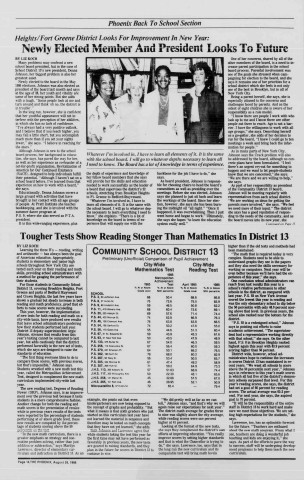
Phoenix Back To School SectionHeights/Fort Greene District Looks For Improvement In New Year:Newly Elected Member And President Locks uTtk \1 U 1 U I U I VWhatever I'm involved in, I have to learn all elements of it. It is the samewith the school board. I will go to whatever depths necessary to learn allI need to know. The Board has a lot of knowledge in terms of experience.BY LIZ KOCHMany problems may confront a new school board president, but in the case of School District 13%u2019s new president, Donna Johnson, her biggest problem is also her greatest asset.Newly elected to the board in the May 1986 elections, Johnson was also elected as president of the board last month and says at the age of 28, her youth and vitality are some of her strong points. But she adds with a laugh, %u201cSome people look at me and turn around and think 'oh no, the district is in trouble%u2019.%u201dIn the long run, however, she is confident that her youthful appearance will not interfere with the perception of her abilities, in which she has no lack of confidence.%u201cI%u2019ve always had a very positive outlook, and I believe that if you reach higher, you may fall a little short, but you accomplish much more than if you set your sights lower,\the stars.\Although Johnson is new to the school board process, her background in education, she says, has paved the way for her, as well as her experience as co-founder of a not-for-profit organization, Revitalization of America for Our Continued Existence (RACE), designed to help individuals fulfill their potential. \school board before, I%u2019ve learned from that experience on how to work with a board,%u201d she says.Educationally, Donna Johnson covers a large ground with activities that have brought in her contact with all age groups of people. At Pratt Institute she teaches bookkeeping, and she is involved with the summer dance program at P.S. 9, where she also served as P.T.A. president.It is this wide-ranging experience, plusthe depth of experience and knowledge of her fellow board members that she says will provide her the skills and education needed to work successfully as the leader of a board that supervises the district%u2019s 22 schools, stretching from Brooklyn Heights to Ft. Greene to Bedford-Stuyvesant.%u201cWhatever I%u2019m involved in, I have to learn all elements of it. It is the same with the school board. I will go to whatever depths necessary to learn everything I need to know,%u201d she explains. %u201cThere is a lot of knowledge on the board in terms of experience that will supply me with thebackbone for the job I have to do,%u201d she says.As board president, Johnson is responsible for choosing chairs to head the board%u2019s committees as well as presiding over the meetings. Before she was elected, Johnson says she planned to just sit back and learn the workings of the board. Since her election, however, she says she has been burning the midnight oil %u201call night.%u201d %u201cOnce it happened, it was overwhelming. Then I just went home and began to work.%u201d Ultimately, she says she hopes %u201cto learn the education system really well.%u201dOne of her concerns, shared by all of the other members of the board, is a need to increase parent participation in the school board process. Parental involvement was one of the goals she stressed when campaigning for election to the board, and she says it remains one of her priorities for a school district which she feels is not only one of the best in Brooklyn, but in all of New York City.Being a parent herself, she says, she is especially attuned to the concerns and challenges faced by parents. And as the oldest of eight children she is aware of her responsibly as a role model.%u201cI know there are people I work with who look up to me and I know there are other people out there to reach. Age is not a barrier. I have the willingness to work with all age groups,%u201d she says. Describing herself as a go-getter, she adds of her decision to run for the board, %u201cI knew I could go to ten meetings a week and bring back the information for people.%u201dAs in many parts of New York City, Johnson says the Crack problem will also be addressed by the board, although no concrete plans have been formulated. %u201cI feel there%u2019s an urgent cry-out for something to happen and we want to let people-students know that we are concerned,%u201d she says.%u201cWe are there and we are willing to help,%u201d she says.As part of her responsiblity as president of the Community District 13 board,Johnson will be meeting regularly with representatives from each school district. %u201cWe are working on ideas for getting the parents more involved,%u201d she says. %u201cWe feel we need more of their input.%u201d The district she says has a good reputation of responding to the needs of the community, and as the board moves into its new year, sheContinued on Page 15Tougher Tests Show Reading Stonger Than Mathematics In District 13Community School District 13P re lim in a ry (U n o ffic ia l) C o m p a ris o n o f P u p il A c h ie v e m e n tCity-Wide City-WideMathematics Test Reading Test1986MetropolitanAchievement1985 Test April 1985 1986% At or Above % A t or Above % At or Above % At or AboveSCHOOLGrade Level 50 th percentile Grade Level 50th percen tileP.S. 3, 50 Jefferson Ave. 68 50.4 68.6 66.8P.S. 8, 37 H icks St 75 72.6 75.5 83.9P.S. 9, 80 Underhill Ave. 59 46.5 50.8 62.2P.S. 11, 419 W averly Ave. 68 60.4 73.6 69.1P.S. 20, 225 Adelphi St 69 57.6 71.4 74.4P.S. 44, 432 Monroe St. 74 62.8 66.9 76.3P.S. 46, 100 Clerm ont Ave. 76 63.8 63.8 66.5P.S. 54, 195 Sanford St. 74 50.2 47.6 55.0P.S. 56, 170 Gates Ave 55 44.6 51.3 60.4P.S. 67, 51 St. Edwards St. 59 43.9 45.3 61.6P.S. 93, 31 N ew York Ave 50 43.5 47.9 48.9P.S. 133, 375 Butler St. 67 54.0 46.3 59.5P.S. 256, 114 Koscuisko St. 67 56.4 60.0 59.3P.S. 270, 241 Emerson PI. 64 50.1 66.2 76.5P.S. 282, 180 Sixth St 78 68.0 60.2 82.9P.S. 287, 50 Navy St 56 53.4 50.5 65.7P.S. 305, 344 Monroe St 61 47.4 49.2 58.9P.S. 307, 209 York St 71 59.2 64.9 73.3J.H.S. 113, 300 Adelphi St. 57 51.63 68.9 74.4J.H.S. 117, 300 W illoughby Ave. 50 22.30 48.1 65.6J.H.S. 258, 141 Macon St. 45 32.88 57.5 67.0J.H.S. 265, 101 Park Ave. 46 28.95 52.1 50.9M icrosatellite 8, 37 H icks st 72 65.4 %u2014 79.4BY LIZ KOCHLearning the three R%u2019s %u2014 reading, writing and arithmetic %u2014 has always been the goal of American education. Appropriately, students in elementary and junior high schools throughout New York City are tested each year on their reading and math skills, providing school administrators with a method for gauging the performance of their students.For those students in Community School District 13, covering Brooklyn Heights, Fort Greene and parts of Bedford Stuyvesant and Crown Heights, the last few years have shown a gradual but steady increase in both reading and math proficiency, proof that efforts to raise scores were succeeding.This year, however, the implementation of new tests for both reading and math on a city-wide basis, have produced new results that leave school administrators pondering how their students performed last year. District 13 deputy superintendent Argie Johnson, stresses that results from this year%u2019s testing cannot be compared to last year, but adds cautiously that the district performed favorably in the new set of tests, which she says are designed to raise the standards of education.%u201cThe first thing everyone likes to do is compare these scores, with previous scores, but that%u2019s impossible,%u201d Johnson says. Students wrestled with a new math test this year, called the Metropolitan Achievement Test, designed to complement the new math curriculum implemented city-wide last year.The new reading test, Degrees of Reading Power (DRP), Johnson says, is an improvement over the previous test because it tests students in a more comprehensive fashion. Another change for both the reading and math scores is the presentation of results: while in previous years results of the tests were reported by the percentage of students performing at or above grade level, these new results are computed by the percentage of students scoring above the 50 ----- p v i v.um uv, u u wiv. wvwv %u2014%u201cIn the new math curriculum, there is a greater emphasis on strategy and nonroutine problem solving, rather than just addition or subtraction,\Lawrence, director of elementary curriculum and instruction in District 13. As anexample, she points out that even kindergarteners are now being exposed to the concept of graphs and probability. %u201cBut what it means is that sixth graders who just started on this curriculum last year have not learned the material in sequence and therefore may be tested on math concepts that they have not yet learned,\D / s i L T *-* V , r , *-\\ T n / Y o t a a 4 L n 4 *-*vbl 1 VUIUMVII UIIU M i n t vtivv. U ^i vv. u iu vwhile students taking the test this year for the first time may not have performed as favorably in previous years, the new tests are geared to raising standards, and they plan in the future for scores in District 13 to continue to rise.%u201cWe did pretty well as far as we can tell,\again raise our expectations for next year.%u201d The district math average for grades three to nine was slightly above the city average, while reading scores were one percent higher at 61 percent.Looking at the format of the new tests, says thpv rn m nlpm en t t.hp d is tric t%u2019s ownefforts at improving education. %u201cYou really improve scores by setting higher standards and that is what the Chancellor is trying to do,%u201d she says. I-awrence, too, says that in the long run the new curriculum and its comparable test will bring math levelshigher than if the old tests and methods had been maintained.%u201cThe math that is required today is very complex. Students need to be able to understand graphs they see in the papers and they also need the skills necessary for working on computers. Next year will be even better because we%u2019ll have had the experience of this year,%u201d she says.One conclusion school administrators can reach from test results this year is a school%u2019s relative performance to other schools in the district, as compared with last year. P.S. 93 on New York Avenue scored the lowest this year in reading and was the only elementary school to dip below the 50 percentile with only 48.9 percent scoring above that level. In previous years, the school also ranked near the bottom for the district.%u201cP.S. 93 is a redesigned school,%u201d Johnson says in pointing out efforts to raise academic achievement. %u201cThe superintendent had a representative working directly with that school,%u201d she says. On the other hand, P.S. 8 in Brooklyn Heights ranked highest again this year with 83.9 percent scoring higher than 50 percent.District wide, however, school administrators hope to continue the increases in scores District 13 has maintained in recent years. %u201cWe want all schools to score above the 50 percentile next year,%u201d Johnson says in reference to this year%u2019s math scores in which all but five of the district%u2019s elementary schools surpassed that level. For this year%u2019s reading scores, she says, the district had set a goal of 66 percent for reading scores. The actual average was 65.2 percent. For next year, she says, the aspired goal is 70 percent.%u201cIt will be the responsibility of the entire staff in District 13 to work hard and make sure we meet those objectives. We are setting high expectations for the students,%u201d shesays.Lawrence, too, has an optimistic forecast for the future. %u201cTeachers are enthused about the new math program. From what I see, teachers are doing a wonderful job teaching and kids are enjoying it,%u201d she says. As part of the efforts to pave the way to success, staff will be undergoing development programs to help them teach the new curriculum.Page 14,THE PHOENIX, August 28, 1986


