


Page 566 - Demo
P. 566
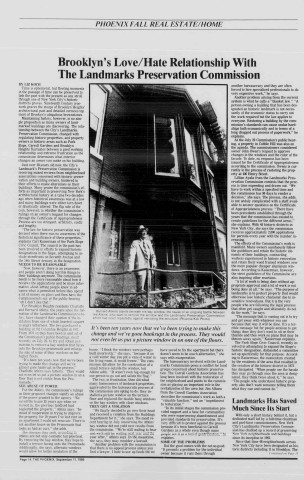
PHOENIX FALL REAL ESTA TE/HOMEBrooklyn%u2019s Love/Hate Relationship WithThe Landmarks Preservation CommissionBY LIZ KOCHTune is ephemeral, but fleeting moments in the passage of time can be preserved to link the past with the present as any stroll through one of New York City's historic districts proves. Nineteenth Century ironwork graces the stoops of Brooklyn Heights' architectural past and detailed cornices top most of Brookyn's ubiquitous brownstones.Maintaining history, however, is no simple proposition as many owners of landmarked buildings are discovering. The relationship between the City%u2019s Landmarks Preservation Commission, charged with regulating historic properties, and property owners in historic areas such as Park Slope, Carroll Gardens and Brooklyn Heights fluctuates between a good working relationship and extreme frustration as the commission determines what exterior changes an owner can make on his building.Just over 20-years old now, the City's Landmark's Preservation Commission is receiving mixed reviews from neighborhood associations concerned with historic preservation and building owners, hindered in their efforts to make alterations on their buildings. Many praise the commission%u2019s efforts as important in preserving New York's architectural history at a time two decades ago when historical awareness was at a low and many buildings were either torn down or drastically altered. The flip side of the coin, however, is whether the commission's rulings on an owner%u2019s request for changes through the Certificate of Appropriateness Process are too stringent, arbitrary, costly and lengthy.%u201cThe law for historic preservation was devised when there was no awareness of the historical significance of these properties,%u201d explains Carl Kaiserman of the Park Slope Civic Council. The council in the past has been involved in efforts to expand historic designations in the Slope, attempting to include storefronts on Seventh Avenue and the 14th Street Armorv in the designation. NEEDS TO BE REASONABLE%u201cNow, however, there is an awareness and people aren't doing terrible things to their buildings anymore. The commission needs to be more reasonable about how it reviews the applications and be more informative about letting people know in advance what is permitted before they spend a lot of money on plans and then have the Commissioners say at the public hearing \another bureaucracy and they are often forced to hire specialized professionals to do very expensive work,%u201d he says.Another problem arising from the current system is what he calls a %u201cblanket law.%u201d %u201cA person owning a building that has been designated an historic landmark is not necessarily of the economic status to carry out the work required but the law applies to everyone. Restoring a building by the commission%u2019s standards can cause undue hardships both economically and in terms of a long dragged out process of paperwork,%u201d he explains.At the July 22 Commission%u2019s public hearing, a property in Cobble Hill was also on the agenda. The commissioners considered owner John Owen%u2019s request to approve changes in the windows and the color of the facade. To date, no response has been issued for the Certificate of Appropriateness according to the commission. Owens is currently in the process of restoring the property at 406 Henry Street.Lillian Ayala from the Landmarks Preservation Commission contests that the process is time expending and drawn out. %u201cWe have to work within a specified time and the commission has 90 days to render a decision,%u201d she says. The process, she adds, is not unduly complicated with a staff available to answer questions on the Certificate of Appropriateness process. %u201cThere have been precedents established through the years that the commission has existed to create guidelines for the different areas,%u201d she explains. With 48 historic districts in New York City, she says the commission receives approximately 2,000 applciations for permits every year with the number increasing.The effects of the Commission%u2019s work is manifold. Many owners assiduously follow the guidelines and retain the historic elements of their buildings, contracting workers experienced in historic renovation and retain their wood framed windows over the more popular cheaper aluminum windows. According to Kaiserman, however, the strict guidelines of the Commission are also inspiring other reactions.%u201c A lot of work is being done without appropriate approval and a lot of work is not being done at all,%u201d he says. %u201cThe purpose of landmarks is to protect property that would otherwise lose historic character due to insensitive renovations. But it is the very people who are following the legal process that often get caught and ultimately do not do the work,%u201d he says.%u201cThe message that is coming out is to try and get awray with whatever you can because that way it will be done. It%u2019s a terrible message but for people anxious to get things done they don%u2019t want to sit on their thumbs and then work on plans that may be thrown away again,%u201d Kaiserman explains.The Park Slope Civic Council, recently involved in attempting to expand the Slope%u2019s historic designation, disbanded a committee set up specifically for that purpose. According to Kaiserman, the momentum created by the residents of the area that resulted in the creation of the historic district in 1973 has dissipated. %u201cWhen people see the hassle they may go through once the area is designated, they think twice about it,%u201d he says. %u201c The people who understand historic property also don%u2019t want someone telling them what they can and cannot do.%u201dLandmarks Has Saved Much Since Its StartWith only a short history behind it, but a dedicated staff led by a full-time chairman and part-time commissioners, New York City%u2019s landm arks Preservation Commission has chalked up a record of preserving Nou; Vnrk noiahhnrhnnds and buildings since its inception in 1965.Since that time 48 neighborhoods across New York City have been designated as historic districts including 11 in Brooklyn. The ( ontinued on Pane 15Bernard Atkins stands beneath his bay window, the cause of an ongoing battle between the Atkins who want to remove the window and the Landmarks Preservation Commission which has ruled repeatedly against removing the structure. (Phoenix/Kirk Photo)It s been ten years now that we've been trying to make thischange and we've gone bankrupt in the process. They wouldnot even let us put a picture window in on one o f the floors.For Brooklyn Heights residents Charlotte and Bernard Atkins, the years since the formation of the Landmarks Commission to today, have changed their opinion of the institution from one of whole hearted support to angry bitterness. The two purchased a building at 162 Columbia Heights in 1971. From 1976 on they have been in and out of the Commission%u2019s public hearings, most recently on July 22. to try and obtain permission to remove a bay window that faces onto the Brooklyn promenade and enlarge the size of some of their windows on the higher floors.%u201c It%u2019s been ten years now that we%u2019ve been trying to make this change and we%u2019ve almost gone bankrupt in the process,%u201d Charlotte Atkins says bitterly. \not even let us put a picture window in on a floor that is not visible from the Promenade.%u201dSEE ABUSE OF POWERF'or the Atkins, the commission%u2019s rulings on their proposed changes signify an abuse of the power granted to the agency. %u201cWe saved the house 25 years ago when we moved in; the previous landlord had neglected the property,%u201d Atkins says. %u201c Instead of cooperation in trying to improve the property, for 10 years I%u2019ve lost rent on an apartment I could not renovate. There is not another house on the Promenade that looks as bad as ours,%u201d she adds.i ne changes iney duuui umg tuAtkins are not only cosmetic but practical. By removing the bay window, they hope to install a terrace facing onto the Promenade. Additionally, she says, alternate windows would allow for better insulation of thehouse. %u201cI think the windows were perhaps built incorrectly,%u201d she says, %u201cbecause if on a cold winter day you put a vase of water in the living room, it would freeze.\mission did allow for the construction of a small terrace outside the window, but Atkins adds. %u201c It wasn't even big enough for one person to go out and salute the flag.%u201d The two, in frustration, then did what many homeowners of landmark properties, aggravated by the bureaucratic process of the commission are opting to do: they installed a picture window on the terrace floor and replaced the double hung windows on the bay window with clear windows. THEY GOT A VIOLATION %u201cWe finally decided to go over their head and received a violation from the Buildings Department for it,%u201d she says. The most recent hearing in July concerning the Atkins%u2019 bay window did not yield new results from the commission. %u201c We%u2019re still waiting to hear anu we u sini ue woiimg licit year and the year after,%u201d Atkins says. In the meantime, she says, they may consider a lawsuit.%u201cAnother problem with the commission is that there is no appeal process unless you find a lawyer. I hate to use up funds tht wehave saved to fix the apartment but there doesn%u2019t seem to be much alternative,%u201d she says with exasperation.The bureaucracy involved with the Landmarks Commission poses a conflict for local groups concerned about historic preservation. The Carroll Gardens Association has long been involved with the restoration of the neighborhood and points to the commission as playing an important role in the revitalization of the area but Jim Albano from the Carroll Gardens Association describes the commission's work as both a %u201cvaluable function,%u201d and an %u201c impediment to restoration.%u201d%u201cIn its initial stages the commission provided support and a base for communities who were experiencing abandonment and provided standards for preservation. It%u2019s very difficult to protest against the process because it%u2019s been beneficial to Carroll Gardens as a whole even though somep C U p lC OL1. U UO CA CVSAAA . . . ..lA u w w t t, llCexplains.SOME OF THE PROBLEMSBut the good comes with the not-so-good. %u201cIt presents a problem for the individual owner because it runs them throughPage 14. THE PHOENIX, September 11, 1986


