


Page 661 - Demo
P. 661
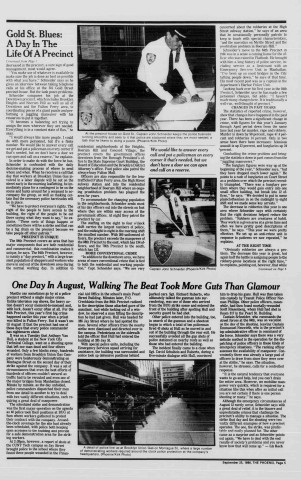
Gold St. Blues:A Day In TheLife Of A PrecinctContinued from Page 1decreased in the precinct, a sure sign of good management, most would agree.%u201cYou make use of whatever is available to make sure the job is done as best as possible with what you have,%u201d Schneider says as he gives an interview between taking telephone calls at his office at the 301 Gold Street precinct house. But the task poses problems.Schneider compares his job at the Downtown precinct, which includes Brooklyn Heights and Boerum Hill as well as all of DowTitown and the Fulton Ferry area, to coordinating pieces of a giant puzzle and performing a juggling maneuver with his resources to put it together.%u201cIt becomes a balancing act trying to assign the men wherever they are needed. Everything is in a constant state of flux,%u201d he says.%u201cI would always like more people. I could do with more personnel, but it%u2019s a finite number. We would like to answer every call we get and put a policeman on every comer if that%u2019s needed, but we don%u2019t have a door we can open and call on a reserve,%u201d he explains.In order to make do with the force he has,Schneider is confronted with the dailydecision-making process of where to sendwhom and when. When he receives a call thatday that workers at Brooklyn Union Gas involved in a labor dispute will be out on thestreet early in the morning leafletting, he immediately plans for a contingent to be on thescene and hunts around for a sergeant to accompany the group, as well as making certain that the necessary police barricades willbe in place.%u201cWe have to protect everyone%u2019s rights. Theright of the people to have access to thebuilding, the right of the people to be outthere saying what they want to say,%u201d he explains. %u201cThese sorts of things happen orsometimes there will be a strike and that canbe a big drain on the precinct because wetake people off other patrols.%u201dPRECINCT IS UNIQUEThe 84th Precinct covers an area that hasmajor components that are both residentialand commercial; this combination makes itunique, he says. The 84th Precinct, however,is mainly a %u201cday precinct,%u201d with a large transient population of shoppers and workers whomove in and out of the downtown area duringthe normal working day. In addition toAt th e p re c in c t h o u s e on G o ld S t., C a p ta in J o h n S c h n e id e r k e e p s th e p o lic e b u s in e s sru n n in g s m o o th ly and s e e s to it th at p o lic e are s ta tio n e d w h ere th e y are m o s t n e e d e d , ata s k th a t he lik e n s to d o in g a puzzle. (P h o e n ix /K irk P hoto)residential neighborhoods of the Heights,Boerum Hill and Concord Village, theprecinct covers the government officesdowntown from the Borough President%u2019s office to the State Supreme Court Building, theBoard of Education and the Brooklyn DistrictAttorney%u2019s office. Foot police also patrol thealways-busy Fulton Mall.Officers are also responsible for the lesstrafficked Fulton Ferry area, the High Streetsubway station and into the residentialneighborhood of Boerum Hill where an ongoing prostitution problem has plagued thearea for years.To accommodate the changing populationin the neighborhoods, Schneider sends mostof his day officers out into the streets on footwhere they are within easy access of thegovernment offices. At night they patrol theprecinct by car.The staffing on the eight to four o%u2019clockshift carries the largest numbers of police,and the midnight to eight in the morning shiftthe smallest number. With 200 uniformed officers, the precinct exceeds the manpower ofthe 88th Precinct to the east, which has 134 officers, and the 78th Precinct to the south,whir*h hscMORE CONVENTIONAL CRIME%u201cIn addition to the downtown area, we haveareas of more conventional crime that is tiedto both the residential and working population,%u201d Capt. Schneider says. %u201cWe are veryW e would like to answer everycall and put a policeman on everycorner if that%u2019s needed, but wedon%u2019t have a door we can openand call on a reserve.C a p ta in J o h n S c h n e id e r (P h o e n ix /K irk P h o to )concerned about the robberies at the High Street subway station,%u201d he says of an area that he occasionally personally patrols to keep in touch with special characteristics, %u201cand the narcotics on Myrtle Street and the prostitution problem in Boerum Hill.\Schneider%u2019s move to the 84th Precinct in 1985 was in a sense a coming home for the officer who was raised in Flatbush. He brought with him a long history of police service, including service as a lieutenant with an Emergency Services Unit in Manhattan. %u201c I%u2019ve been up on most bridges in the City talking people down,%u201d he says of that time. His most recent post was as a captain in the department%u2019s Harbor Police Unit.looking back over his first year in the 84th Precinct, Schneider says he has made a few personnel changes, but adds: %u201cI haven%u2019t made many changes here. It is traditionally a well-run, well-thought of precinct.%u201d CHANGES IN PAST YEARS The statistics of reported crime, however, show that changes have happened in the past year. There has been a significant change in crime, with figures for this year%u2019s January through April period down from the same time last year for murder, rape and robbery. Murder is down by 50 percent, rape 47.4 percent and robberies 14 percent. Only in two areas have there been increases: felonious assault is up 53 percent, and burglaries up 24 percent.Combatting the crime problem and bringing the statistics down in part comes from the %u201cjuggling maneuvers.%u201d%u201cThe burglary figures were way up at thebeginning of the year,%u201d Schneider says, %u201cbutthey have dropped much lower again.%u201d Hepoints to a rash of burglaries on Court Streetas a problem over which the precinct recently triumphed. %u201cThere was a burglary problem where they would gain entry into onesmall office building, but break into 12 offices,%u201d he says. %u201cWe decided to put in someplainclothesmen in on the midnight to eightshift and we made some key arrests.%u201dThe decrease in robberies this year is onearea where Schneider says with certaintythat the right decisions helped reduce theproblem. %u201cRobbers are creatures of habit.They work in a given area at a given time andoften we have pretty good descriptions ofthem,%u201d he says. %u201cThis year we were prettyeffective. We set up an anti-crime unit inresponse to patterns we saw repeated,%u201d heexplains.AT THE RIGHT TIME%u201cObviously robberies are always a pro-,blem. The decrease this year is great, butagain half the battle is assigning people to therobbery-prone locations at the right time,%u201dhe explains, pointing out, however, that whileContinued on Page 6O n e D a y I n A u g u s t , W a l k i n g T h e B e a t T o o k M o r e G u t s T h a n G l a m o u rMonths can sometimes go by at a policeprecinct without a single major crime.Unlike television cop shows, the heavy action doesn%u2019t occur moment-to-moment and,with luck, doesn%u2019t occur often at all. For the84th Precinct, this year%u2019s first big crimehappened earlier this year when a priestwas killed in Fulton Ferry. But it wasn%u2019t until August 12 that the precinct had one ofthose days that every police commanderhas nightmares about.It was on a Tuesday that Anthony VanHull, a student at the New York CityTechnical College, went on a shooting spreethat left one man dead and four otherswounded. Only a few blocks away, hundredsof workers from Brooklyn Union Gas Company were boisterously demonstrating onMontague Street on the second day of theirstrike against the company. It was a set ofcircumstances that even the best efforts ofhundreds of officers couldn%u2019t unravel astraffic had to be rerouted and even one ofthe major bridges from Manhattan closed.Minute by minute, as the day unfolded,police commanders dispatched their menfrom one detail to another to try to dealwith two vastly different situations, each requiring a great deal of manpower.The scheduled strike and demonstrationwas the first major operation on the agendaas 40 police took their positions at BUG at9am where workers gathered to protesttheir contract with the company. Aroundthe-clock coverage for the site had alreadybeen scheduled, with police both keepingopen accesses to tne building and providefor a safe demonstration area for the striking workers.At 2:20pm, however, a report of shots atthe CUNY Tech campus on Jay Streetbrought police to the school where theyfound three people wounded in the Financial Aid Office in the school%u2019s main PearlStreet Building. Minutes later, P.O.Crechkinto from the 84th Precinct radioedin the description those attacked gave of theassailant. And while looking out of a window, he observed a man fitting the description he had just given. Hull was headed for285 Jay Street where he had spotted theman. Several other officers from the nearbystrike were dismissed and directed over tothe campus. Pedestrians on the sidewalktold the officer that Hull had entered thebuilding at 285 Jay St.With special police units, including theEmergency Services squad arriving forassistance, the building was surrounded andpolice took up defensive positions behindparked cars. Sgt. Richard Ruberto, whoultimately talked the gunman into surrendering, was one of those who arrivedfrom the BUG strike scene and entered thefront of the building after spotting Hull andsecurity guard he had shot.Other police entered into the building, too,in search of the gunman and a shootoutbegan in which a total of ten policemanfired 43 shots at Hull as he moved in andout of the building through the rear exit. Hesuccessfully avoided all the gun shots ofpolice stationed on nearby roofs as well asthose who had entered the building.The incident finally came to a close whenSgt. David Schulteis and Ruberto, during afive-minute dialogue with Hull, convincedA d e ta il o f p o lic e lin e up at B ro o klyn U nion G a s on M o n ta g u e S t., w h e re a larg e n u m b e ro f d e m o n s tra tin g w o rk e rs req u ired a ro u n d th e c lo c k p o lice p ro te c tio n at th e c o m p a n y 'sh e a d q u a rte rs . (P h o e n ix /K irk P hoto)him to drop his guns. Hull was then takeninto custody by Transit Police Officer Norman Phillips. Other police officers, meanwhile, had then found mortally-woundedScott Riesenberg, whom Hull had shot inRoom 317 in the Pearl St. Building.Captain Schneider, who commands thestreet forces at the 84th, was on vacationon the day of the shooting, leaving CaptainEmmanuel Neuwirth, who is the precinct%u2019stop administrative officer in command ofthe force. Schneider says there was a verydefinite method in the operation for the dispatching of police officers in these kinds ofemergency situations. %u201cThe ranking officerassesses the availability of manpower. Conveniently there was already a large pool ofofficers to draw from since they were overat the strike,%u201d he says. The situation,however, he stresses, calls for a controlledresponse.%u201cIt is the natural tendency that everyonewants to go and help, but you can%u2019t drainthe entire area. However, we mobilize manpower very quickly, which is required for asituation like this when after an initial callyou are not certain if there is one personshooting or many,%u201d he says.Although the emergency circumstances ofAugust 12 rarely occur, Schneider says witha great deal of relief, it is the bizarre andunpredictable crimes that challenge theprecinct%u2019s ability to manage a situation. Thestrike that day and the shooting were twovastly different examples of how a precinctoperates. The one, the strike, was predictable and easily planned for. The othercame as a surprise and as Schneider pointsout again, %u201cWe have to deal with the endresults of society%u2019s problems and you neverknow how that will come up.%u201d %u2014 Liz KochS e p te m b e r 25, 1986, T H E P H O E N IX , P ag e 5


