


Page 705 - Demo
P. 705
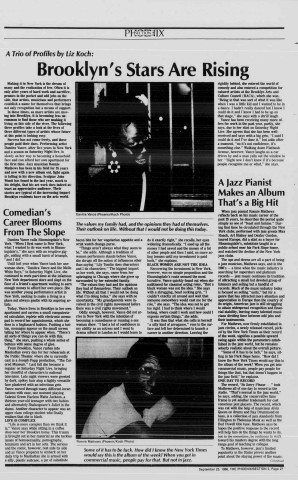
A Trio of Profiles by Liz Koch:Brooklyn's Stars Are RisingMaking it in New York is the dream ofmany and the realization of few. Often it isonly after years of hard work and sacrifice,pennies in the pocket and odd jobs on theside, that artists, musicians and performersestablish a name for themselves that bringsnot only recognition but a means of support.In these times, as more artists are moving into Brooklyn, it is becoming less uncommon to find those who are making itliving on this side of the river. The followingthree profiles take a look at the lives ofthree different types of artists whose futureat this point is looking rosy.Success has not come freely, and thesepeople paid their dues. Performing artistDanitra Vance, after five years in New Yorkand a season on Saturday Night live, isslowly on her way to becoming a householdface and can afford her own apartment forthe first time. Jazz musician RonnieMathews has been in his field for 25 yearsand now with a new album out, light againis falling in his direction. Sculptor JohnMonti has found in the last year, much tohis delight, that his art work does indeed attract an appreciative audience. Theirstories are typical of the increasing impactBrooklyn residents have on the arts world.Comedian'sCareer BloomsFrom The SlopeDanitra Vance calls Bloomingdale%u2019s NewYork. %u201cWhen I first came to New York,what I wanted to do was work in Bloomingdale%u2019s,%u201d she says with an eruptive giggle, adding with a small burst of triumph,%u201cand I did.%u201dUntil last year when Vance took her onewoman show, %u201cDanitra Vance and the MelloWhite Boys,%u201d to Saturday Night Live, diecontinued to work part-time at the infamousNew York department store and slept on thefloor of a friend%u2019s apartment waiting to earnenough money to afford her own place. Shewas another young performance artist inNew York, seeking to make a living in aplace not always gentle with its aspiring artists.Today, Vance lives in Brooklyn in her ownapartment and carries a small computerized calculator, replete with electronic memopad to record her appointments, which shedoes in a haphazard fashion. Pushing a button, messages appear on the small screentelling her where to appear when. %u201cThere%u2019sall sorts of things you can do with thisthing,%u201d she says, pushing a whole series ofbuttons with some degree of glee.From Brooklyn, Vance rushes intoManhattan every day for her rehearsals atthe Public Theater where she is currentlycast in a Joseph Papp production, %u201cThe Colored Museum.%u201d Last fall she became aregular on Saturday Night Live, bringingher closetful of characters to nationaltelevision. Late night viewers were greetedby dark, spikey hair atop a highly versatileface plastered with an infectious grin.Vance moved through many different incarnations with ease, one moment playingCabrini Green Harlem Watts Jackson, athirteen year-old teenager with two babiesand alternately Shakespeare%u2019s Juliet in theslums. Another character to appear was anupper class college student who finallyrealizes that she is black.LIFE IS COMPLEX%u201cLife is more complex than we think itis,%u201d Vance says while sitting in a coffeeshop near her Brooklyn home. This truismis brought out in her material as she tacklesissues of homosexuality, pornography,feminism and art in her acts. The seriousand the comic, however, rest side by sideand as Vance prepares to embark on herdaily trip to Manhattan she is armed witha silly, plastic suitcase, a jar of substituterigidity behind, she entered the world ofcomedy and also entered a competition forcabaret artists at the Brooklyn Arts andCulture Council (BACA), which she won.%u201cBeing in that was sort of what it was likewhen I was a little kid and I wanted to be ina dance. I hadn%u2019t really danced but I knew Icould do it and I knew I had to be up onthat stage,\Vance has been receiving many more offers for work in the past year, partly, shesays, due to her stint on Saturday NightLive. She agrees that she has been wellreceived and says with a big grin, %u201cI said Icould do it and I%u2019ve done it,%u201d but adds aftera moment, %u201cno it%u2019s not confidence, it%u2019ssomething else.%u201d Walking down FlatbushAvenue, however, Vance laughs as a cardrives by and a man yells out the window toher. %u201cRight now I don%u2019t know if it%u2019s becausepeople recognize me or what,%u201d she says.D a n itra V a n c e (P h o e n ix /K o c h P h o to )The values m y fam ily had. an d the opinions they h ad o f themselves.Their o u tlo o k on life. W ith o u t that I w o u ld not be doing this today.bacon bits for her vegetarian appetite and awrist watch change purse.%u201cThings aren%u2019t always what they seem tobe,%u201d she adds. Although a tradition ofwomen performers stands before Vance,she shrugs off the notion of influences otherthan saying %u201cLily Tomlin does charactersand I do characters.%u201d The biggest impacton her work, she says, came from herupbringing in Chicago where she grew upsurrounded by her extended family.%u201cThe values they had and the opinionsthey had of themselves. Their outlook onlife. Without all that I would not be doingwhat I%u2019m doing today,%u201d she says with nouncertainty. %u201cMy grandparents were involved in tile civil rights movement beforethere was a civil rights movement.%u201dOddly enough, however, Vance did not arrive in New York with the intention ofbecoming a comedienne or running a onewoman show. %u201cI had a lot of confidence inmy ability as an actress and I went todrama school in London so I would learn todo it exactly right,%u201d she recalls, her eyeswidening dramatically. %u201cI used up all themoney I had saved and the money of a lotof other people and then I said, no more acting lessons until my investment is paidback,%u201d she explains.BLACK WOMEN ARE NOT THE IDEARecovering the investment in New York,however, was no simple proposition and theBloomingdale%u2019s route seemed the mostlucrative. Vance quickly found out when sheauditioned for classical acting roles, %u201cthat ablack woman was not the idea.\with a shrugging, head cocking grin, %u201c Icouldn%u2019t exactly sit around and wait thatsomeone somewhere would cast me for therole,%u201d she says. %u201cThe idea was not to gettoo rigid. I had to think where I wouldbelong, where could I work and how could Iexpress certain things,%u201d she adds.It was then that what she calls in herself%u201ca silly kind of arrogance,%u201d rose to the surface and left her determined to launch acareer in another direction. Leaving theR o n n ie M a th e w s (P h o e n ix /K o c h P h o to )Some o f it has to be luck. H o w did I kn ow the N ew York Timesw o u ld say this is th e album o f the w e e k? W hen you get inco m m ercial music, people pay for that. But not in jazz.A Jazz PianistMakes an AlbumThat's a Big HitWhen jazz pianist Ronnie Mathewsreflects back on his music career of thepast 25 years, he describes the period quitesimply as one of %u201cfeast and famine.%u201d During that time he circulated through the NewYork clubs, performed with jazz greats MaxRoach, Art Blakey and Dexter Gordon,toured Europe, did a stint as a buyer forBloomingdale%u2019s, substitute taught in apublic school near his Park Slope home,and watched the decline of the New Yorkjazz clubs.The ups and downs are all a part of beinga jazz musician, Mathews says, and in the1980%u2019s %u2014 a time when the music industry issearching for superstars and platinumrecords %u2014 jazz music continues its traditionof attracting a small but devoted group oflisteners and selling but a handful ofrecords. Much of the music industry todayis focused on selling %u201cunits,%u201d but for agenre that has attracted more attention andappreciation in Europe than the country ofits origin, American jazz is still strugglingto attain widespread recognition and financial stability, leaving many talented musicians dividing time between odd jobs andtheir instruments.For Mathews, now firmly established injazz circles, a newly released record, picked by the New York Times as their recordof the week, signifies a possible upwardswing again within the parameters established in the jazz world, but he remainssoberly realistic about the overall picture.%u201cSome of it has to be luck,%u201d he says, sitting in his Park Slope home. %u201cHow did Iknow the New York Times would say this isthe album of the week? When you get intocommercial music, people pay people forthings like that, but that doesn%u2019t happen inthe jazz field,%u201d he explains.ONE DAY TO RECORDThe record, %u201cSo Sorry Please ...%u201d tookMathews all of one day to record in thestudio. %u201cThat%u2019s normal in the jazz world,%u201dhe says, adding, the conservative timeframe is yet another trademark for costconscious jazz players. The record, whichwas cut with the help of musicians AlvinQueen on drums and Ray Drummond onbass, is a collection of jazz standards fromEllington to Thelonius Monk as well as thePowell title tune. Mathews says hehopes the positive response to the recordwill help him do the things he wants to do,toward his masters degree with the longrange goal of teaching in colleges.To Mathews, however, jazz%u2019s limitedpopularity in the States proves anotherpoint about the staying power of the music.ContinuedS e p te m b e r 2 5 , 1 9 8 6 , T H E P H O E N IX /S E C T IO N 2, P a g e 27


