


Page 707 - Demo
P. 707
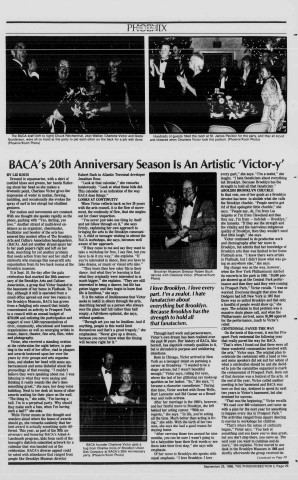
T h e B A C A s ta ff (le ft to rig h t) C h u c k R e ic h e n th a l, J ean W a lk e r, C h a rle n e V ic to r an d G re taG u n d e rs o n , w e re all on h an d a t th e party to p at e a c h o th e r o n th e b a c k fo r a jo b w ell d o n e .(P h o e n ix /K o c h P h o to )H u n d re d s o f g u e s ts fille d th e room at S t. J a m e s P avilio n fo r th e party, a n d they all s to o dan d c h e e re d w h en C h a rle n e V ic to r to o k th e p o d iu m . (P h o e n ix /K o c h P h o to )BACA's 20th Anniversary Season Is An Artistic 'Victor-y'BY LIZ KOCHDressed in aquamarine, with a skirt ofmottled blues and greens, her hands fluttering about her head as she makes adramatic point, Charlene Victor gives theimpression of water in motion, flowing,tumbling, and occasionally she evokes thespray of surf in her abrupt but ebullientgestures.Her motion and movements are constant.With one thought she speaks rapidly on thephone, gushing with %u201cYes, darling, yeslove.%u201d Another strand of multi-level existence as an organizer, cheerleader,facilitator and booster of the arts hasentered this modest office of The BrooklynArts and Culture Association headquarters.(BACA). And yet another strand spurs herto her push papers right and left on herdesk, searching for yet another problemthat needs action from her and her staff ofstalwarts who manage this non-profit artsorganization from its two back rooms at theBrooklyn museum.It is Sept. 18, the day after the galacelebration that marked the 20th anniversary of the Brooklyn Arts and CultureAssociation, a group that Victor founded inthe basement of her home in Flatbush. Today, although it still is operated from asmall office spread out over two rooms inthe Brooklyn Museum, BACA has grownfrom a fledgling arts council that intiallyconcentrated on activity in Prospect Parkto a council with an annual budget of$750,000 and enlisting the participation andsupport of over 3,500 representatives ofcivic, community, educational and businessorganizations as well as emerging artists inmusic, dance, theater, fine arts, film, videoand photography.Victor, who received a standing ovationat the celebration the night before, is pointing to the wall of her office, clad in plaquesand awards bestowed upon her over theyears by civic groups and arts organizations, and shakes her head with some embarrassment and some disbelief about theproceedings of that evening. %u201cI couldn%u2019tbelieve they were speaking about me. I waslistening to what they were saying andthinking it really sounds like she%u2019s donesomething great,%u201d she says, her deep voicebubbling. Next to her desk sit boxes of otherawards waiting for their place on the wall.%u201cThe thing is,%u201d she adds, %u201cI%u2019m having aball. I%u2019m in a perpetual party. Why shouldthey make such a fuss, when I%u2019m havingsuch a ball?%u201d she asks.While Victor muses on this thought andwonders aloud where the boxes of awardsshould go, she remarks suddenly that herbest award is actually something quite different. This year, as part of the 20th anniversary and honoring BACA's Adopt-ALandmark program, kids from each of theborough%u2019s districts submitted artwork for acalendar that was handed out at thecelebration. BACA%u2019s diverse appeal couldbe noted with attendance that ranged frompeople like Brooklyn Museum directorRobert Buck to Atlantic Terminal developerJonathan Rose.%u201cLook at that calendar,%u201d she remarksboisterously. %u201cLook at what those kids did.This calendar is an indication of the wayBACA does things.%u201dLOOKS AT CONTINUITYWhen Victor reflects back on her 20 yearswith the arts council, it is the flow of movement, the continuity of flow, that she singlesout for closer inspection.%u201cYou never just take one thing by itselfand not follow through on it,%u201d she saysfirmly, explaining her own approach tobringing the arts to the Brooklyn community. A child or teenager wishing to attend theBACA workshops, she says, becomes wellaware of her approach.%u201cIf they come to me and say they want totake a workshop for free, I say fine, but youhave to do it my way,%u201d she explains. %u201cIfyou%u2019re interested in dance, then you have totake drama, or music or visual arts also.%u201d%u201cThey learn then how color fits in theirdance. And what they%u2019re learning is thatwhat they originally were interested in ismuch bigger,%u201d she explains. %u201cThey are stillinterested in being a dancer, but life hasgotten bigger and they begin to learn thatlife is limitless,%u201d she says.It is the notion of limitlessness that Victorseeks to instill in others through the arts,describing herself as a person who alwayssees the glass half full rather than halfempty, a full-blown optimist, she says,without question.%u201cThrough art you can be limitless. And ifanything, people in this world limitthemselves and that%u2019s a great tragedy,%u201d sheemphasizes. %u201cNever give up a dream,because you never know when the timingwill become right for it.%u201dB A C A fo u n d e r C h a rle n e V ic to r g e ts ahug fro m C h a rle s In n is o f B ro o klyn U n io nG a s C o m p a n y a t B A C A 's 2 0 th A n n iv e rs a ryparty. (P h o e n ix /K o c h P h o to )B ro o k ly n M u s e u m D ire c to r R obert B u ckd a n c e s w ith C h a rle n e V icto r. (P h o e n ix /K o c hP h o to )I love B rooklyn. I love everypart, /'n i a z e a lo t. I hatefanatacism abou teverything b u t Brooklyn.Because Brooklyn has thestrength to h o ld allthat fanatacism .Through hard work and perseverance,Victor%u2019s own dream has been realized overthe past 20 years. Her history of BACA, likeherself, has slapstick comedy qualities to it,but is shrouded in purpose and unfalteringintentions.Born in Chicago, Victor arrived in NewYork as a teenager intent on pursuing acareer on Broadway. %u201cI wanted to be astage actress, but I wasn%u2019t beautifulenough,%u201d Victor says, rolling her eyes,where the last of her glittering eye make-upsparkles on her lashes. %u201cSo,%u201d she says, %u201cIbecame a character comedienne.%u201d Duringthat time, Victor worked with Orson Wells,Burt Lancaster and Sid Caesar as a Broadway and radio actress.After her marriage in the 1950%u2019s, however,and her fateful move to Brooklyn, she leftbehind her acting career. %u201cWith noregrets,%u201d she says. %u201cIn life, you%u2019re actingall the time. Much better than acting is living,%u201d she adds. With the birth of her twosons, she says she had a good reason forstaying home.%u201cAfter carrying those two around for ninemonths, you can be sure I wasn%u2019t going tolet a babysitter hear their first words or seethem take their first step,%u201d she says withemphasis.Of her move to Brooklyn she speaks withequal emphasis. %u201cI love Brooklyn. I loveevery part,%u201d she says. %u201cI%u2019m a zealot,%u201d shelaughs. %u201cI hate fanaticism about everythingbut Brooklyn. Because Brooklyn has thestrength to hold all that fanaticism.%u201dABOLISH BROOKLYN CHUCKLEIn that vein, one of her goals as a Brooklyndevotee has been to abolish what she callsthe Brooklyn chuckle. %u201cPeople need to getrid of that apologetic little chuckle,%u201d shesays. %u201cPeople say, oh, I%u2019m from LosAngeles or I%u2019m from Cleveland and thenthey say, I%u2019m from %u2014 heh-heh %u2014 Brooklyn,%u201dshe laments. %u201cIf they see the strength andthe vitality and the marvelous indigenousquality of Brooklyn, then they wouldn%u2019t needthat little laugh,%u201d she says.Victor continued to do production workand choreography after her move toBrooklyn, but admits that her knowledge ofBrooklyn arts then was limited to her homeFlatbush area. %u201cI knew there were artistsin Flatbush, but I didn%u2019t know what was going on anywhere else,%u201d she says.Big change was on the way, however,when the New York Philharmonic startedits concerts in the park in 1965. %u201c30,000 people showed up at the Central Park performance and then they said they were comingto Prospect Park,%u201d Victor recalls. %u201cI was soworried. Everyone thought that since theDodgers had left New York in 1957 thatthere was no united Brooklyn and that onlya handful of people would show up,%u201d shesays. The solution to that problem was amassive chain phone call, and when thePhilharmonic arrived, some 35,000 apperedfor the performance, much to Victor%u2019srelief.CENTENNIAL PAVED THE WAYOn the heels of this event, it was the Prospect Park centennial the following yearthat really paved the way for BACA.%u201cThat%u2019s when I found out that there were allthese wonderful communities involved withthe arts,%u201d Victor says. The original plan tocelebrate the centennial with a band or twoand some speakers did not suit her notion ofwhat a celebration should be and she decided to join the committee organized to markthe centenennial of Prospect Park. Bom outof that decision was a festival of the arts. Atthe end of the year, Victor called anothermeeting in her basement and BACA wasbom on that day, destined to spend its nexttwo years in Victor%u2019s basement, but alsodestined for success.%u201cThat was the beginning,%u201d Victor recalls.%u201cWe used over 600 volunteers and came upwith a plan for the next year for somethingto happen every day in Prospect Park.%u201dThe activities ranged from square dancingto movies to workshops for children.%u201cThat%u2019s where the notion of continuitybegan,%u201d Victor says. %u201cYou look atsomething and you know you%u2019ve done great,but you don%u2019t stop there, you move on. Thenext year you want to continue and domore,%u201d she explains. Victor moved to onedesk in the Brooklyn Museum in 1968 andshortly afterwards the group received itsContinued on Page 30mS e p te m b e r 25, 1986, T H E P H O E N IX /S E C T IO N 2, P a g e 29


