


Page 148 - ALEF EDUCATION PR REPORT - SEPTEMBER 2025
P. 148
9/8/25, 10:37 AM UAE Private K12 Education Market Size & Share Analysis - Industry Research Report - Growth Trends
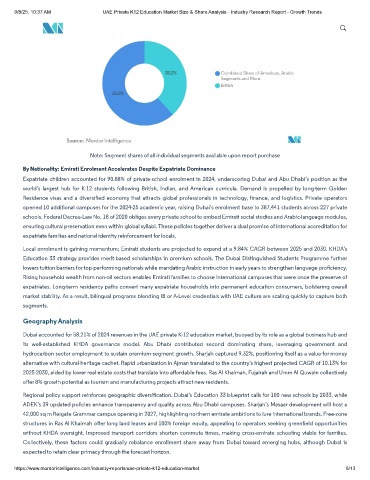
Note: Segment shares of all individual segments available upon report purchase
By Nationality: Emirati Enrolment Accelerates Despite Expatriate Dominance
Expatriate children accounted for 90.88% of private-school enrolment in 2024, underscoring Dubai and Abu Dhabi’s position as the
world’s largest hub for K-12 students following British, Indian, and American curricula. Demand is propelled by long-term Golden
Residence visas and a diversied economy that attracts global professionals in technology, nance, and logistics. Private operators
opened 10 additional campuses for the 2024-25 academic year, raising Dubai’s enrolment base to 387,441 students across 227 private
schools. Federal Decree-Law No. 18 of 2020 obliges every private school to embed Emirati social studies and Arabic-language modules,
ensuring cultural preservation even within global syllabi. These policies together deliver a dual promise of international accreditation for
expatriate families and national identity reinforcement for locals.
Local enrolment is gaining momentum; Emirati students are projected to expand at a 9.84% CAGR between 2025 and 2030. KHDA’s
Education 33 strategy provides merit-based scholarships in premium schools. The Dubai Distinguished Students Programme further
lowers tuition barriers for top-performing nationals while mandating Arabic instruction in early years to strengthen language prociency.
Rising household wealth from non-oil sectors enables Emirati families to choose international campuses that were once the preserve of
expatriates. Long-term residency paths convert many expatriate households into permanent education consumers, bolstering overall
market stability. As a result, bilingual programs blending IB or A-Level credentials with UAE culture are scaling quickly to capture both
segments.
Geography Analysis
Dubai accounted for 58.21% of 2024 revenues in the UAE private K-12 education market, buoyed by its role as a global business hub and
its well-established KHDA governance model. Abu Dhabi contributed second dominating share, leveraging government and
hydrocarbon sector employment to sustain premium-segment growth. Sharjah captured 9.32%, positioning itself as a value-for-money
alternative with cultural-heritage cachet. Rapid urbanization in Ajman translated to the country’s highest projected CAGR of 10.13% for
2025-2030, aided by lower real-estate costs that translate into affordable fees. Ras Al Khaimah, Fujairah and Umm Al Quwain collectively
offer 8% growth potential as tourism and manufacturing projects attract new residents.
Regional policy support reinforces geographic diversication. Dubai’s Education 33 blueprint calls for 100 new schools by 2033, while
ADEK’s 39 updated policies enhance transparency and quality across Abu Dhabi campuses. Sharjah’s Masaar development will host a
42,000 sq m Reigate Grammar campus opening in 2027, highlighting northern emirate ambitions to lure international brands. Free-zone
structures in Ras Al Khaimah offer long land leases and 100% foreign equity, appealing to operators seeking greeneld opportunities
without KHDA oversight. Improved transport corridors shorten commute times, making cross-emirate schooling viable for families.
Collectively, these factors could gradually rebalance enrollment share away from Dubai toward emerging hubs, although Dubai is
expected to retain clear primacy through the forecast horizon.
https://www.mordorintelligence.com/industry-reports/uae-private-k12-education-market 6/13

