


Page 146 - ALEF EDUCATION PR REPORT - SEPTEMBER 2025
P. 146
9/8/25, 10:37 AM UAE Private K12 Education Market Size & Share Analysis - Industry Research Report - Growth Trends
Alef Education posted AED 759 million revenues in 2024 and secured contract extensions with Abu Dhabi’s education authority through
2033, illustrating the commercial scale attainable via digital-learning solutions. GESS Dubai exhibitions showcase heightened interest in
[3]
AI, AR and data analytics tools as schools in the UAE private K-12 education market seek instructional differentiation. GEMS
Education’s forthcoming School of Research and Innovation will feature advanced robotics and AI laboratories, demonstrating how
premium campuses convert technology leadership into pricing power. KHDA’s regulated frameworks for distance-learning evaluation
ensure minimum standards for hybrid and online models, promoting condence among parents considering blended options. EdTech
integration also streamlines administrative workflows, potentially easing fee-cap pressures by lowering operating costs over time.
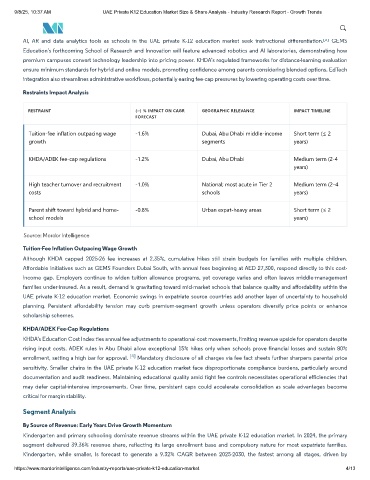
Restraints Impact Analysis
RESTRAINT (~) % IMPACT ON CAGR GEOGRAPHIC RELEVANCE IMPACT TIMELINE
FORECAST
Tuition-fee inflation outpacing wage -1.6% Dubai, Abu Dhabi middle-income Short term (≤ 2
growth segments years)
KHDA/ADEK fee-cap regulations -1.2% Dubai, Abu Dhabi Medium term (2-4
years)
High teacher turnover and recruitment -1.0% National; most acute in Tier 2 Medium term (2–4
costs schools years)
Parent shift toward hybrid and home- -0.8% Urban expat-heavy areas Short term (≤ 2
school models years)
Source: Mordor Intelligence
Tuition-Fee Inflation Outpacing Wage Growth
Although KHDA capped 2025-26 fee increases at 2.35%, cumulative hikes still strain budgets for families with multiple children.
Affordable initiatives such as GEMS Founders Dubai South, with annual fees beginning at AED 27,300, respond directly to this cost-
income gap. Employers continue to widen tuition allowance programs, yet coverage varies and often leaves middle-management
families under-insured. As a result, demand is gravitating toward mid-market schools that balance quality and affordability within the
UAE private K-12 education market. Economic swings in expatriate source countries add another layer of uncertainty to household
planning. Persistent affordability tension may curb premium-segment growth unless operators diversify price points or enhance
scholarship schemes.
KHDA/ADEK Fee-Cap Regulations
KHDA’s Education Cost Index ties annual fee adjustments to operational-cost movements, limiting revenue upside for operators despite
rising input costs. ADEK rules in Abu Dhabi allow exceptional 15% hikes only when schools prove nancial losses and sustain 80%
enrollment, setting a high bar for approval. [4] Mandatory disclosure of all charges via fee fact sheets further sharpens parental price
sensitivity. Smaller chains in the UAE private K-12 education market face disproportionate compliance burdens, particularly around
documentation and audit readiness. Maintaining educational quality amid tight fee controls necessitates operational efficiencies that
may defer capital-intensive improvements. Over time, persistent caps could accelerate consolidation as scale advantages become
critical for margin stability.
Segment Analysis
By Source of Revenue: Early Years Drive Growth Momentum
Kindergarten and primary schooling dominate revenue streams within the UAE private K-12 education market. In 2024, the primary
segment delivered 39.36% revenue share, reflecting its large enrollment base and compulsory nature for most expatriate families.
Kindergarten, while smaller, is forecast to generate a 9.32% CAGR between 2025-2030, the fastest among all stages, driven by
https://www.mordorintelligence.com/industry-reports/uae-private-k12-education-market 4/13

