


Page 145 - ALEF EDUCATION PR REPORT - SEPTEMBER 2025
P. 145
9/8/25, 10:37 AM UAE Private K12 Education Market Size & Share Analysis - Industry Research Report - Growth Trends
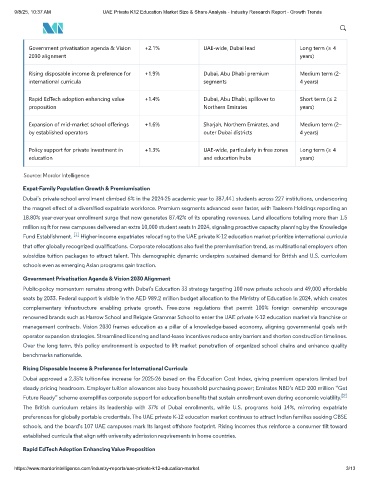
DRIVER (~) % IMPACT ON CAGR GEOGRAPHIC RELEVANCE IMPACT TIMELINE
FORECAST
Government privatisation agenda & Vision +2.1% UAE-wide, Dubai lead Long term (≥ 4
2030 alignment years)
Rising disposable income & preference for +1.9% Dubai, Abu Dhabi premium Medium term (2-
international curricula segments 4 years)
Rapid EdTech adoption enhancing value +1.4% Dubai, Abu Dhabi, spillover to Short term (≤ 2
proposition Northern Emirates years)
Expansion of mid-market school offerings +1.6% Sharjah, Northern Emirates, and Medium term (2–
by established operators outer Dubai districts 4 years)
Policy support for private investment in +1.3% UAE-wide, particularly in free zones Long term (≥ 4
education and education hubs years)
Source: Mordor Intelligence
Expat-Family Population Growth & Premiumisation
Dubai’s private-school enrollment climbed 6% in the 2024-25 academic year to 387,441 students across 227 institutions, underscoring
the magnet effect of a diversied expatriate workforce. Premium segments advanced even faster, with Taaleem Holdings reporting an
18.80% year-over-year enrollment surge that now generates 87.42% of its operating revenues. Land allocations totaling more than 1.5
million sq ft for new campuses delivered an extra 10,000 student seats in 2024, signaling proactive capacity planning by the Knowledge
Fund Establishment. [1] Higher-income expatriates relocating to the UAE private K-12 education market prioritize international curricula
that offer globally recognized qualications. Corporate relocations also fuel the premiumisation trend, as multinational employers often
subsidize tuition packages to attract talent. This demographic dynamic underpins sustained demand for British and U.S. curriculum
schools even as emerging Asian programs gain traction.
Government Privatisation Agenda & Vision 2030 Alignment
Public-policy momentum remains strong with Dubai’s Education 33 strategy targeting 100 new private schools and 49,000 affordable
seats by 2033. Federal support is visible in the AED 989.2 million budget allocation to the Ministry of Education in 2024, which creates
complementary infrastructure enabling private growth. Free-zone regulations that permit 100% foreign ownership encourage
renowned brands such as Harrow School and Reigate Grammar School to enter the UAE private K-12 education market via franchise or
management contracts. Vision 2030 frames education as a pillar of a knowledge-based economy, aligning governmental goals with
operator expansion strategies. Streamlined licensing and land-lease incentives reduce entry barriers and shorten construction timelines.
Over the long term, this policy environment is expected to lift market penetration of organized school chains and enhance quality
benchmarks nationwide.
Rising Disposable Income & Preference for International Curricula
Dubai approved a 2.35% tuition-fee increase for 2025-26 based on the Education Cost Index, giving premium operators limited but
steady pricing headroom. Employer tuition allowances also buoy household purchasing power; Emirates NBD’s AED 200 million “Get
Future Ready” scheme exemplies corporate support for education benets that sustain enrollment even during economic volatility. [2]
The British curriculum retains its leadership with 37% of Dubai enrollments, while U.S. programs hold 14%, mirroring expatriate
preferences for globally portable credentials. The UAE private K-12 education market continues to attract Indian families seeking CBSE
schools, and the board’s 107 UAE campuses mark its largest offshore footprint. Rising incomes thus reinforce a consumer tilt toward
established curricula that align with university admission requirements in home countries.
Rapid EdTech Adoption Enhancing Value Proposition
https://www.mordorintelligence.com/industry-reports/uae-private-k12-education-market 3/13

