


Page 307 - Royal Liverpool Philharmonic Coverage Book 2023-24
P. 307
the slow movement’s string interjections sound like angry recitatives, and he and Ohlsson give us
               a finale full of balletic grace. I’ve never found No. 5 as interesting as its two predecessors, but
               there’s much to enjoy in this performance: time stands still in Ohlsson’s slow movement and the
               6/8 finale skips along, timpani nicely audible before the final bars. As a bonus, there’s the
               overture to The Creatures of Prometheus. My new favourite Beethoven Piano Concertos set,
               then. Do investigate – it might become yours too.
                        •   Beethoven on Amazon


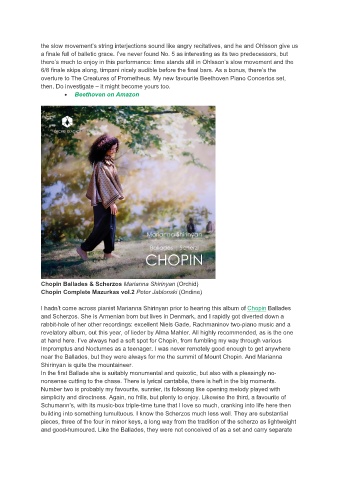
               Chopin Ballades & Scherzos Marianna Shirinyan (Orchid)
               Chopin Complete Mazurkas vol.2 Peter Jablonski (Ondine)

               I hadn’t come across pianist Marianna Shirinyan prior to hearing this album of Chopin Ballades
               and Scherzos. She is Armenian born but lives in Denmark, and I rapidly got diverted down a
               rabbit-hole of her other recordings: excellent Niels Gade, Rachmaninov two-piano music and a
               revelatory album, out this year, of lieder by Alma Mahler. All highly recommended, as is the one
               at hand here. I’ve always had a soft spot for Chopin, from fumbling my way through various
               Impromptus and Nocturnes as a teenager. I was never remotely good enough to get anywhere
               near the Ballades, but they were always for me the summit of Mount Chopin. And Marianna
               Shirinyan is quite the mountaineer.
               In the first Ballade she is suitably monumental and quixotic, but also with a pleasingly no-
               nonsense cutting to the chase. There is lyrical cantabile, there is heft in the big moments.
               Number two is probably my favourite, sunnier, its folksong like opening melody played with
               simplicity and directness. Again, no frills, but plenty to enjoy. Likewise the third, a favourite of
               Schumann’s, with its music-box triple-time tune that I love so much, cranking into life here then
               building into something tumultuous. I know the Scherzos much less well. They are substantial
               pieces, three of the four in minor keys, a long way from the tradition of the scherzo as lightweight
               and good-humoured. Like the Ballades, they were not conceived of as a set and carry separate

