


Page 323 - Ranah Studi Agraria: Penguasaan Tanah dan Hubungan Agraris
P. 323
Ranah Studi Agraria

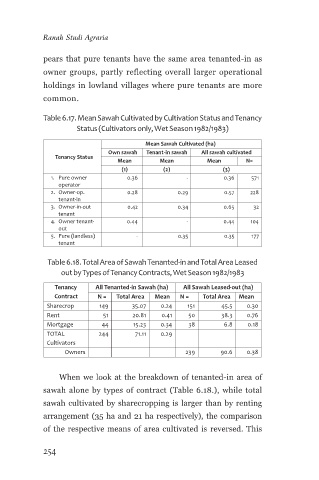
            pears that pure tenants have the same area tenanted-in as
            owner groups, partly reflecting overall larger operational
            holdings in lowland villages where pure tenants are more
            common.


            Table 6.17. Mean Sawah Cultivated by Cultivation Status and Tenancy
                    Status (Cultivators only, Wet Season 1982/1983)

                                     Mean Sawah Cultivated (ha)
                            Own sawah  Tenant-in sawah  All sawah cultivated
               Tenancy Status
                              Mean       Mean        Mean     N=
                               (1)        (2)           (3)
              1. Pure owner      0.36          -         0.36   571
                operator
              2. Owner-op.       0.28        0.29        0.57  228
                tenant-in
              3. Owner-in-out    0.42        0.34        0.65   32
                tenant
              4. Owner tenant-   0.44          -         0.44  104
                out
              5. Pure (landless)   -         0.35        0.35   177
                tenant

             Table 6.18. Total Area of Sawah Tenanted-in and Total Area Leased
                out by Types of Tenancy Contracts, Wet Season 1982/1983
               Tenancy   All Tenanted-in Sawah (ha)  All Sawah Leased-out (ha)
               Contract  N =  Total Area  Mean  N =  Total Area  Mean
             Sharecrop    149     35.07  0.24   151     45.5  0.30
             Rent          51     20.81  0.41   50      38.3  0.76
             Mortgage     44      15.23  0.34   38       6.8   0.18
             TOTAL        244      71.11  0.29
             Cultivators
                 Owners                        239      90.6  0.38


                When we look at the breakdown of tenanted-in area of
            sawah alone by types of contract (Table 6.18.), while total
            sawah cultivated by sharecropping is larger than by renting
            arrangement (35 ha and 21 ha respectively), the comparison
            of the respective means of area cultivated is reversed. This

            254

