


Page 68 - Handout Digital Electronics
P. 68
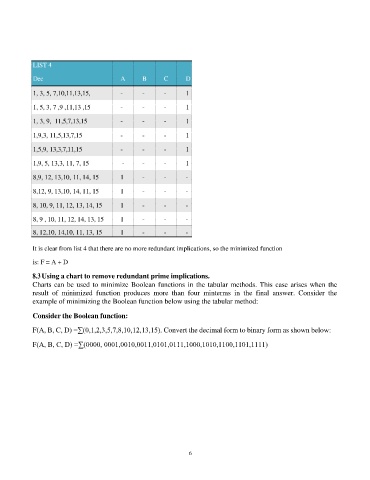
LIST 4

            Dec                          A      B      C       D
            1, 3, 5, 7,10,11,13,15,      -      -      -       1

            1, 5, 3, 7 ,9 ,11,13 ,15     -      -      -       1

            1, 3, 9,  11,5,7,13,15       -      -      -       1

            1,9,3, 11,5,13,7,15          -      -      -       1

            1,5,9, 13,3,7,11,15          -      -      -      1

            1,9, 5, 13,3, 11, 7, 15      -      -      -      1

            8,9, 12, 13,10, 11, 14, 15   1      -      -       -

            8,12, 9, 13,10, 14, 11, 15   1      -      -       -

            8, 10, 9, 11, 12, 13, 14, 15   1    -      -       -
            8, 9 , 10, 11, 12, 14, 13, 15   1   -      -       -

            8, 12,10, 14,10, 11, 13, 15   1     -      -       -

            It is clear from list 4 that there are no more redundant implications, so the minimized function

            is: F = A + D

            8.3 Using a chart to remove redundant prime implications.
            Charts can be used to minimize Boolean functions in the tabular methods. This case arises when the
            result  of  minimized  function  produces  more  than  four  minterms  in  the  final  answer.  Consider  the
            example of minimizing the Boolean function below using the tabular method:

            Consider the Boolean function:

            F(A, B, C, D) =∑(0,1,2,3,5,7,8,10,12,13,15). Convert the decimal form to binary form as shown below:

            F(A, B, C, D) =∑(0000, 0001,0010,0011,0101,0111,1000,1010,1100,1101,1111)


                                                                68

