


Page 73 - Handout Digital Electronics
P. 73
LECTURE 9 COMBINATIONAL LOGIC  CIRCUIT BUILDING BLOCKS
            9.1 Implementation of Logic Gates
            Combinational logic circuits are a logic circuit whose outputs entirely depend on the present inputs. This
            type of circuit has no memory capabilities. This type of logic circuit gets its name from the way output is
            obtained, that is the output value a binary one or zero, depends on the inputs which would have been
            applied at the inputs.


            Figure 10: Block diagram of basic combinational logic circuit
            The array of outputs for  fn entirely depends on the array of inputs xo- xn.  Combinational logic circuits
            can  be  used  to  build  devices  for  solving  problems  of  simple  logic  nature.  The  typical  examples  of
            combinational logic circuits are logic gates, half adders, full adders, multiplexers, decoders, comparators
            and others.

            9.2 Adders
            An Adder is a logic circuit used to perform binary addition operations in a digital computer. The Adders
            are of two types:

               •  Half Adders
               •  Full Adders

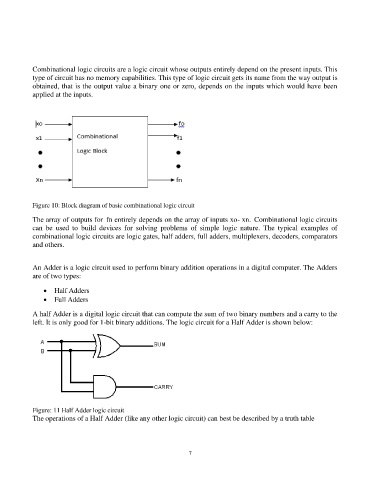
            A half Adder is a digital logic circuit that can compute the sum of two binary numbers and a carry to the
            left. It is only good for 1-bit binary additions. The logic circuit for a Half Adder is shown below:


            Figure: 11 Half Adder logic circuit
            The operations of a Half Adder (like any other logic circuit) can best be described by a truth table


                                                                73

