


Page 38 - Phil Holiday Pops 2025 digital program book
P. 38
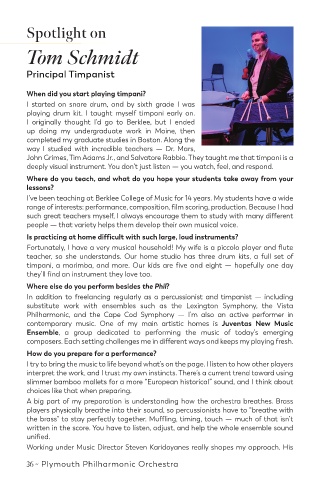
Spotlight on


        Tom Schmidt


        Principal Timpanist

        When did you start playing timpani?
        I started on snare drum, and by sixth grade I was
        playing drum kit. I taught myself timpani early on.
        I originally  thought I’d go  to Berklee, but I ended
        up doing my undergraduate work in Maine,  then
        completed my graduate studies in Boston. Along the
        way I studied with incredible  teachers — Dr. Mars,
        John Grimes, Tim Adams Jr., and Salvatore Rabbio. They taught me that timpani is a
        deeply visual instrument. You don’t just listen — you watch, feel, and respond.
        Where do you teach, and what do you hope your students take away from your
        lessons?
        I’ve been teaching at Berklee College of Music for 14 years. My students have a wide
        range of interests: performance, composition, film scoring, production. Because I had
        such great teachers myself, I always encourage them to study with many different
        people — that variety helps them develop their own musical voice.
        Is practicing at home difficult with such large, loud instruments?
        Fortunately, I have a very musical household! My wife is a piccolo player and flute
        teacher, so she understands. Our home studio has  three drum kits, a full set of
        timpani, a marimba, and more. Our kids are five and eight — hopefully one day
        they’ll find an instrument they love too.
        Where else do you perform besides the Phil?
        In addition to freelancing regularly as a percussionist and timpanist — including
        substitute work with ensembles such as  the Lexington Symphony,  the  Vista
        Philharmonic, and  the Cape Cod Symphony — I’m also an active performer in
        contemporary  music.  One of my  main artistic homes is  Juventas New Music
        Ensemble, a group dedicated  to performing  the music of  today’s emerging
        composers. Each setting challenges me in different ways and keeps my playing fresh.
        How do you prepare for a performance?
        I try to bring the music to life beyond what’s on the page. I listen to how other players
        interpret the work, and I trust my own instincts. There’s a current trend toward using
        slimmer bamboo mallets for a more “European historical” sound, and I think about
        choices like that when preparing.
        A big part of my preparation is understanding how the orchestra breathes. Brass
        players physically breathe into their sound, so percussionists have to “breathe with
        the brass” to stay perfectly together. Muffling, timing, touch — much of that isn’t
        written in the score. You have to listen, adjust, and help the whole ensemble sound
        unified.
        Working under Music Director Steven Karidoyanes really shapes my approach. His

        36 ~ Plymouth Philharmonic Orchestra

