


Page 36 - Phil Holiday Pops 2025 digital program book
P. 36
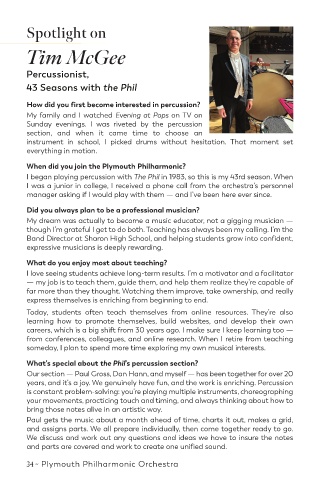
Spotlight on


        Tim McGee


        Percussionist,
        43 Seasons with the Phil

        How did you first become interested in percussion?
        My family and I watched Evening at Pops on TV on
        Sunday evenings. I was riveted by  the percussion
        section, and when  it came  time  to choose  an
        instrument in school, I picked drums without hesitation.  That moment set
        everything in motion.
        When did you join the Plymouth Philharmonic?
        I began playing percussion with The Phil in 1983, so this is my 43rd season. When
        I was a junior in college, I received a phone call from the orchestra’s personnel
        manager asking if I would play with them — and I’ve been here ever since.

        Did you always plan to be a professional musician?
        My dream was actually to become a music educator, not a gigging musician —
        though I’m grateful I get to do both. Teaching has always been my calling. I’m the
        Band Director at Sharon High School, and helping students grow into confident,
        expressive musicians is deeply rewarding.

        What do you enjoy most about teaching?
        I love seeing students achieve long-term results. I’m a motivator and a facilitator
        — my job is to teach them, guide them, and help them realize they’re capable of
        far more than they thought. Watching them improve, take ownership, and really
        express themselves is enriching from beginning to end.
        Today, students often  teach  themselves from online resources.  They’re also
        learning how  to promote  themselves, build websites, and develop  their own
        careers, which is a big shift from 30 years ago. I make sure I keep learning too —
        from conferences, colleagues, and online research. When I retire from teaching
        someday, I plan to spend more time exploring my own musical interests.
        What’s special about the Phil’s percussion section?
        Our section — Paul Gross, Dan Hann, and myself — has been together for over 20
        years, and it’s a joy. We genuinely have fun, and the work is enriching. Percussion
        is constant problem-solving: you’re playing multiple instruments, choreographing
        your movements, practicing touch and timing, and always thinking about how to
        bring those notes alive in an artistic way.
        Paul gets the music about a month ahead of time, charts it out, makes a grid,
        and assigns parts. We all prepare individually, then come together ready to go.
        We discuss and work out any questions and ideas we have to insure the notes
        and parts are covered and work to create one unified sound.

        34 ~ Plymouth Philharmonic Orchestra

