


Page 40 - Phil Holiday Pops 2025 digital program book
P. 40
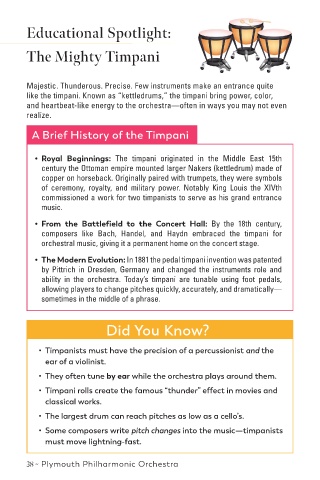
Educational Spotlight:


        The Mighty Timpani


        Majestic. Thunderous. Precise. Few instruments make an entrance quite
        like the timpani. Known as “kettledrums,” the timpani bring power, color,
        and heartbeat-like energy to the orchestra—often in ways you may not even
        realize.


          A Brief History of the Timpani


          •  Royal Beginnings: The timpani originated in the Middle East 15th
            century the Ottoman empire mounted larger Nakers (kettledrum) made of
            copper on horseback. Originally paired with trumpets, they were symbols
            of ceremony, royalty, and military power. Notably King Louis the XIVth
            commissioned a work for two timpanists to serve as his grand entrance
            music.

          •  From the  Battlefield to the  Concert  Hall: By the 18th century,
            composers like Bach, Handel, and Haydn embraced the timpani for
            orchestral music, giving it a permanent home on the concert stage.

          •  The Modern Evolution: In 1881 the pedal timpani invention was patented
            by Pittrich in Dresden, Germany and changed the instruments role and
            ability in the orchestra. Today’s timpani are tunable using foot pedals,
            allowing players to change pitches quickly, accurately, and dramatically—
            sometimes in the middle of a phrase.


                              Did You Know?


           •  Timpanists must have the precision of a percussionist and the
             ear of a violinist.

           •  They often tune by ear while the orchestra plays around them.
           •  Timpani rolls create the famous “thunder” effect in movies and
             classical works.
           •  The largest drum can reach pitches as low as a cello’s.

           •  Some composers write pitch changes into the music—timpanists
             must move lightning-fast.


        38 ~ Plymouth Philharmonic Orchestra

