


Page 27 - BSA_Something's Brewing_MARAPR 2026 (2)
P. 27
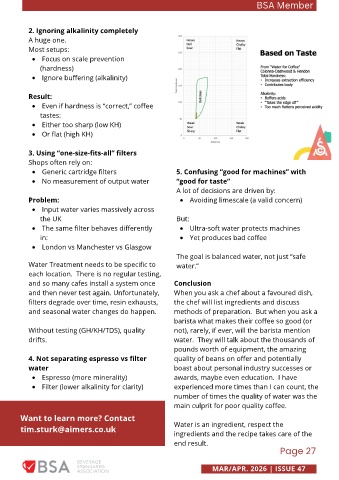
2. Ignoring alkalinity completely                                               BSA Member
           A huge one.
           Most setups:
                Focus on scale prevention
               (hardness)
                Ignore buffering (alkalinity)

           Result:
                Even if hardness is “correct,” coffee
               tastes:
                Either too sharp (low KH)
                Or flat (high KH)


           3. Using “one-size-fits-all” filters
           Shops often rely on:
                Generic cartridge filters                      5. Confusing “good for machines” with
                No measurement of output water                 “good for taste”
                                                               A lot of decisions are driven by:
           Problem:                                                 Avoiding limescale (a valid concern)
                Input water varies massively across
               the UK                                          But:
                The same filter behaves differently                 Ultra-soft water protects machines
               in:                                                  Yet produces bad coffee
                London vs Manchester vs Glasgow
                                                               The goal is balanced water, not just “safe
           Water Treatment needs to be specific to             water.”
           each location.  There is no regular testing,
           and so many cafes install a system once            Conclusion
           and then never test again. Unfortunately,          When you ask a chef about a favoured dish,
           filters degrade over time, resin exhausts,         the chef will list ingredients and discuss
           and seasonal water changes do happen.              methods of preparation.  But when you ask a
                                                              barista what makes their coffee so good (or
           Without testing (GH/KH/TDS), quality               not), rarely, if ever, will the barista mention
           drifts.                                            water.  They will talk about the thousands of
                                                              pounds worth of equipment, the amazing

           4. Not separating espresso vs filter               quality of beans on offer and potentially
           water                                              boast about personal industry successes or
                Espresso (more minerality)                    awards, maybe even education.  I have
                Filter (lower alkalinity for clarity)         experienced more times than I can count, the
                                                              number of times the quality of water was the
                                                              main culprit for poor quality coffee.

        Want to learn more? Contact
        tim.sturk@aimers.co.uk                                Water is an ingredient, respect the
                                                              ingredients and the recipe takes care of the
                                                              end result.
                                                                                                   Page 27


                                                                            MAR/APR. 2026 | ISSUE 47

