


Page 264 - Atlas Sea Birds Ver1
P. 264
2.2.4.16         Breeding by seabirds at Lake St Lucia, KwaZulu-Natal


                  Authors: C Fox, RH Taylor, and RJM Crawford
                  Abstract:
                  Lake St Lucia lies on the central Zululand coast within the iSimangaliso Wetland Park at the northeast of South Africa. Four species
                  of seabird have bred at 21 sites around the lake. Maximum numbers recorded breeding were c. 3,700 pairs of Great White Pelican
                  (Pelecanus onocrotalus) in 2012, c. 300 pairs of White-breasted Cormorant (Phalacrocorax lucidus) in 1964, c. 1,500 pairs of Grey-
                  headed Gull (Chroicocephalus cirrocephalus) in 1992 and c. 750 pairs of Caspian Tern (Hydroprogne caspia) in 1972.

                  Introduction:
                  Four species of seabird  have bred at 21 sites around  Lake St Lucia, which lies on the central Zululand  coast and is protected
                  within the iSimangaliso Wetland Park World Heritage Site and the St Lucia Ramsar Site. They are: Great White Pelican (Pelecanus
                  onocrotalus), White-breasted Cormorant (Phalacrocorax lucidus), Grey-headed Gull (Chroicocephalus cirrocephalus), and Caspian Tern
                  (Hydroprogne caspia). Lake St Lucia is an estuarine lake almost 70 km long and 18 km at its widest point, which has a surface area of
                  225–417 km  depending on the water level. It extends from the Ozabeni Wilderness in the north to Cape St Lucia in the south and from the
                           2
                  Indian Ocean inland to west of False Bay (Figure 1). The park encompasses all of the lake as well as substantial portions of surrounding
                  grassland, savanna, coastal forest, dunes and urban habitats (Johnson et al. 1998, Bowker and Downs 2012). The seabird nesting sites
                  comprise islands, pans, trees and marshes. Substantial fluctuations occur in the lake’s water level and influence the availability of suitable
                  habitat. There is also large spatial and temporal variability in salinity and food availability in response to wet-dry periods (Bowker and
                  Downs 2012). The four seabirds all breed at inland as well as coastal habitats and they may move between different regions to breed
                  (Hockey et al. 2005).
                  From  1975  to  2021  Ezemvelo  KwaZulu-Natal  (EKZN)    St Lucia. For White-  breasted  Cormorant  the  maximum
                  Wildlife  undertook  109  counts  of  114  different  waterbird   ratio  was  increased  to  12 to  improve sample size.  For
                  species  that use Lake St Lucia. No counts were made   this (and the other) species it is likely that in some years
                  in 1977, 1982  and 2019. In  other years the numbers of   not all breeding colonies were counted. The relationships
                  counts ranged from 1–5 (Table 1). All counts were made   between  maximum  counts  (X)  and  numbers  of  breeding
                  on  a  single  day. The lake was divided into sections and   pairs (Y) are shown in Figure 2 and were as follows:
                  counted by observers using three boats from 1975–2003
                  or an aircraft from 2004–2021. Maximum counts obtained   Great White Pelican:
                  for Great White Pelican, White-breasted Cormorant, Grey-  Y = 0.4424X + 155.4 (n = 15, r = 0.945, p < 0.001);
                  headed Gull and Caspian Tern at  Lake St  Lucia in each   White-breasted Cormorant:
                  year surveyed are shown in Table 1.               Y = 0.1146X + 66.291 (n = 10, r = 0.640, p < 0.05);
                     Records of breeding by these four species at Lake St   Grey-headed Gull:
                  Lucia were  obtained from the literature and  unpublished    Y = 0.2874X + 68.898 (n = 10, r = 0.854, p < 0.001);
                  information  of EKZN Wildlife and are shown by year in    Caspian Tern:
                  Table  2.  Where available, estimates  of  the  numbers of   Y = 0.3343X + 55.833 (n = 13, r = 0.761, p < 0.01).
                  pairs of these species that bred are given but they seldom
                  reflect complete counts. The mid-points of reported ranges   Future monitoring of numbers of individuals and of breed-
                  were used. Numbers of breeding adults were divided by   ers  will enable the  usefulness of  these relationships  as
                  two to estimate pairs except for those at nests, which each     predictors of breeding pairs to be assessed. Numbers breed-
                  represent  a pair.  Unattended  chicks were  assumed  to   ing at Lake St Lucia have been difficult to estimate because
                  represent pairs of Great White  Pelicans, which only rear   many  colonies  are  sensitive  to  disturbance  or  difficult  to
                  one  chick,  or  halved and rounded upwards to  estimate   access. It is of interest that the best-fitting relationship was
                  pairs  of  White-breasted  Cormorants, Grey-headed  Gulls   obtained for the Great White Pelican, which often breeds
                  and  Caspian  Terns, which all may rear two or more   in large colonies and is the most  accurately counted of
                  chicks  (Hockey  et  al.  2005).  The  adjective  ‘several’   the four species considered. The emergent use of drones
                  was  conservatively  taken to represent  ‘two’, e.g. several   may enable improved precision of breeding estimates for all
                  hundred  Grey-headed  Gull  chicks in 1991 (Bowker and   four species.
                  Downs 2012) to be 200 chicks and hence reflect 100 pairs.  Counts of Great White Pelicans at Lake St Lucia were
                     Counts of  African Penguins  moulting feathers were    made in 42 of the years between 1976 and 2021 (Table 1).
                  significantly linearly related to numbers that bred (Crawford
                  and Boonstra 1994). Therefore, for each of the four spe-
                  cies  considered  at  Lake  St  Lucia  the  best-fitting  linear
                  relationships  between maximum counts of  birds and
                  numbers  of pairs breeding  were derived.  In years when
                  information was available for both these parameters, the
                  ratio between them was obtained. If the ratio was < 1 or
                  >  5  (>  12  for  White-breasted  Cormorant)  the  data  were
                  excluded from the analyses. In the first instance (ratio <
                  1) it is not possible for the number of birds to be less than
                  the number of pairs,  so  the  number of  birds was likely
                  underestimated.  In  the  second  instance  (ratio  >  5)  it  is
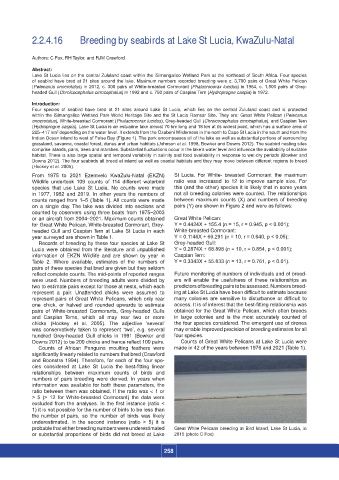
                  probable that either breeding numbers were underestimated   Great White Pelicans breeding at Bird Island, Lake St Lucia, in
                  or substantial proportions of  birds  did not breed at Lake   2015 (photo C Fox)


                                                                 258

