


Page 282 - Atlas Sea Birds Ver1
P. 282
2.3.1    Cape Fur Seals breeding in Angola


                  Authors: A Amaro, and M Morais

                  Abstract:
                  Cape Fur Seals (Arctocephalus pusillus pusillus) were first recorded breeding in Angola at Ilha dos Tigres, which lies in Baia dos Tigres,
                  in 2001.  Small numbers have also pupped at the north of a sandspit that runs northwards from the mainland at the west of Baia dos Tigres.
                  The number of pups born in Angola increased from 4,378 in 2006 to 12,159 in 2014 and then fell to 3,707 in 2020.

                  Introduction:
                  Cape Fur Seals (Arctocephalus pusillus pusillus) were first recorded breeding in Angola in 2001 at the southwest (16.654 S; 11.702 E) of
                  Ilha dos Tigres, which lies near the south of Angola in the northern portion of the Benguela upwelling system (Dean et al. 2002). In  Angola,
                  they also hauled out at the north (16.775 S; 11.772 E) of a sandspit that runs northwards from the mainland at the west of Baia dos Tigres.
                  In 2006, two pups were born on this sandspit, and in 2008 one pup was born there (FJ de Almeida, Instituto Nacional de Investigação
                  Pesqueira [INIP] unpubl.). Formerly, an extension of the sandspit connected the mainland to Ilha dos Tigres.
                     On a visit to Ilha dos Tigres in November 2005, 1,167 seal pups and 4,006 older animals were counted (Dyer 2007). Subsequently,
                  five aerial surveys of Ilha and Baia dos Tigres were conducted in December, the main pupping season of A. p. pusillus, between 2006
                  and 2020 by INIP (Meÿer 2007, INIP unpubl.). On these, numbers of pups increased from 4,378 in 2006 to 12,159 in 2014 and then fell
                  to 3,707 in 2020 (Table 1). There were 13,000–21,000 older individuals from 2006–2014 and c. 7,000 in 2020 (Table 1). On photos from an
                  aerial survey conducted in March 2017, 15,831 Cape Fur Seals were counted (Mendelsohn and Haraes 2018). Colonisation of the region
                  by seals at the recent turn of the century coincided with the formation of other seal colonies in northern Namibia, as seals in the northern
                  part of the Benguela ecosystem expanded their range northwards (Meÿer 2007). Less than 4,000 seals were seen on a visit to Ilha dos
                  Tigres in 2021, when many dead seals were observed along its coast (M Morais prs.obs.). Cape Cormorants (Phalacrocorax capensis)
                  also colonised Ilha dos Tigres at the turn of the century (Dean et al. 2002, Mendelsohn and Haraes 2018). Unlike seals, their numbers
                  at Ilha dos Tigres have continued to increase (Morais 2024).

                  Table 1. Numbers of pups and older individuals of Cape Fur Seals counted at Baia dos Tigres on photographs taken on aerial surveys,
                  2006–2020

                      Year                  Pups                                  Older individuals
                      2006                  4,378                                     17,062
                      2008                  5,694                                     13,532
                      2011                  9,097                                     17,256
                      2014                 12,159                                     21,290
                      2020                  3,707                                     7,194


                  References                                        Morais  M. 2024.  Coastal  breeding  sites of seabirds  in Angola.
                                                                        This volume.
                  Dean  WRJ,  Dowsett  RJ,  Sakko  A,  Simmons  RE.  2002.  New    Mwaala DN, Nghimwatya L, BNS Tjandja BNS, Kaholongo I. 2024.
                      records and amendments to the birds of Angola. Bulletin of   Breeding sites and pup production  of  Cape Fur  Seals in
                      the British Ornithologists’ Club 122: 180–185.    Namibia. This volume.
                  Dyer BM.  2007.  Report  on top-predator survey of  southern
                      Angola including  Ilha dos  Tigres, 20–29 November 2005.
                      In: Kirkman SP (ed.). Final report of the BCLME (Benguela
                      current  large  marine  ecosystem)  Project  on  top  predators
                      as biological indicators of ecosystem change in the BCLME.
                      Avian Demography Unit; Cape Town: 303–306.
                  Mendelsohn  JM,  Haraes L.  2018.  Aerial census of  Cape
                      Cormorants and Cape Fur Seals at Baía dos Tigres, Angola.
                      Namibian Journal of Environment 2 A: 1-6.
                  Meÿer MA. 2007. The first aerial survey of Cape Fur Seal numbers
                      at Baia dos Tigres, southern Angola. In: Kirkman  SP  (ed.).
                      Final report of the BCLME (Benguela current large marine
                      ecosystem) Project on top predators  as  biological  indicators
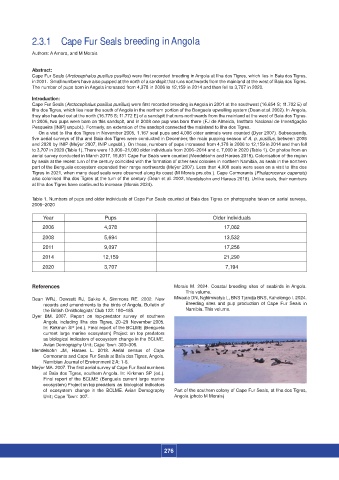
                      of  ecosystem  change in the BCLME. Avian Demography   Part of the southern colony of Cape Fur Seals, at Ilha dos Tigres,
                      Unit; Cape Town: 307.                         Angola (photo M Morais)


                                                                 276

