


Page 286 - Atlas Sea Birds Ver1
P. 286
and 2018, and no breeding occurred at two former colonies
                  (Penguin at Lüderitz and Possession islands). Ten localities
                  were colonised  or recolonised  by seals after the 1970s:
                  Möwe Bay, Torra Bay, Toscanini, Pelican Point, Sandwich
                  Harbour, Conception Bay, Sylvia Hill, Mercury Island, Little
                  Ichaboe and North Reef (in the Possession Island group).
                     No breeding has taken place at  Mercury Island since
                  1993.  The  overall  number  of  pups  fluctuated  around  a
                  level of about 150,000 between 1972 and 2002 and then
                  increased to about 300,000 in 2018 (Table 1). There was a
                  northward shift in the distribution of pups. In 1972, 63% of
                  pups were born south of Lüderitz whereas, in 2018, 71%
                  were born north of Walvis Bay.
                  Descriptions of breeding localities
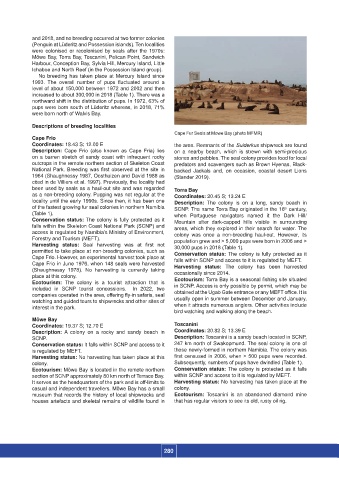
                                                                    Cape Fur Seals at Mowe Bay (photo MFMR)
                  Cape Frio
                  Coordinates: 18.43 S; 12.00 E                     the area. Remnants of the Suiderkus shipwreck are found
                  Description:  Cape  Frio  (also  known  as  Cape  Fria)  lies   on a nearby  beach, which  is strewn with semi-precious
                  on a barren stretch of sandy coast with infrequent rocky   stones and pebbles. The seal colony provides food for local
                  outcrops in the remote northern section of Skeleton Coast   predators and scavengers such as Brown Hyenas, Black-
                  National Park. Breeding was first observed at the site in   backed Jackals and, on occasion, coastal desert Lions
                  1964 (Shaughnessy 1987, Oosthuizen and David 1988 as   (Stander 2019).
                  cited in de Villiers et al. 1997). Previously, the locality had
                  been used by seals as a haul-out site and was regarded   Torra Bay
                  as a non-breeding colony. Pupping was not regular at the   Coordinates: 20.45 S; 13.24 E
                  locality until the early 1990s. Since then, it has been one   Description:  The colony is on a long, sandy beach in
                  of the fastest growing fur seal colonies in northern Namibia   SCNP. The name Torra Bay originated in the 16  century,
                                                                                                           th
                  (Table 1).                                        when Portuguese navigators named it the Dark Hill/
                  Conservation status: The colony is fully protected as it   Mountain after dark-capped  hills visible in surrounding
                  falls within the Skeleton Coast National Park (SCNP) and   areas, which they explored in their search for water. The
                  access is regulated by Namibia’s Ministry of Environment,   colony  was once a non-breeding haul-out.  However, its
                  Forestry and Tourism (MEFT).                      population grew and > 5,000 pups were born in 2006 and >
                  Harvesting status:  Seal  harvesting  was  at  first  not   30,000 pups in 2018 (Table 1).
                  permitted to take place at non-breeding colonies, such as   Conservation status: The colony is fully protected as it
                  Cape Frio. However, an experimental harvest took place at   falls within SCNP and access to it is regulated by MEFT.
                  Cape Frio in June 1976, when 148 seals were harvested   Harvesting status:  The  colony has been harvested
                  (Shaughnessy  1978).  No  harvesting  is  currently  taking   occasionally since 2014.
                  place at this colony.
                  Ecotourism:  The colony is a tourist attraction that  is   Ecotourism: Torra Bay is a seasonal fishing site situated
                  included  in SCNP tourist concessions.   In 2022, two   in SCNP. Access is only possible by permit, which may be
                  companies operated in the area, offering fly-in safaris, seal   obtained at the Ugab Gate entrance or any MEFT office. It is
                  watching and guided tours to shipwrecks and other sites of   usually open in summer between December and January,
                  interest in the park.                             when it attracts numerous anglers. Other activities include
                                                                    bird watching and walking along the beach.
                  Möwe Bay
                  Coordinates: 19.37 S; 12.70 E                     Toscanini
                  Description:  A  colony on a rocky  and sandy beach in   Coordinates: 20.82 S; 13.39 E
                  SCNP.                                             Description: Toscanini is a sandy beach located in SCNP,
                  Conservation status: It falls within SCNP and access to it   247 km north of Swakopmund. The seal colony is one of
                  is regulated by MEFT.                             those newly-formed in northern Namibia. The colony was
                  Harvesting status: No harvesting has taken place at this   first censused in 2006, when > 500 pups were recorded.
                  colony.                                           Subsequently, numbers of pups have dwindled (Table 1).
                  Ecotourism: Möwe Bay is located in the remote northern   Conservation status: The colony is protected as it falls
                  section of SCNP approximately 80 km north of Terrace Bay.   within SCNP and access to it is regulated by MEFT.
                  It serves as the headquarters of the park and is off-limits to   Harvesting status: No harvesting has taken place at the
                  casual and independent travellers. Möwe Bay has a small   colony.
                  museum that records the history of local shipwrecks and   Ecotourism:  Toscanini  is an abandoned  diamond  mine
                  houses artefacts and skeletal remains of wildlife found in   that has regular visitors to see its old, rusty oil rig.


                                                                 280

