


Page 291 - Atlas Sea Birds Ver1
P. 291
Wolf Bay and Atlas Bay                            North Reef in the Possession Island group
                  Coordinates: Wolf  26.81  S;  15.12  E;  Atlas  26.82  S;  Coordinates: 27.00 S; 15.19 E
                  15.13 E                                           Description:  A  small island north of  Possession Island.
                  Description: Two large mainland colonies established on   Conservation status:  Activities are controlled  at and
                  rocky shores. They are merely a kilometre apart and are   around  the island as it falls within NIMPA (Currie et  al.
                  located  in  the  vicinity  of  the  Lüderitz  coastal  upwelling   2009, Ludynia et al. 2012).
                  cell (Bakun 1996). In 1993, > 100,000 pups were born at   Ecotourism: None currently.
                  Atlas and Wolf bays but this decreased to <  30,000 in   Harvesting status: There is currently no commercial har-
                  2018 (Table 1). The decrease was related to changes in   vesting of seals.
                  the abundance and composition of prey species (Kirkman   Note:  Excavations undertaken by  South Africa’s  Depart-
                  et al. 2007, 2013).                               ment of  Forestry,  Fisheries and the Environment (DFFE,
                  Conservation  status: Apart  from  harvests,  the  colonies   unpublished information) showed that seals formerly bred
                  are fully protected  as they fall within  the  Tsau  //Khaeb   at Possession Island (27.013 S; 15.194 E), the main island
                  (Sperrgebiet) National Park (MEFT 2020) as well as with-   in the group. They have not bred there since the 1960s
                  in  a  proclaimed  diamond  mining  area  (NAMDEB),  which   or  earlier  (Rand  1963).  Possession  Island  was  formerly
                  strictly restricts human access.                  the base for  sealing at  Long and Sinclair islands (Rand
                  Ecotourism:  There is potential  for land-based  tourism;   1963).
                  however, the site is not yet accessible to visitors as it falls
                  within a mining area.                             Albatross Rock
                  Harvesting status: The earliest recorded seal harvests at  Coordinates: 27.12 S; 15.24 E
                  Wolf and Atlas bays were in 1937 (David and Van Sittert  Description:   A  steep,  elongated  rocky  island.
                  2008). The first seal harvesting concession for these bays   Conservation status: Activities at and around the island
                  was granted in 1947, when a quota of about 30,000 year-   are controlled as it falls within NIMPA (Currie et al. 2009,
                  lings (and no adults) was allocated to the concessionaires   Ludynia et al. 2012).
                  (Shaughnessy 1978). A long-term concession for Wolf and   Ecotourism: None currently.
                  Atlas bays  was  negotiated in 1974,  when quotas were   Harvesting status:  The  first  concession  was  granted
                  generally introduced into contracts as they were renewed   in 1974 with a  quota of  1,500 yearlings  and 400 adults
                  (Shaughnessy  1978).  At  present  controlled,  commercial   (Shaughnessy  1978).  There  is  currently  no  commercial
                                                                    harvesting of seals.
                  harvesting of Cape Fur Seals takes place at both the Wolf   Note:  Kirkman  (2009)  observed  from  records  in  Rand
                  and Atlas colonies with at least three right holders operat-   (1972)  and  Shaughnessy  (1984)  that  sealers  and  seals
                  ing. Historical harvest data for the colonies are shown be-   were possibly present on Albatross Rock in the 1820s, but
                  low (the numbers include yearlings, sub-adults and adults,   seals may have been extirpated by hunters before 1843,
                  irrespective of their sex as they were then difficult to dis-   when  guano  harvests boomed  in southern Africa. Seals
                  tinguish).                                        were then apparently absent until the 20th century. They
                                                                    were resighted on the island in 1947 (Rand 1972, cited by
                         Year               No. harvested           Shaughnessy 1978). Seals then displaced the seabird col-
                        1973                   45,891               onies that had produced the guano (Shaughnessy 1978).
                        1974                   31,506               Historical  harvesting  data at Albatross Rock  are shown
                                                                    below (the numbers include  yearlings,  sub-adults and
                        1975                    35,616              adults irrespective of their sex as they were then difficult
                        1976                    30,968              to distinguish).
                  Shaughnessy (1978)                                      Year               No. harvested
                                                                          1973                   224
                                                                          1975                   1,668
                                                                          1976                   1,125
                                                                    Shaughnessy (1978)


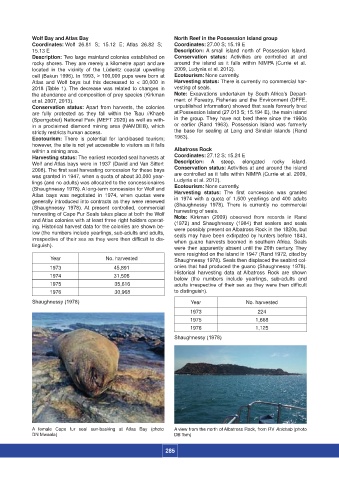
                  A   female   Cape   fur   seal   sun-basking   at  Atlas   Bay   (photo  A view from the north of Albatross Rock, from RV Anichab (photo
                  DN Mwaala)                                        DB Tom)


                                                                 285

