


Page 316 - Atlas Sea Birds Ver1
P. 316
3.1   Introduction to summaries for seabird species


                     Section 2.2 briefly described 369 breeding sites of seabirds in the Benguela upwelling system (BUS) and adjacent
                  coastal areas, to the north in Angola and to the east in South Africa. It provided coordinates of the sites and, in instances,
                  photographs for them, to facilitate their relocation in the future. It also listed records of breeding by different seabirds at
                  each locality.
                     This section collated data from Section 2.2 on numbers nesting at different localities for each of the 15 seabirds that
                  bred in the region. In doing so, it aimed to consolidate the information into a readily-accessible format, to gauge recent (c.
                  2020) levels of and trends in the seabird populations, to inform Red List classifications of the species, and to investigate
                  distributional changes of and identify important breeding areas for them. Seven species and two subspecies were endemic
                  to the BUS as breeders, and the coastal populations of the other six seabirds were thought to be somewhat discrete, even
                  though four of the species also bred at inland waterbodies in the region.
                     The Atlas aimed to document as many breeding records as possible, including those that were received after completion
                  of the chapters in Section 2.2. Therefore, some records in this section may not be listed in Section 2.2. As indicated in the
                  introduction to Section 2.2, limitations of abundance data should be borne in mind when interpreting estimates of sizes
                  or trends in species in the following chapters, for example data gaps, variability in participation in and the timing of peak
                  breeding by species, and the opportunistic nature of visits to remote localities.
                     Taking cognisance of such caveats, the chapters in this section attempted to provide preliminary, updated estimates
                  of the Red List status of each of the 15 seabirds that breed in the region, based on criteria adopted for this purpose by the
                  International Union for Conservation of Nature (IUCN 2012). However, final appraisals of their global status will need to
                  be made by IUCN, or of their regional status by organisations appointed for that purpose by states party to the Benguela
                  Current Convention. In attempting to identify sites important for breeding, for species thought to be globally or regionally
                  threatened or small, the chapters made use of guidelines provided by BirdLife International (2020). These guidelines take
                  cognisance of the IUCN conservation status of a species and hence also are provisional.

                  References

                  BirdLife  International.  2020.  Guidelines  for  the  application  of  the  IBA  criteria.  Final  version,  July  2020.  18  pp.  Downloaded  from
                      http://datazone.birdlife.org/ 20 May 2022.
                  IUCN. 2012. IUCN Red List Categories and Criteria: Version 3.1. Second edition. IUCN: Gland, Switzerland and Cambridge, UK. iv +
                      32pp.


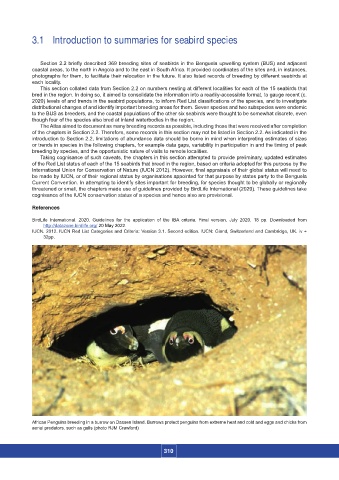
                  African Penguins breeding in a burrow on Dassen Island. Burrows protect penguins from extreme heat and cold and eggs and chicks from
                  aerial predators, such as gulls (photo RJM Crawford)


                                                                 310

