


Page 319 - Atlas Sea Birds Ver1
P. 319
heavy  fishing  of  sardine  in  its  vicinity:  70,000  tonnes  of
                                                                    sardine were caught within 30 km of Dyer Island in 2004
                                                                    (Ludynia et al. 2014). When the colony size at Dyer Island
                                                                    was  >  3,500  pairs,  numbers  of  penguins  breeding  there
                                                                    were negatively related to sardine catches made within 20
                                                                    nautical miles of the island (Ludynia et al. 2014).
                                                                      In 2015, African Penguins were considered Endangered
                                                                    (EN)  in  both  Namibia  (Kemper  2015)  and  South  Africa
                                                                    (Hagen 2015). Generation length (G) for birds is defined
                                                                    as: G = A + (1/(1 − ϕ )), where A is age at first breeding
                                                                                      a
                                                                    and  ϕ   is  annual  survival  of  adults  (Birdlife  International
                                                                         a
                                                                    2000). For African Penguins, A can vary from four to six
                                                                    years  depending  on  food  availability  (Crawford  et  al.
                                                                    1999,  Whittington  et  al.  2005).  When  food  is  reasonably
                                                                    abundant  ϕ   is  about  0.81  or  0.82  p.a.  (Crawford  et  al.
                                                                              a
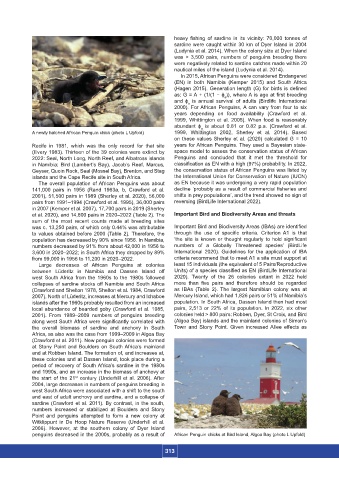
                  A newly hatched African Penguin chick (photo L Upfold)  1999,  Whittington  2002,  Sherley  et  al.  2014).  Based
                                                                    on these values Sherley et al. (2020) calculated G = 10
                  Recife  in  1981,  which  was  the  only  record  for  that  site   years for African Penguins. They used a Bayesian state-
                  (Every 1983). Thirteen of the 39 colonies were extinct by   space model to assess the conservation status of African
                  2022: Seal, North Long, North Reef, and Albatross islands   Penguins  and  concluded  that  it  met  the  threshold  for
                  in Namibia; Bird (Lambert’s Bay), Jacob’s Reef, Marcus,   classification as EN with a high (97%) probability. In 2022,
                  Geyser, Quoin Rock, Seal (Mossel Bay), Brenton, and Stag   the conservation status of African Penguins was listed by
                  islands and the Cape Recife site in South Africa.  the International Union for Conservation of Nature (IUCN)
                     The overall population of African Penguins was about   as EN because it was undergoing a very rapid population
                  141,000  pairs  in  1956  (Rand  1963a,  b,  Crawford  et  al.   decline ‘probably as a result of commercial fisheries and
                  2001), 51,500 pairs in 1989 (Sherley et al. 2020), 56,000   shifts in prey populations’, and the trend showed no sign of
                  pairs from 1991–1994 (Crawford et al. 1995), 36,000 pairs   reversing (BirdLife International 2022).
                  in 2007 (Kemper et al. 2007), 17,700 pairs in 2019 (Sherley
                  et al. 2020), and 14,800 pairs in 2020–2022 (Table 2). The   Important Bird and Biodiversity Areas and threats
                  sum  of  the  most  recent  counts  made  at  breeding  sites
                  was c. 13,250 pairs, of which only 0.44% was attributable   Important Bird and Biodiversity Areas (IBAs) are identified
                  to values obtained before 2000 (Table 2). Therefore, the   through  the  use  of  specific  criteria.  Criterion  A1  is  that
                  population has decreased by 90% since 1956. In Namibia,   ‘the site is known or thought regularly to hold significant
                  numbers decreased by 91% from about 42,000 in 1956 to   numbers  of  a  Globally  Threatened  species’  (BirdLife
                  3,600 in 2020–2022; in South Africa they dropped by 89%   International  2020).  Guidelines  for  the  application  of  IBA
                  from 99,000 in 1956 to 11,200 in 2020–2022.       criteria recommend that to meet A1 a site must support at
                     Large  decreases  of  African  Penguins  at  colonies   least 15 individuals (the equivalent of 5 Pairs/Reproductive
                  between  Lüderitz  in  Namibia  and  Dassen  Island  off   Units) of a species classified as EN (BirdLife International
                  west  South Africa  from  the  1960s  to  the  1980s  followed   2020).  Twenty  of  the  26  colonies  extant  in  2022  held
                  collapses of sardine stocks off Namibia and South Africa   more  than  five  pairs  and  therefore  should  be  regarded
                  (Crawford and Shelton 1978, Shelton et al. 1984, Crawford   as  IBAs  (Table  2).  The  largest  Namibian  colony  was  at
                  2007). North of Lüderitz, increases at Mercury and Ichaboe   Mercury Island, which had 1,826 pairs or 51% of Namibia’s
                  islands after the 1960s probably resulted from an increased   population. In South Africa, Dassen Island then had most
                  local abundance of bearded goby (Crawford et al. 1985,   pairs,  2,513  or  22%  of  its  population.  In  2022,  six  other
                  2001).  From  1989–2009  numbers  of  penguins  breeding   colonies held > 800 pairs: Robben, Dyer, St Croix, and Bird
                  along west South Africa were significantly correlated with   (Algoa Bay) islands and the mainland colonies of Simon’s
                  the  overall  biomass  of  sardine  and  anchovy  in  South   Town  and  Stony  Point.  Given  increased Allee  effects  as
                  Africa, as also was the case from 1999–2009 in Algoa Bay
                  (Crawford et al. 2011). New penguin colonies were formed
                  at  Stony  Point  and  Boulders  on  South Africa’s  mainland
                  and at Robben Island. The formation of, and increases at,
                  these colonies and at Dassen Island, took place during a
                  period of recovery of South Africa’s sardine in the 1980s
                  and 1990s, and an increase in the biomass of anchovy at
                  the  start  of  the  21   century  (Underhill  et  al.  2006). After
                                 st
                  2004, large decreases in numbers of penguins breeding in
                  west South Africa were associated with a shift to the south
                  and east of adult anchovy and sardine, and a collapse of
                  sardine (Crawford et al. 2011). By contrast, in the south,
                  numbers  increased  or  stabilized  at  Boulders  and  Stony
                  Point  and  penguins  attempted  to  form  a  new  colony  at
                  Witklippunt  in  De  Hoop  Nature  Reserve  (Underhill  et  al.
                  2006).  However,  at  the  southern  colony  of  Dyer  Island
                  penguins decreased in the 2000s, probably as a result of   African Penguin chicks at Bird Island, Algoa Bay (photo L Upfold)


                                                                 313

