


Page 343 - Atlas Sea Birds Ver1
P. 343
(a)      Namibia
                                  South Africa
                     200

                     150

                     100

                      50
                    Thousand pairs  100  (b)  West of Cape Agulhas


                                  Algoa Bay

                      80

                      60
                      40                                            Cape Gannet juveniles (photo L Upfold)
                                                                    2014, Rishworth et al. 2014). Between 2011 and 2014 there
                      20
                                                                    was a net deficit in energy expenditure during foraging for
                                                                    most Cape Gannets tracked from Malgas Island (Grémillet
                      1956  1964  1972  1980  1988  1996  2004  2012  2020   et al. 2016). However, adult gannets buffered their survival
                                                                    to  a  considerable  extent  by  feeding  on  alternative  food,
                                                                    such as saury Scomberesox saury and hake Merluccius sp.
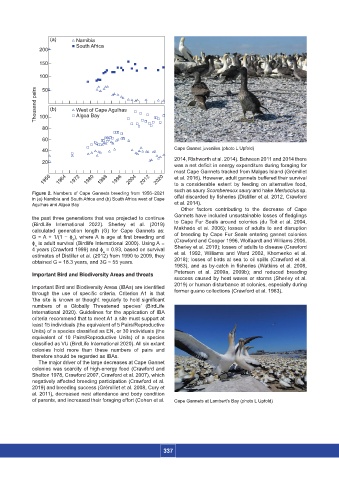
                  Figure 2. Numbers of Cape Gannets breeding from 1956–2021
                  in (a) Namibia and South Africa and (b) South Africa west of Cape   offal discarded by fisheries (Distiller et al. 2012, Crawford
                  Agulhas and Algoa Bay                             et al. 2014).
                                                                      Other  factors  contributing  to  the  decrease  of  Cape
                                                                    Gannets have included unsustainable losses of fledglings
                  the past three generations that was projected to continue
                  (BirdLife  International  2022).  Sherley  et  al.  (2019)   to  Cape  Fur  Seals  around  colonies  (du Toit  et  al.  2004,
                  calculated  generation  length  (G)  for  Cape  Gannets  as:     Makhado et al. 2006); losses of adults to and disruption
                  G = A + 1/(1 − ϕ ), where A is age at first breeding and   of breeding by Cape Fur Seals entering gannet colonies
                                a
                  ϕ  is adult survival (Birdlife International 2000). Using A =     (Crawford and Cooper 1996, Wolfaardt and Williams 2006,
                   a
                  4 years (Crawford 1999) and ϕ  = 0.93, based on survival   Sherley et al. 2019); losses of adults to disease (Crawford
                                           a
                  estimates of Distiller et al. (2012) from 1990 to 2009, they   et  al.  1992,  Williams  and  Ward  2002,  Khomenko  et  al.
                  obtained G = 18.3 years, and 3G ~ 55 years.       2018); losses of birds at sea to oil spills (Crawford et al.
                                                                    1983), and as by-catch in fisheries (Watkins et al. 2008,
                                                                    Petersen  et  al.  2009a,  2009b);  and  reduced  breeding
                  Important Bird and Biodiversity Areas and threats
                                                                    success caused by heat waves or storms (Sherley et al.
                                                                    2019) or human disturbance at colonies, especially during
                  Important Bird and Biodiversity Areas (IBAs) are identified
                  through  the  use  of  specific  criteria.  Criterion  A1  is  that   former guano collections (Crawford et al. 1983).
                  ‘the site is known or thought regularly to hold significant
                  numbers  of  a  Globally  Threatened  species’  (BirdLife
                  International  2020).  Guidelines  for  the  application  of  IBA
                  criteria recommend that to meet A1 a site must support at
                  least 15 individuals (the equivalent of 5 Pairs/Reproductive
                  Units) of a species classified as EN, or 30 individuals (the
                  equivalent  of  10  Pairs/Reproductive  Units)  of  a  species
                  classified as VU (BirdLife International 2020). All six extant
                  colonies  hold  more  than  these  numbers  of  pairs  and
                  therefore should be regarded as IBAs.
                     The major driver of the large decreases at Cape Gannet
                  colonies was scarcity of high-energy food (Crawford and
                  Shelton 1978, Crawford 2007, Crawford et al. 2007), which
                  negatively affected breeding participation (Crawford et al.
                  2019) and breeding success (Grémillet et al. 2008, Cury et
                  al. 2011), decreased nest attendance and body condition
                  of parents, and increased their foraging effort (Cohen et al.   Cape Gannets at Lambert’s Bay (photo L Upfold)


                                                                337

