


Page 347 - Atlas Sea Birds Ver1
P. 347
3.6  Numbers, trends, status, and conservation of Cape Cormorant
                           (Phalacrocorax capensis)


                  Authors: AB Makhado, M Morais, DB Tom, BM Dyer, M Masotla,  RM Randall, L Upfold, and RJM Crawford

                  Abstract:
                  Cape Cormorants (Phalacrocorax capensis) are endemic to southern Africa, where they bred at 95 sites in the Benguela upwelling system
                  (BUS) between Ilha dos Tigres, in south Angola, and Algoa Bay on South Africa’s south coast. Their overall population decreased from c.
                  250,000 pairs in 1978/79 to c. 100,000 pairs in 2005/06 and then recovered to c. 190,000 pairs in 2020/21. The recovery was attributable
                  to their colonisation of Ilha dos Tigres in the 1990s, where c. 95,000 pairs (half the species’ population) bred in 2020/21. Numbers in
                  Namibia decreased from about 143,000 pairs in 1978/79 to c. 50,000 pairs in 2020/21 and in South Africa from about 104,000 pairs in
                  1978/79 to c. 18,000 in 2021/22. Recently categorised as Endangered, the species no longer qualifies as Threatened in terms of criteria
                  of the International Union for Conservation of Nature, but should be regarded as Near Threatened given its heavy dependency on its
                  northernmost colony and the continuing decreases farther south. The populations in Namibia and South Africa should be regarded as
                  Vulnerable and Endangered, respectively. The decreases in Namibia and South Africa were largely driven by food scarcity, although
                  diseases such as avian cholera and avian influenza caused substantial mortality. Human disturbance, predation at and around islands,
                  and oil spills also contributed to losses.

                  Introduction:
                  Cape Cormorants (Phalacrocorax capensis) are endemic to southern Africa, where their usual non-breeding range extends from Lobito
                  (12° S) in Angola to Maputo Bay (25° S, formerly Delagoa Bay) in Mozambique (Cooper et al. 1982). They have bred almost exclusively in
                  the the Benguela upwelling system (BUS), between Ilha dos Tigres in south Angola (Dean et al. 2002) and Algoa Bay in the Eastern Cape
                  Province on South Africa’s south coast (Figure 1, Cooper et al. 1982). There was one record of breeding farther east at Hole-in-the-Wall
                  in the Eastern Cape in 1925 or 1926 (Cooper et al. 1982).
                     For most of the 20  century, breeding by Cape Cormorants was restricted to Namibia and South Africa, with the main nesting sites
                                  th
                  grouped in three regions: guano platforms off central Namibia, islands off southern Namibia and islands off South Africa’s Western Cape
                  Province (Rand 1963a, b, Cooper et al. 1982). Between 1956/57 and 1978/79, numbers breeding in Namibia increased due to augmented
                  availability of breeding space and adequate supplies of food. In the same period, numbers in the Western Cape remained stable (Crawford
                  et al. 2007). In the early 1980s, numbers decreased off southern Namibia following the collapse of Namibia’s sardine (Sardinops sagax),
                  an important food source for the cormorants (Crawford 2007). Their numbers off central Namibia decreased in the early 1990s, when
                  environmental perturbations reduced the availability of food (Crawford et al. 2007). Numbers decreased in the Western Cape in the early
                  1990s, following periods of scarcity of anchovy (Engraulis encrasicolus), another important food item, and an outbreak of avian cholera
                  caused by the bacterium Pasteurella multocida (Crawford et al. 1992a). They remained low as cholera outbreaks continued and South
                  Africa’s sardine and anchovy stocks were partly displaced to the east beyond the foraging range of cormorants at formerly important
                  breeding sites (Crawford et al. 2007). Following the displacements, the proportion of South Africa’s Cape Cormorants that bred south of
                  Dassen Island increased from 35% in 1977–1981 to 66% in 2010–2014, with the opposite situation in the north-west.
                     From 1996, or earlier, some Cape Cormorants bred at Ilha dos Tigres in southern Angola (Dean et al. 2002), probably moving north
                  on account of a shortage of food in Namibia (Crawford et al. 2007). About 2,000 pairs were observed at Ilha dos Tigres in 2001 (Simmons
                  et al . 2006), c. 16,000 pairs (and c. 251,000 individuals) in 2017 (Mendelsohn and Haraes 2018), and c. 95,000 pairs in 2020 (Morais
                  2024).
                     The overall pattern of distributional change was for Cape Cormorants to decrease in the central portions of the BUS and attempt
                  expansions to the north and southeast, with greatest success in the north where artificial guano platforms were established, and Ilha dos
                  Tigres provided ample breeding space (Makhado et al. 2021) and good foraging opportunities (Mendelsohn and Haraes 2018).
                  Numbers, trends, and conservation status          were c. 56,000 pairs at Mile 4 Saltworks (Swakopmund),
                                                                    48,000 pairs at both Dassen and Dyer islands, 39,000 pairs
                  Cape  Cormorants  have  been  recorded  breeding  at  95    at Ichaboe Island, 31,000 pairs at Penguin (Bird) Island,
                  sites, one in Angola, 33 in Namibia and 61 in South Africa   Lambert’s Bay, 30,000 pairs at Jutten Island, 26,000 pairs
                  (Figure 1). Records of breeding at these sites in different   at Cape Cross north platform, 21,000 pairs at Seal Island
                  years from 1925–2022 are shown in Table 1. Information   (Lüderitz),  18,000  pairs  at  Penguin  Island  (Lüderitz),
                  was collated from Rand (1963a, b), Cooper et al. (1982),
                  Loutit et al. (1986), Williams (1987), Du Toit et al. (2003),
                  Simmons et al. (2006), Crawford et al. (2007, 2016), Dyer
                  (2007),  Kemper  et  al.  (2007),  Mendelsohn  and  Haraes
                  (2018), and relevant breeding site chapters in this volume.
                  When multiple counts were obtained at a site in a given year,
                  the maximum was used. ‘√’ signifies that breeding occurred
                  at a locality but the numbers were not ascertained; ‘#’ that
                  breeding was assumed; ‘?’ that breeding may have taken
                  place. Cape Cormorants mainly breed in the austral spring
                  and summer (Crawford et al. 1999). The years shown on
                  Table 1 are the first in the split-year breeding season.
                     The  maximum  number  of  Cape  Cormorants  that  bred
                  at sites varied from one pair at each of Robbe and Owen
                  islands and Cape Hangklip Rocks to nearly 95,000 pairs
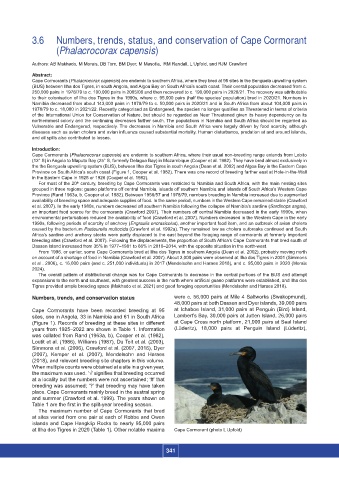
                  at Ilha dos Tigres in 2020 (Table 1). Other notable maxima   Cape Cormorant (photo L Upfold)


                                                                 341

