


Page 351 - Atlas Sea Birds Ver1
P. 351
propensity of the species to move between breeding areas,   may  be  present  in  birds  but  only  become  symptomatic
                  consideration should also be given to including sites where   under conditions of stress, such as food scarcity (Crawford
                  large numbers of Cape Cormorants formerly bred as sites   et al. 1992a).
                  of importance for the species.                      Cape Cormorants are sensitive to human disturbance
                                                                    at  breeding  sites  and,  if  displaced  from  nests,  may  lose
                  Conservation issues                               eggs  and  chicks  to  avian  predators,  such  as  Kelp  Gulls
                                                                    (Larus domicanus) (Jarvis and Cram 1971, Cooper et al.
                  A  decreased  availability  of  high-energy  fish  prey  led  to   1982, Kemper and Simmons 2015). Great White Pelicans
                  decreases  in  numbers  of  Cape  Cormorants  breeding  in   (Pelecanus onocrotalus)  have  fed  on  Cape  Cormorant
                  Namibia and South Africa (Crawford 2007, Crawford et al.   adults  and  chicks  (de  Ponte  Machado  2010,  Mwema
                  2007, 2014, 2016, 2018, 2019, Masiko et al. 2021). When   et  al.  2010).  Cape  Fur  Seals  (Arctocephalus  pusillus
                                                                    pusillus)  have  killed  large  numbers  of  fledglings  around
                  food is scarce Cape Cormorants may suffer high mortality,   islands  (Voorbergen  et  al.  2012,  Makhado  et  al.  2013).
                  have greatly reduced breeding success, skip or abandon   Cape Cormorants are vulnerable to oil spills (Crawford et
                  breeding, and defer their age at first breeding (Berry 1976,   al.  2000).  Rehabilitation  success  of  oiled  birds  was  low
                  Crawford  et  al.  1980,  1992b,  2001,  Duffy  et  al.  1984,   (Crawford 2005). In South Africa, Cape Cormorants often
                  Crawford and Dyer 1995). Diseases such as avian cholera   move east in winter after breeding (Crawford 2005). At that
                  and avian influenza have killed substantial numbers of birds   time large numbers often feed in estuaries in the east of
                  (Crawford  et  al.  1992a,  Williams  and  Ward  2002,  Waller   the Western Cape and in the Eastern Cape (Crawford et
                  and Underhill 2007, Khomenko et al. 2018). Avian cholera   al. 2016).


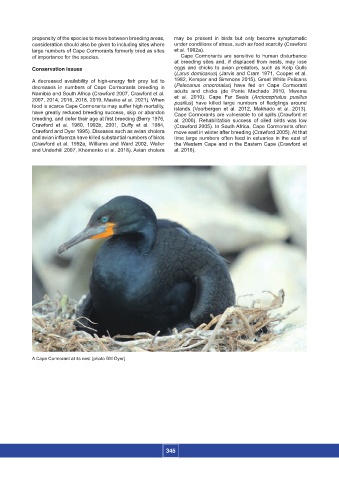
                  A Cape Cormorant at its nest (photo BM Dyer)


                                                                 345

