


Page 350 - Atlas Sea Birds Ver1
P. 350
et al. 2016) and 3G = 27.75 years. Cook (2015) used a
                                                                    slightly  shorter  G  =  8.67  years  but  did  not  describe  its
                                                                    derivation.
                                                                      There was a decrease of c. 64,000 pairs (24%) in the
                                                                    overall population of Cape Cormorants, from 250,000 pairs
                                                                    in  1978/79  to  189,000  pairs  in  2020/21,  a  period  of  42
                                                                    years or 4.5 G. This is equivalent to a decrease of c. 16% in
                                                                    3G, which is less than the lower threshold of 30% required
                                                                    for categorisation as Vulnerable (VU, IUCN 2022). Hence
                                                                    the species should no longer be regarded as Threatened.
                                                                    However, given that in 2020/21 half the species population
                                                                    resided at one site in Angola and that numbers in Namibia
                                                                    and South Africa remained depressed, it would be prudent
                                                                    to regard it as Near Threatened.
                                                                      The  Namibian  population  decreased  by  95,500  pairs
                                                                    (65%)  from  143,000  pairs  in  1978/79  to  c.  50,000  pairs
                                                                    in  2020/21,  a  rate  equivalent  to  43%  in  3G.  This  meets
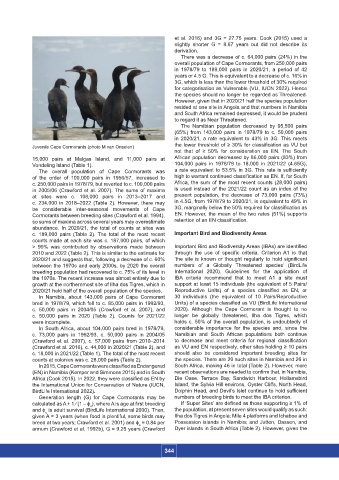
                  Juvenile Cape Cormorants (photo M van Onselen)    the lower threshold of ≥ 30% for classification as VU but
                                                                    not  that  of  ≥  50%  for  consideration  as  EN.  The  South
                  15,000  pairs  at  Malgas  Island,  and  11,000  pairs  at   African population decreased by 86,000 pairs (83%) from
                  Vondeling Island (Table 1).                       104,000  pairs  in  1978/79  to  18,000  in  2021/22  (4.65G),
                     The  overall  population  of  Cape  Cormorants  was   a rate equivalent to 53.5% in 3G. This rate is sufficiently
                  of  the  order  of  100,000  pairs  in  1956/57,  increased  to     high to warrant continued classification as EN. If, for South
                  c. 250,000 pairs in 1978/79, but reverted to c. 100,000 pairs   Africa, the sum of the most recent counts (28,000 pairs)
                  in  2005/06  (Crawford  et  al.  2007). The  sums  of  maxima    is used instead of the 2021/22 count as an index of the
                  at  sites  were  c.  108,000  pairs  in  2013–2017  and    present  population,  the  decrease  of  73,000  pairs  (73%)
                  c. 234,000  in 2018–2022  (Table  2). However,  there  may   in 4.5G, from 1978/79 to 2020/21, is equivalent to 49% in
                  be  considerable  inter-seasonal  movements  of  Cape   3G, marginally below the 50% required for classification as
                  Cormorants between breeding sites (Crawford et al. 1994),   EN. However, the mean of the two rates (51%) supports
                  so sums of maxima across several years may overestimate   retention of an EN classification.
                  abundance.  In  2020/21,  the  total  of  counts  at  sites  was
                  c.  189,000  pairs  (Table  2).  The  total  of  the  most  recent   Important Bird and Biodiversity Areas
                  counts made at each site was c. 187,000 pairs, of which
                  >  99%  was  contributed  by  observations  made  between   Important Bird and Biodiversity Areas (IBAs) are identified
                  2010 and 2022 (Table 2). This is similar to the estimate for   through  the  use  of  specific  criteria.  Criterion  A1  is  that
                  2020/21 and suggests that, following a decrease of c. 60%   ‘the site is known or thought regularly to hold significant
                  between the 1970s and early 2000s, by 2020 the overall   numbers  of  a  Globally  Threatened  species’  (BirdLife
                  breeding population had recovered to c. 75% of its level in   International  2020).  Guidelines  for  the  application  of
                  the 1970s. The recent increase was almost entirely due to   IBA  criteria  recommend  that  to  meet  A1  a  site  must
                  growth at the northernmost site of Ilha dos Tigres, which in   support at least 15 individuals (the equivalent of 5 Pairs/
                  2020/21 held half of the overall population of the species.   Reproductive  Units)  of  a  species  classified  as  EN,  or
                     In  Namibia,  about  143,000  pairs  of  Cape  Cormorant   30  individuals  (the  equivalent  of  10  Pairs/Reproductive
                  bred in 1978/79, which fell to c. 85,000 pairs in 1992/93,   Units) of a species classified as VU (BirdLife International
                  c.  50,000  pairs  in  2004/05  (Crawford  et  al.  2007),  and   2020).  Although  the  Cape  Cormorant  is  thought  to  no
                  c.  50,000  pairs  in  2020  (Table  2).  Counts  for  2021/22     longer  be  globally  threatened,  Ilha  dos  Tigres,  which
                  were incomplete.                                  holds c. 50% of the overall population, is undoubtedly of
                     In South Africa, about 104,000 pairs bred in 1978/79,   considerable  importance  for  the  species  and,  since  the
                  c.  73,000  pairs  in  1992/93,  c.  50,000  pairs  in  2004/05   Namibian  and  South  African  populations  both  continue
                  (Crawford  et  al.  2007),  c.  57,000  pairs  from  2010–2014   to  decrease  and  meet  criteria  for  regional  classification
                  (Crawford et al. 2016), c. 44,000 in 2020/21 (Table 2), and   as VU and EN respectively, other sites holding ≥ 10 pairs
                  c. 18,000 in 2021/22 (Table 1). The total of the most recent   should  also  be  considered  important  breeding  sites  for
                  counts at colonies was c. 28,000 pairs (Table 2).  the species. There are 20 such sites in Namibia and 26 in
                     In 2015, Cape Cormorants were classified as Endangered   South Africa, making 46 in total (Table 2). However, more
                  (EN) in Namibia (Kemper and Simmons 2015) and in South   recent observations are needed to confirm that, in Namibia,
                  Africa (Cook 2015). In 2022, they were classified as EN by   Die  Oase,  Terrace  Bay,  Sandwich  Harbour,  Hollamsbird
                  the International Union for Conservation of Nature (IUCN,   Island, the Sylvia Hill environs, Oyster Cliffs, North Head,
                  BirdLife International 2022).                     Dolphin Head, and Devil’s Islet continue to hold sufficient
                     Generation  length  (G)  for  Cape  Cormorants  may  be   numbers of breeding birds to meet the IBA criterion.
                  calculated as A + 1 ⁄ (1 – ϕ ), where A is age at first breeding   If ‘Super Sites’ are defined as those supporting ≥ 1% of
                                       α
                  and ϕ  is adult survival (BirdLife International 2000). Then,   the population, at present seven sites would qualify as such:
                       α
                  given A = 3 years (when food is plentiful, some birds may   Ilha dos Tigres in Angola; Mile 4 platforms and Ichaboe and
                  breed at two years; Crawford et al. 2001) and ϕ  = 0.84 per   Possession islands in Namibia; and Jutten, Dassen, and
                                                        α
                  annum (Crawford et al. 1992b), G = 9.25 years (Crawford   Dyer islands in South Africa (Table 2). However, given the


                                                                 344

