


Page 397 - Atlas Sea Birds Ver1
P. 397
3.8  Numbers,  trends,  status, and conservation of White-
                           breasted Cormorant (Phalacrocorax lucidus) breeding coastally
                           in southern Africa


                  Authors: RJM Crawford, DG Allan, C Fox, AP Martin, M Morais, DB Tom, PA Whittington, BM Dyer, M Masotla, L Upfold, and AB Makhado


                  Abstract:
                  White-breasted Cormorants (Phalacrocorax lucidus) bred at 165 sites around southern Africa’s coast between Luanda in Angola and
                  South Africa’s border with Mozambique. There was some interchange between birds breeding coastally and those nesting inland but the
                  coastal population was relatively discrete. The largest coastal colony observed was 754 pairs at Bird Rock Platform in central Namibia
                  in 1978. About 1,825 pairs bred coastally in c. 2020, which was a decrease from c. 2,160 pairs in 1995–2006 and a decrease of > 28%
                  over 41 years from > 2,572 pairs in 1977–1981. However, the minimum rate of decrease was equivalent to 17% in three generations,
                  which was insufficient to warrant classification as Vulnerable. Therefore, the present listings of Least Concern in Namibia and South Africa
                  should be retained. Twenty-eight sites held > 1% of the most recent estimate of the coastal population, with Lake St Lucia in northeast
                  South Africa having the biggest proportion (13%) of those birds. Threats to White-breasted Cormorants in the region included human
                  disturbance at breeding sites, loss of suitable breeding habitat, extreme weather events, avian diseases, and entanglement in plastic
                  debris used in nests.

                  Introduction:
                  The White-breasted Cormorant (Phalacrocorax lucidus) was deemed a species in Africa south of the Sahara (Sinclair and Ryan 2003)
                  and in southern Africa (Chittenden et al. 2016). However, it has also been regarded as a subspecies of the Great Cormorant (P. carbo),
                  which has a broad global distribution that includes Europe, south Asia, Japan, Africa, Australia, New Zealand, and the east coast of North
                  America (Del Hoyo et al. 1992).
                     The International Union for Conservation of Nature (IUCN) treated P. lucidus as a subspecies of P. carbo, and thought the conservation
                  status of that species to be Least Concern (LC, BirdLife International 2022). Similarly, in 2015 the conservation status of White-breasted
                  Cormorant in Namibia and South Africa was adjudged as LC (Simmons et al. 2015, Taylor et al. 2015).
                     White-breasted Cormorants breeding coastally are a relatively discrete group within the southern African population of the species,
                  although birds breeding inland in the Western Cape may be derived from the coastal population because they nest at artificial waterbod-
                  ies (Jarvis 1970, Brooke et al. 1982). Some inland birds disperse to the coast and vice versa, but the majority are sedentary at colonies
                  (Underhill et al. 1999). There were thought to be about 3,000 White-breasted Cormorants in southern Mozambique, mainly along the
                  coast (Parker 1999) and small numbers bred there at Inhaca Island (De Boor and Bento 1999). These birds may mix with those found
                  along the northern coast of KwaZulu-Natal.
                     This chapter updates information on numbers of White-breasted Cormorants breeding coastally between Luanda in Angola and South
                  Africa’s border with Mozambique and reviews the status and conservation of, and threats to, this population.
                  Numbers, trends, and status


                  Records  of  breeding  by  White-breasted  Cormorant  at
                  coastal sites in Angola, Namibia, and South Africa in dif-
                  ferent years from c. 1870 to 2022 are shown in Table 1.
                  Information was collated from Rand (1963a, b), Cooper and
                  Brooke (1978), Berruti (1980), Brooke et al. (1982), Martin
                  and Randall (1987), Williams (1987), Du Toit et al. (2003),
                  Crawford  (2007),  Crawford  et  al.  (2009,  2013,  2018),
                  Dyer  (2007),  Kemper  et  al.  (2007),  Bowker  and  Downs
                  (2012), and relevant breeding site chapters in this volume.
                  Bushman’s River was listed as a breeding site by Crawford
                  et al. (2013) but the relevant nest record card could not be
                  relocated, so it is no longer considered a former breeding
                  site of the species. When  multiple  counts  were  obtained
                  at  a  site  in  a  given year, the maximum was used. When a
                  range was given, the mid-point was used.
                     White-breasted Cormorants nested at 165 coastal sites
                  between Luanda in Angola and South Africa’s border with
                  Mozambique, of which three were in Angola, 34 in Namibia,
                  and 128 in South Africa (Figure 1). Maximum numbers ob-
                  served at sites ranged from one pair at each of six sites
                  to 754  pairs  at Bird  Rock  Platform  in  central  Namibia  in
                  1978 (Brooke et al. 1982); 24 other sites held ≥ 100 pairs
                  (Table 1).
                     From 1977–1981, Brooke et al. (1982) recorded 2,524
                  pairs breeding along the coast between north Namibia and
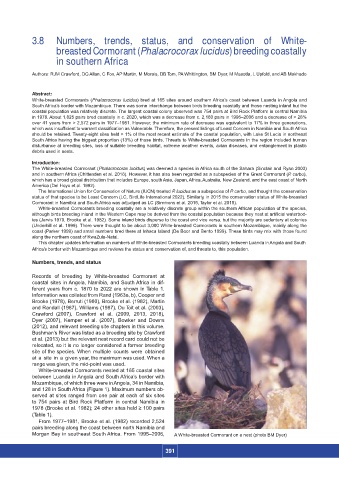
                  Morgan Bay in southeast South Africa. From 1995–2006,   A White-breasted Cormorant on a nest (photo BM Dyer)


                                                                 391

