


Page 503 - Atlas Sea Birds Ver1
P. 503
3.11  Numbers, trends, status, and conservation of Hartlaub’s Gull
                           (Chroicocephalus hartlaubii)


                  Authors: RJM Crawford, BM Dyer, AP Martin, DB Tom, L Upfold, JL Visagie, PA Whittington, and AB Makhado


                  Abstract:
                  Hartlaub’s Gulls (Chroicocephalus  hartlaubii) are endemic  to the Benguela upwelling  ecosystem, where they have bred at 67 sites
                  between Mile 4, Swakopmund, in central Namibia and estuaries in Algoa Bay, southern South Africa. The largest number observed at a
                  colony was 4,309 pairs at Robben Island in 1979. In 1990, the species’ population was thought to number about 12,000 pairs. In 2020,
                  it was about 6,000 pairs, of which 16% were in Namibia and 84% in South Africa. Hartlaub’s Gulls have a generation length (G) of 10.7
                  years, so the decrease was equivalent to c. 53% in 3G. That met criterion A1 of the International Union for Conservation of Nature for
                  classification as Vulnerable (VU). Hartlaub’s Gull was classified as VU in Namibia in 2015, but not in South Africa or overall. Further
                  monitoring to confirm an overall VU status should be undertaken, while in the interim it should be considered Near Threatened. For a VU
                  species, sites holding ≥ 10 pairs may be regarded as Important Bird and Biodiversity Areas (IBAs). In 2020, there were 24 such sites, but
                  recent information on numbers breeding was lacking for four of these areas and six other sites were in industrial or urban environments,
                  making it difficult to afford adequate protection to the gulls. Threats to Hartlaub’s Gulls include loss of suitable breeding habitat, human
                  disturbance, destruction of nests at urban sites, loss of eggs and chicks to feral predators at mainland sites and at Robben Island, and
                  pathogenic avian diseases.

                  Introduction:
                  Hartlaub’s Gulls (Chroicocephalus hartlaubii) are endemic to the Benguela upwelling ecosystem (BUS) off southwestern Africa. They were
                  mostly encountered along the coast from Cape Cross to Cape Agulhas and in Algoa Bay; they occasionally reached the Cunene River
                  to the north and vagrants were reported as far as Lake St Lucia in the east (Hockey and Crawford 2005, Simmons 2015). They were not
                  found at Ilha dos Tigres in Angola (Dyer 2007).
                     Hartlaub’s Gulls have bred at 67 sites between Mile 4, Swakopmund, in central Namibia and estuaries in Algoa Bay in southern South
                  Africa. In 1990, 27 of 48 Hartlaub’s Gull colonies were at natural habitat, including offshore islands, coastal pans, rivers, and desert,
                  and 21 were at man-made habitat, including sewage and salt works, harbours, and urban areas. Most of the sites were along the coast,
                  although one in the Namib desert was c. 20 km inland and one at a sewage works 48 km inland. Local populations of the species may
                  alternate breeding sites between seasons (Williams et al. 1990, Crawford et al. 1994, Simmons 2015). Hartlaub’s Gulls frequently bred in
                  mixed colonies with Greater Crested Terns (Thalasseus bergii) and sometimes with Grey-headed Gulls (C. cirrocephalus) (Williams et al.
                  1990). They sometimes hybridised with Grey-headed Gulls (Simmons 2015, Martin and Whittington 2024). Small numbers of Hartlaub’s
                  Gull may breed year-round but most nested between January and September (Crawford and Underhill 2003). They may double brood.
                  Pairs lay 1–3 (mean 1.8) eggs (Hockey and Crawford 2005). Of eggs laid, 27% produced young (Steele 1992), which was equivalent to a
                  breeding success of 0.49 chicks per pair.
                     Hartlaub’s Gulls fed in the nearshore marine environment, intertidally, in estuaries, and at inland fields on small fish, and marine and
                  terrestrial invertebrates. They hawked aerial insects, including those attracted to lights at night. They scavenged food at fish factories
                  and in urban environments (Hockey and Crawford 2005). They can form large flocks; a maximum count of 3,650 birds was recorded in
                  February 2008 at the Swakopmund Sewage Works (Simmons 2015).
                     Up until the latter part of the 20  century Hartlaub’s Gulls only bred west of Cape Agulhas. They were first seen in the Port Elizabeth
                                           th
                  vicinity in 1977 (Nicholls 1977)and were first recorded breeding in the Eastern Cape in 1982 (Crawford et al. 2009).They are not known to
                  have bred between Dyer Island in the Western Cape and Algoa Bay in the Eastern Cape.
                     This chapter collates estimates of numbers of Hartlaub’s Gulls breeding at different sites. It makes a preliminary assessment of the Red
                  List status of, identifies Important Bird and Biodiversity Areas (IBAs) for, and summarises threats to the species.

                  Numbers, population trend, and conservation status
                  Numbers  of Hartlaub’s Gulls estimated  to have  bred at
                  known sites in Namibia and South Africa in different years
                  from 1888–2022 are shown  in  Table  1. Information was
                  collated from Kriel et al. (1980), Williams (1987), Williams
                  et al. (1990), Steele (1992), Upfold and Underhill (2000),
                  Crawford and Underhill  (2003), du  Toit et al. (2003),
                  Paterson  (2004),  Crawford  et al. (2007,  2009),  Kemper
                  et  al.  (2007), Simmons (2015), and relevant breeding
                  site chapters in this volume. When multiple counts were
                  obtained at a site in a given year, the maximum was used.
                  When  an  estimated  range  was  given  the  mid-point  was
                  used.
                     Hartlaub’s Gull bred at 67 sites, 17 in Namibia and 50 in
                  South Africa. The largest number observed at a colony was
                  4,309 pairs at Robben Island in 1979 (Kriel et al. 1980).
                  Eleven more sites  at  some time  held >  1,000 pairs and
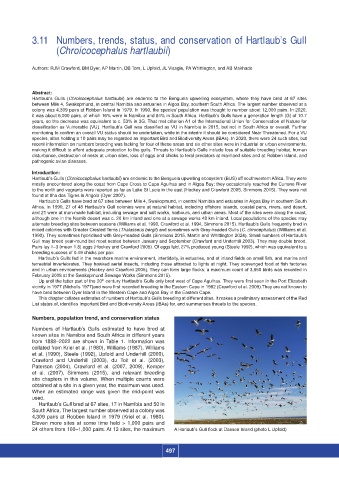
                  24 others from 100–1,000 pairs. At 13 sites, the maximum   A Harlaub’s Gull flock at Dassen Island (photo L Upfold)


                                                                 497

