


Page 507 - Atlas Sea Birds Ver1
P. 507
numbers  of a Globally  Threatened  species  (BirdLife   1987) but subsequently the nature of the evaporation pans
                  International 2020).  Guidelines for  the  application  of  IBA   changed, they became more flooded and no suitable nesting
                  criteria recommend that, to meet A1, ‘a site must support:   habitat remained (Tom et al. 2024a). Human alteration of
                  30 individuals (10 Pairs/Reproductive Units) of a species   the Orange River Estuary reduced availability of breeding
                  classified as Vulnerable’ (BirdLife International 2020).  habitat there (Anderson et al. 2003). When Hartlaub’s Gulls
                     In view of this, should the Hartlaub’s Gull be reclassified   breed in urban environments, they frequently nest on roofs
                  as  VU,  all  sites  holding  ≥  10  pairs  would  meet  the    (Steele 1992). Noise at the colony may disturb residents
                  guideline  for designation  as an IBA. Based on the most   occupying buildings and nests, feathers, and corpses may
                  recently available counts at sites there are 24 such sites,   block drains and gutters. Therefore, their nests are often
                  nine in Namibia and 15 in South Africa (Table 2). However,   cleared  from roofs (Steele  1992). Sometimes  chicks are
                  more recent counts need  to be obtained  for three sites   rescued during such removals and taken to a rescue centre
                  (Swakopmund Sewage Works, Walvis Bay Bird Paradise,   for rehabilitation and are returned to the wild. Nests near
                  North Long Island) in Namibia and one (Klein Riviers Vlei)   airfields were destroyed because of the risk of bird strikes
                  in South Africa to check that they still hold at least 10 pairs.  to air-traffic (du Toit et al. 2003).
                     Amongst other sites that met the IBA guideline, Northern   An expansion  of Lüderitz Harbour in the late 1990s,
                  Mining Pond N83 is a pond that was created by diamond   consequent  increased  activities at the harbour, and a
                  mining in the southern portion of  the  Tsau //  Khaeb   simultaneous, large increase in the numbers of feral cats
                  (formerly Sperrgebiet) National Park in southern Namibia   (Felis  catus) around  the harbour  may have  displaced
                  (Maritz 2024). The region has restricted access but it would   Hartlaub’s Gulls from Lüderitz Harbour and Shark Island
                  require the cooperation of the mining agency to ensure that   to breed at Penguin, Seal, and Halifax islands  (Tom et
                  birds breeding at the pond were not disturbed. Of the sites   al. 2024b). The joining of Marcus Island to the mainland
                  identified  in South Africa  as potential  IBAs,  at Alexander   allowed  access by mainland  predators and likely led to
                  Bay Harbour, Hartlaub’s Gulls bred on boats that were not in   cessation of breeding there by Hartlaub’s Gulls (Makhado
                  use, Sandy Point was a fish factory, Saldanha Harbour was   et  al.  2024).  It  was thought that  a  burgeoning  feral cat
                  a commercial port, and areas used for breeding at Cape   population  at  Robben Island displaced  Hartlaub’s  Gulls
                  Town waterfront and Sea Point were mainly the roofs of   from breeding  there in 1997 and 1998 (Crawford and
                  buildings. These sites are unlikely to prove effective IBAs.   Kroese 2000). Hartlaub’s Gulls were infected by highly
                  Instead, consideration should be given to designating the   pathogenic avian influenza (HPAI) (Khomenko et al. 2018)
                  other 14–18 sites as IBAs and, given that Hartlaub’s Gulls   and are likely susceptible to other avian diseases.
                  often change breeding sites, perhaps also including other   In order to secure the future of Hartlaub’s Gulls it will
                  natural sites that recently supported breeding  but not at     be important to ensure that safe and undisturbed habitat is
                  the time of their latest count.                   provided at natural breeding localities and at sewage works
                                                                    that support substantial  colonies.  The most important
                  Threats                                           colonies are at sewage works in Swakopmund and Walvis
                                                                    Bay, islands in the vicinity of Lüderitz, Possession Island,
                  Some suitable  breeding  habitat for Hartlaub’s Gulls has   islands in West Coast National Park, and Dassen, Robben
                  been lost. Nests on islands in salt and sewage works are   and Dyer islands (Table 2). Feral cats should be removed
                  vulnerable to changing water levels that may flood them or,   from Robben Island and all breeding colonies should be
                  by receding, increase their accessibility to predators. Up   protected from human  disturbance.  Measures  to prevent
                  to 75 pairs of Hartlaub’s Gulls bred at Mile 4 Saltworks,   the spread of disease between different breeding localities
                  north of Swakopmund, in the 1970s and 1980s (Williams   should be maintained.


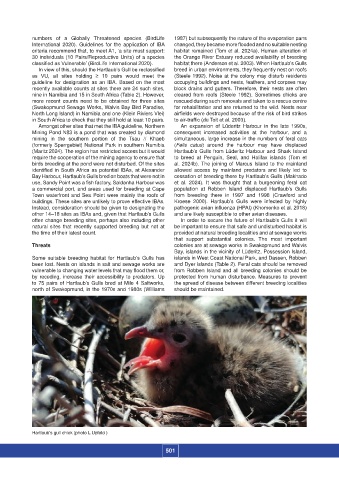
                  Hartlaub’s gull chick (photo L Upfold )


                                                                 501

