


Page 517 - Atlas Sea Birds Ver1
P. 517
3.12  Numbers,  trends, status, and conservation of  Grey-headed
                           Gull (Chroicocephalus cirrocephalus) breeding coastally in
                           southern Africa


                  Authors: RJM Crawford, AP Martin, C Fox, DB Tom, PA Whittington, BM Dyer, and AB Makhado


                  Abstract:
                  In southern Africa, Grey-headed Gulls (Chroicocephalus cirrocephalus) bred at mesic inland and coastal sites. Although wide dispersal
                  was observed, there was no substantial movement of birds between inland and coastal breeding sites. However, there was longshore
                  movement of birds in KwaZulu-Natal. Grey-headed Gulls bred at 29 coastal sites, five in Namibia and 24 in South Africa, where between
                  1970 and 2022 the population fluctuated around a level of c. 1,130 pairs. As with the global population, the southern African coastal
                  population was considered to be of Least Concern. However, it was heavily dependent on colonies in the Swartkops and Coega estuaries
                  in Algoa Bay and at Lake St Lucia being sustained.The largest coastal colony observed was of c. 1,500 pairs at Lake St Lucia in 1992.

                  Introduction:
                  The Grey-headed Gull (Chroicocephalus cirrocephalus) breeds in Africa south of the Sahara, Madagascar, and South America (coastal
                  Ecuador and Peru, eastern and coastal Brazil, and Argentina inland to Paraguay) (BirdLife International 2022). Two subspecies are
                  recognised: C. c. cirrocephalus in South America and C. c. poiocephalus in Africa and Madagascar (Del Hoyo et al. 1996). In 1996, the
                  species’ overall population was estimated to be under 50,000 pairs, with several colonies > 2,000 pairs in Senegal, Kenya, and Tanzania
                  but probably < 10,000 pairs in east South America (Del Hoyo et al. 1996). In 2022, it was considered to be of Least Concern because of
                  its wide distribution and large, stable population (BirdLife International 2022).
                     In southern Africa, Grey-headed Gulls are distributed in the mesic interior and around the coast, wandering into drier areas when
                  water is available (Crawford and Hockey 2005). In 1999, the species’ southern African population numbered c. 2,000 pairs and had been
                  recorded breeding at 67 sites in Namibia, Botswana, Zimbabwe, South Africa, and Mozambique (Brooke et al. 1999). The inland breeding
                  was mostly at shallow wetlands in the east, especially in Gauteng (Underhill et al. 1999). In South Africa, numbers of Grey-headed Gull
                  increased in Gauteng, Eastern Cape and, to a lesser extent, Western Cape in the latter part of the 20  century (McInnes and Allan 2011).
                                                                                         th
                  Brooke et al. (1999) noted that > 1,000 pairs bred in Gauteng; c. 2,400 pairs bred there in 2004 (McInnes and Allan 2011). Grey-headed
                  Gulls were present in the Port Elizabeth area in 1951 but were considered uncommon there until the late 1960s (Skead 1967). The first
                  records of breeding by this species in the Eastern Cape were at Fishwater Flats in 1979 (Hosten 1981) and at Redhouse Saltpan in 1982
                  (Randall and Hosten 1983). Both these sites are in the Swartkops River valley. By 1990, that valley held 95 pairs and in 2006 it hosted
                  608 pairs of Grey-headed Gull (Crawford et al. 2009).
                     Grey-headed Gulls banded at Benoni in Gauteng showed wide dispersal, moving to Mozambique, Zimbabwe, Zambia, Botswana,
                  Angola, Namibia, and all South African provinces (Underhill et al. 1999). However, 67% of recoveries of chicks banded in Gauteng were
                  made in Gauteng, when the birds were on average two years old (McInnes and Allan 2011). Similarly, most recoveries of chicks banded
                  in North West, KwaZulu-Natal (KZN), and Eastern Cape provinces were in their natal provinces (McInnes and Allan 2011). Re-sightings
                  of banded birds provided little evidence for regular movements of substantial numbers of birds between Gauteng and the KZN coast but
                  suggested regular longshore movements of adults between Lake St Lucia and Durban in KZN (McInnes and Allan 2011). Grey-headed
                  Gulls often show fidelity to breeding sites. In northeast KZN, 55 breeding events took place at five sites (Bowker and Downs 2012).
                  However, they sometimes change their breeding areas (Crawford et al. 2009, Fox et al. 2024).
                     This chapter collates records of numbers breeding around the shores of Namibia and South Africa, where it nests between the Cunene
                  River (Paterson 2004) and northeast KZN (Berruti 1980, McInnes and Allan 2011, Fox et al. 2024), in order to examine trends in the
                  coastal portion of the southern African population, which may be relatively discrete. A study of colour-banded birds was suggested as a
                  means to further elucidate movements of birds between different components of the southern African population (Underhill et al. 1999).

                  Numbers and population trend

                  Records of breeding by Grey-headed Gulls at coastal sites
                  in Namibia and South Africa between 1865 and 2022 were
                  obtained from Berruti (1980), Brooke et al. (1999), Kemper
                  et  al. (2007), Crawford et  al. (2009), McInnes and Allan
                  (2011), Bowker and Downs (2012), unpublished records of
                  Namibia’s Ministry of Fisheries and Marine Resources and
                  South Africa’s Department of Forestry, Fisheries and the
                  Environment, and relevant breeding  site chapters in this
                  volume. They are shown in Table 1 and indicate that Grey-
                  headed Gulls bred at 29 coastal sites, five in Namibia and
                  24 in South Africa. Along the lower Swartkops River they
                  bred at six sub-sites and in Lake St Lucia at nine sub-sites
                  (Figure 1). The species is not recorded to have bred on
                  Angola’s coastline (Morais 2024).
                     Brooke  et al. (1999)  considered the entire  southern
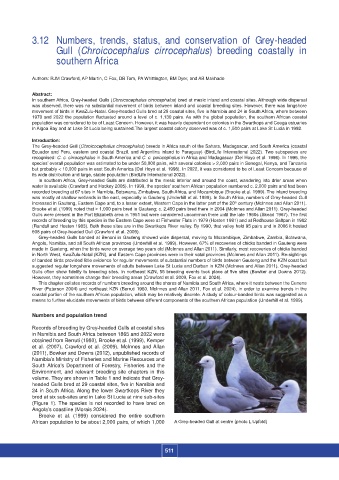
                  African population to be about 2,000 pairs, of which 1,000   A Grey-headed Gull at centre (photo L Upfold)


                                                                 511

