


Page 519 - Atlas Sea Birds Ver1
P. 519
pairs  bred  in  Gauteng. Records  listed  by Brooke  et al.
                  (1999) suggested that up to 1,434 pairs had bred coastally   Important Bird and Biodiversity Areas
                  (Table  2). Sums of maxima at sites from information
                  collated  for coastal  sites indicated  that of the order  of   Important Bird and Biodiversity Areas (IBAs) are identified
                  1,260 pairs, 657 pairs, 1,670 pairs, 1,391 pairs, and 685   through the use of specific criteria. Regional IBA criterion
                  pairs may have bred coastally in the 1970s, 1980s, 1990s,   B3 applies to sites ‘known or thought to hold, on a regular
                  2000s, and 2010s, respectively. If gulls moved sites within   basis, >= 1% of a biogeographic or other distinct population
                  periods,  these sums of maxima likely  overestimated   of a congregatory  waterbird, breeding  seabird or other
                  abundance. Alternatively, counts not made, or made out   species’  (BirdLife  International  2020).  If  Grey-headed
                  of peak breeding, may have resulted in underestimation of   Gulls that breed around the coasts of Namibia and South
                  numbers. The five decadal totals showed large fluctuations   Africa are relatively distinct from birds that nest at inland
                  but no long-term trend and averaged 1,133 pairs. The sum   waterbodies  in southern  Africa, and if this criterion is
                  of  maxima  for  the  most  recent  five-year  period  (2018–  applied to a population size of 1,000 pairs (the most recent
                  2022) was 911 pairs (Table 2) but omitted some sites. The   estimate for  this  populaion),  then  sites regularly holding
                  sum of the most recent counts made at sites was 999 pairs   ≥ 10 pairs would qualify as regional IBAs. In interpreting
                  (Table 2) but birds may have bred at multiple sites. Counts   ‘regular’ presence, it is important to bear in mind that
                  made between 2010 and 2020 contributed 93% of the sum   Grey-headed Gulls may change their site of breeding. The
                  of most recent counts, so only 7% of that total is from older   most recent counts at sites indicated that Walvis Bay Bird
                  counts. The coastal population of Namibia and South Africa   Paradise, Paarl Sewage Works,  Theewaterskloof Dam,
                  was probably c. 1,130 pairs, which was the approximate   Swartkops River valley, Coega River Saltpans, and Lake St
                  mean of the five decadal estimates.               Lucia all held > 1% of, and may qualify as regional IBAs for,
                     Maxima observed at sites ranged from one pair at each   the coastal population (Table 2). However, the most recent
                  of seven sites to a colony of 1,500 pairs at Lane Island,   counts at Walvis Bay Bird Paradise and Theewaterskloof
                  Lake St  Lucia in 1992 (Table 1).  The Swartkops River   Dam were made in 1984 and 2004, respectively, and so do
                  valley held 834 pairs in 2022, Walvis Bay Bird Paradise c.   not provide up-to-date information. Of the other 23 sites,
                  500 pairs in 1984, the Coega River Saltpans 436 pairs in   ony Rietvlei (11 pairs in 1995) held ≥ 10 pairs (Table 1).
                  2008, and Bird Island at Lake St Lucia 100 pairs in 2001.
                  Although counts of nests at Lake St Lucia from 2010–2022   Conservation issues
                  were lower than in some earlier years, four counts of Grey-
                  headed  Gulls made there between  2014  and 2020  had   The population of Grey-headed Gulls breeding around the
                  values of from 1,232–2,866 birds. Applying a relationship   coasts of Namibia and South Africa numbers c. 1,000 pairs
                  between counts of numbers of birds and counts of nests   and is stable. Therefore, from a conservation perspective
                  derived for Grey-headed Gulls at Lake St Lucia (Fox et al.   it is of Least Concern (IUCN 2022). However, it is heavily
                  2024), the counts of birds suggested that Lake St Lucia’s   dependent on the three large, eastern aggregations of the
                  breeding population was 423–893 pairs from 2014–2022.   species  at the Swartkops  and  Coega  estuaries  entering
                  The largest colonies  observed  between  Walvis Bay in   Algoa Bay and at Lake St Lucia. Colonies at these sites
                  central Namibia and Algoa Bay at the south of South Africa   are reliant on availability of suitable, predator-free nesting
                  were 40 pairs at Theewaterskloof Dam in 2004, 25 pairs at   habitat, which may be influenced by floods, droughts, and
                  Paarl Sewage Works in both 1993 and 1994, and 23 pairs   management  practices. Most saltpans  in the Swartkops
                  at De Hoop Vlei in 1961.                          River valley fall within the Nelson Mandela Bay Metropolitan
                                                                    Open Space System and are located on land leased from
                                                                    the Nelson Mandela Bay Municipality. The Redhouse pan
                                                                    falls within the Zwartkops Valley Local Nature Reserve. The
                                                                    Coega Saltpans are within the Coega Special Economic
                                                                    Zone. The Coega Open Space Management Plan protects
                                                                    areas worthy of  conservation from  development (Martin
                                                                    and Whittington  2024). Lake St  Lucia falls within the
                                                                    iSimangaliso Wetland Park.
                                                                      It  is thought that  Caracal (Caracal caracal)  or  Black-
                                                                    backed Jackal (Canis mesomelas)  preyed on the gull
                                                                    colony at the Coega River Saltpans causing it to relocate to
                                                                    the Swartkops River valley (Martin and Whittington 2024).
                                                                    Grey-headed  Gulls  were  infected  with  highly  pathogenic
                                                                    avian influenza (HPAI) in western South Africa and Uganda
                                                                    in 2017 and 2018 (Khomenko  et al. 2018)  and may be
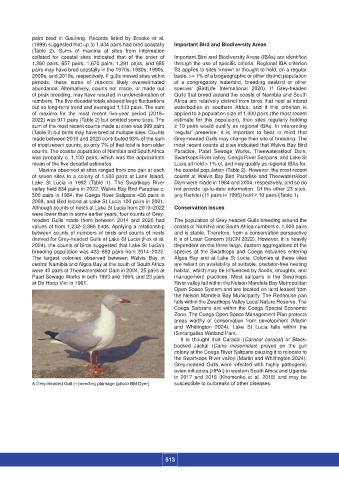
                  A Grey-headed Gull in breeding plumage (photo BM Dyer)  susceptible to outbreaks of other diseases.


                                                                 513

