


Page 751 - Atlas of Creation Volume 1
P. 751
Harun Yahya


                 Another of the misleading methods that evolutionists employ on the issue of natural selection is their ef-
             fort to present this mechanism as conscious. However, natural selection has no consciousness. It does not
             possess a will that can decide what is good and what is bad for living things. As a result, one cannot explain

             biological systems and organs that possess the feature of "irreducible complexity" by natural selection.
             These systems and organs are composed of a great number of parts cooperating together, and are of no use if
             even one of these parts is missing or defective. (For example, the human eye does not function unless it ex-
             ists with all its components intact). Therefore, the will that brings all these parts together should be able to
             foresee the future and aim directly at the advantage that is to be acquired at the final stage. Since natural se-

             lection has no consciousness or will, it can do no such thing. This fact, which demolishes the foundations of
             the theory of evolution, also worried Darwin, who wrote: "If it could be demonstrated that any complex
             organ existed, which could not possibly have been formed by numerous, successive, slight modifica-

             tions, my theory would absolutely break down."           17
                 Through natural selection, only the disfigured, weak, or unfit individuals of a species are selected out.
             New species, new genetic information, or new organs cannot be produced. That is, living things cannot
             evolve through natural selection. Darwin accepted this reality by saying: "Natural selection can do nothing
             until favourable variations chance to occur".        18  This is why neo-Darwinism has had to elevate mutations

             next to natural selection as the "cause of beneficial changes". However as we shall see, mutations can only be
             "the cause for harmful changes".


                 Mutations

                 Mutations are defined as breaks or replacements taking place in the DNA molecule, which is found in
             the nuclei of the cells of a living organism and which contains all its genetic information. These breaks or re-

             placements are the result of external effects such as radiation or chemical action. Every mutation is an "acci-
             dent" and either damages the nucleotides making up the DNA or changes their locations. Most of the time,
             they cause so much damage and modification that the cell cannot repair them.
                 Mutation, which evolutionists frequently hide behind, is not a magic wand that transforms living or-

             ganisms into a more advanced and perfect form. The direct effect of mutations is harmful. The changes ef-
             fected by mutations can only be like those experienced by people in Hiroshima, Nagasaki, and Chernobyl:
             that is, death, disability, and sickness…
                 The reason for this is very simple: DNA has a very complex structure, and random effects can only dam-

             age the organism. B.G. Ranganathan states:
                 First, genuine mutations are very rare in nature. Secondly, most mutations are harmful since they are random,
                 rather than orderly changes in the structure of genes; any random change in a highly ordered system will be
                 for the worse, not for the better. For example, if an earthquake were to shake a highly ordered structure such as
                 a building, there would be a random change in the framework of the building which, in all probability, would
                 not be an improvement.    19

                 Not surprisingly, no useful mutation has been so far observed. All mutations have proved
             to be harmful. The evolutionist scientist Warren Weaver comments on the report prepared by the
             Committee on Genetic Effects of Atomic Radiation, which had been formed to investigate mu-
             tations that might have been caused by the nuclear weapons used in the Second World War:

                 Many will be puzzled about the statement that practically all known mutant genes are harmful.
                 For mutations are a necessary part of the process of evolution. How can
                 a good effect - evolution to higher forms of life - results from muta-
                 tions practically all of which are harmful?   20


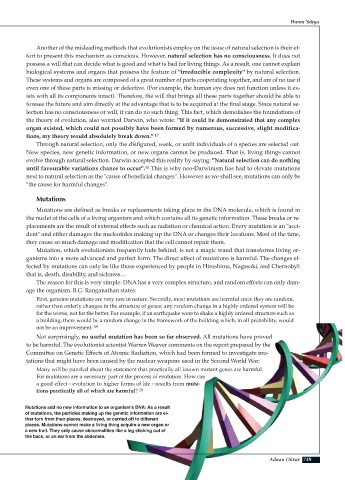
            Mutations add no new information to an organism's DNA: As a result
            of mutations, the particles making up the genetic information are ei-
            ther torn from their places, destroyed, or carried off to different
            places. Mutations cannot make a living thing acquire a new organ or
            a new trait. They only cause abnormalities like a leg sticking out of
            the back, or an ear from the abdomen.


                                                                                                                          Adnan Oktar 749

