


Page 756 - Atlas of Creation Volume 1
P. 756
The Miracle of Creation That Confounds Evolution


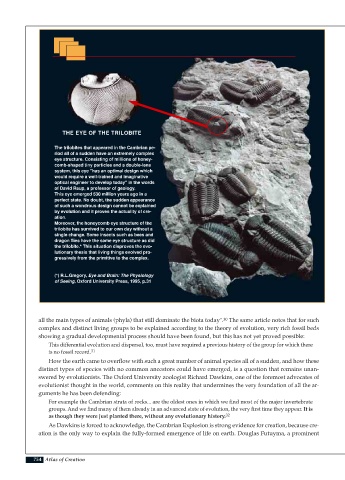
                             THE EYE OF THE TRILOBITE


                         The trilobites that appeared in the Cambrian pe-
                         riod all of a sudden have an extremely complex
                         eye structure. Consisting of millions of honey-
                         comb-shaped tiny particles and a double-lens
                         system, this eye "has an optimal design which
                         would require a well-trained and imaginative
                         optical engineer to develop today" in the words
                         of David Raup, a professor of geology.
                         This eye emerged 530 million years ago in a
                         perfect state. No doubt, the sudden appearance
                         of such a wondrous design cannot be explained
                         by evolution and it proves the actuality of cre-
                         ation.
                         Moreover, the honeycomb eye structure of the
                         trilobite has survived to our own day without a
                         single change. Some insects such as bees and
                         dragon flies have the same eye structure as did
                         the trilobite.* This situation disproves the evo-
                         lutionary thesis that living things evolved pro-
                         gressively from the primitive to the complex.


                         (*) R.L.Gregory, Eye and Brain: The Physiology
                         of Seeing, Oxford University Press, 1995, p.31


                  all the main types of animals (phyla) that still dominate the biota today". The same article notes that for such
                                                                                                     30
                  complex and distinct living groups to be explained according to the theory of evolution, very rich fossil beds
                  showing a gradual developmental process should have been found, but this has not yet proved possible:

                       This differential evolution and dispersal, too, must have required a previous history of the group for which there
                       is no fossil record. 31
                       How the earth came to overflow with such a great number of animal species all of a sudden, and how these

                  distinct types of species with no common ancestors could have emerged, is a question that remains unan-
                  swered by evolutionists. The Oxford University zoologist Richard Dawkins, one of the foremost advocates of
                  evolutionist thought in the world, comments on this reality that undermines the very foundation of all the ar-
                  guments he has been defending:

                       For example the Cambrian strata of rocks... are the oldest ones in which we find most of the major invertebrate
                       groups. And we find many of them already in an advanced state of evolution, the very first time they appear. It is
                       as though they were just planted there, without any evolutionary history.      32
                       As Dawkins is forced to acknowledge, the Cambrian Explosion is strong evidence for creation, because cre-

                  ation is the only way to explain the fully-formed emergence of life on earth. Douglas Futuyma, a prominent


                754 Atlas of Creation

