


Page 757 - Atlas of Creation Volume 1
P. 757
Harun Yahya


             evolutionist biologist admits this fact: "Organisms either appeared on the earth fully developed or they did
             not. If they did not, they must have developed from pre-existing species by some process of modification. If
             they did appear in a fully developed state, they must indeed have been created by some omnipotent in-

             telligence."  33  Darwin himself recognised the possibility of this when he wrote: "If numerous species, be-
             longing to the same genera or families, have really started into life all at once, the fact would be fatal to the
             theory of descent with slow modification through natural selection."              34  The Cambrian Period is nothing
             more or less than Darwin's "fatal stroke". This is why the Swedish evolutionist paleoanthropologist Stefan
             Bengtson, who confesses the lack of transitional links while describing the Cambrian Age, makes the follow-

             ing comment: "Baffling (and embarrasing) to Darwin, this event still dazzles us".           35
                 Obviously, the fossil record indicates that living things did not evolve from primitive to the advanced
             forms, but instead emerged all of a sudden and in a perfect state. In short, living beings did not come into ex-

             istence by evolution, they were created.

                 Molecular Comparisons Deepen Evolution's Cambrian Impasse


                 Another fact that puts evolutionists into a deep quandary about the Cambrian Explosion is the compar-
             isons between different living taxa. The results of these comparisons reveal that animal taxa considered to be
             "close relatives" by evolutionists until quite recently, are genetically very different, which puts the "interme-
             diate form" hypothesis, that only exists theoretically, into an even greater quandary. An article published in

             the Proceedings of the National Academy of Sciences in 2000 reports that DNA analyses have displaced taxa
             that used to be considered "intermediate forms" in the past:
                 DNA sequence analysis dictates new interpretation of phylogenic trees. Taxa that were once thought to repre-
                 sent successive grades of complexity at the base of the metazoan tree are being displaced to much higher posi-
                 tions inside the tree. This leaves no evolutionary "intermediates" and forces us to rethink the genesis of
                 bilaterian complexity... 36

                 In the same article, evolutionist writers note that some taxa which were considered "intermediate" be-
             tween groups such as sponges, cnidarians and ctenophores can no longer be considered as such because of
             new genetic findings, and that they have "lost hope" of constructing such evolutionary family trees:

                 The new molecular based phylogeny has several important implications. Foremost among them is the disap-
                 pearance of "intermediate" taxa between sponges, cnidarians, ctenophores, and the last common ancestor of
                 bilaterians or "Urbilateria." ...A corollary is that we have a major gap in the stem leading to the Urbilataria. We
                 have lost the hope, so common in older evolutionary reasoning, of reconstructing the morphology of the
                 "coelomate ancestor" through a scenario involving successive grades of increasing complexity based on the
                 anatomy of extant "primitive"lineages.   37


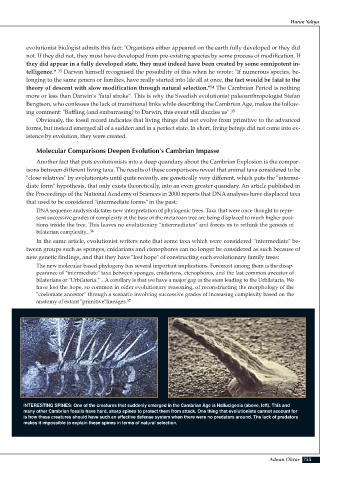
            INTERESTING SPINES: One of the creatures that suddenly emerged in the Cambrian Age is Hallucigenia (above, left). This and
            many other Cambrian fossils have hard, sharp spines to protect them from attack. One thing that evolutionists cannot account for
            is how these creatures should have such an effective defense system when there were no predators around. The lack of predators
            makes it impossible to explain these spines in terms of natural selection.


                                                                                                                          Adnan Oktar    755

