


Page 759 - Atlas of Creation Volume 1
P. 759
Harun Yahya


             entific circles until the end of the 1930's. The coelacanth was presented as a genuine transitional form that
             proved the evolutionary transition from water to land.
                 However on December 22, 1938, a very interesting discovery was made in the Indian Ocean. A living

             member of the coelacanth family, previously presented as a transitional form that had become extinct sev-
             enty million years ago, was caught! The discovery of a "living" prototype of the coelacanth undoubtedly
             gave evolutionists a severe shock. The evolutionist paleontologist J.L.B. Smith said that "If I'd met a dinosaur
             in the street I wouldn't have been more astonished".         41  In the years to come, 200 coelacanths were caught
             many times in different parts of the world.

                 Living coelacanths revealed how far the evolutionists could go in making up their imaginary scenarios.
             Contrary to what had been claimed, coelacanths had neither a primitive lung nor a large brain. The organ
             that evolutionist researchers had proposed as a primitive lung turned out to be nothing but a lipid pouch.               42

             Furthermore, the coelacanth, which was introduced as "a reptile candidate getting prepared to pass from sea
             to land", was in reality a fish that lived in the depths of the oceans and never approached nearer than 180 me-
             tres from the surface.  43


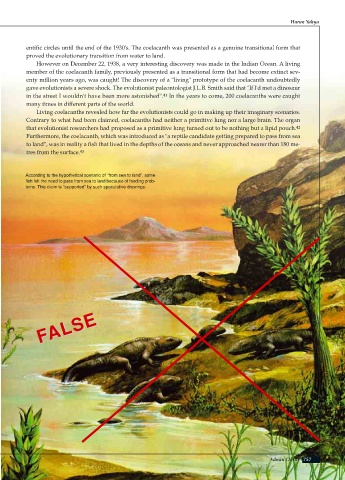
             According to the hypothetical scenario of "from sea to land", some
             fish felt the need to pass from sea to land because of feeding prob-
             lems. This claim is "supported" by such speculative drawings.


                   FALSE
                   FALSE


                                                                                                                          Adnan Oktar    757

