


Page 764 - Atlas of Creation Volume 1
P. 764
Bird Feathers: The Design That Evolution
                                                                         Fails to Explain


                             he theory of evolution, which claims that             among vertebrates".    2
                             birds evolved from reptiles, is unable to ex-          There is no fossil evidence to prove that bird feath-
                      T plain the huge differences between these two               ers evolved from reptile scales. On the contrary,
                     different living classes. In terms of such features as        "feathers appear suddenly in the fossil record, as
                     their skeleton structure, lung systems, and warm-             an'undeniably unique' character distinguishing
                     blooded metabolism, birds are very different from             birds" as Prof. Brush states. Besides, in reptiles, no
                                                                                                                   3
                     reptiles. Another trait that poses an insurmountable          epidermal structure has yet been detected that pro-
                     gap between birds and reptiles is the feathers of             vides an origin for bird feathers.  4
                     birds which have a form entirely peculiar to them.             In 1996, paleontologists made abuzz about fossils
                      The bodies of reptiles are covered with scales,              of a so-called feathered dinosaur, called
                     whereas the bodies of birds are covered with feath-           Sinosauropteryx. However, in 1997, it was revealed
                     ers. Since evolutionists consider reptiles the ances-         that these fossils had nothing to do with birds and
                     tor of birds, they are obliged to claim that bird             that they were not feathers of today’s birds.    5
                     feathers have evolved from reptile scales. However,            On the other hand, when we examine bird feathers
                     there is no similarity between scales and feathers.           closely, we come across a very complex design that
                      A professor of physiology and neurobiology from              cannot be explained by any evolutionary process.
                     the University of Connecticut, A.H. Brush, accepts            The famous ornithologist Alan Feduccia states that
                                       this reality although he is an evolu-       "every feature of them has aerodynamic functions.
                                           tionist: "Every feature from gene       They are extremely light, have the ability to lift up
                                               structure and organization, to      which increases in lower speeds, and may return to
                                                 development, morphogene-          their previous position very easily". Then he contin-
                                                  sis and tissue organiza-         ues, "I cannot really understand how an organ per-
                                                    tion is different (in          fectly designed for flight may have emerged for
                                                     feathers and scales)."    1   another need at the beginning".     6
                                                      Moreover, Prof. Brush         The design of feathers also compelled Charles
                                                       examines the protein        Darwin ponder them. Moreover, the perfect aesthet-
                                                          structure of bird        ics of the peafowl's feathers had made him "sick"
                                                             feathers and ar-      (his own words). In a letter he wrote to Asa Gray on
                                                               gues that it is     April 3, 1860, he said "I remember well the time when
                                                                    "unique        the thought of the eye made me cold all over, but I
                                                                                   have got over this stage of complaint..."And then
                                                                                   continued: "...and now trifling particulars of struc-
                                                                                   ture often make me very uncomfortable. The sight of
                                                                                   a feather in a peacock's tail, whenever I gaze at it,
                                                                                   makes me sick!"    7


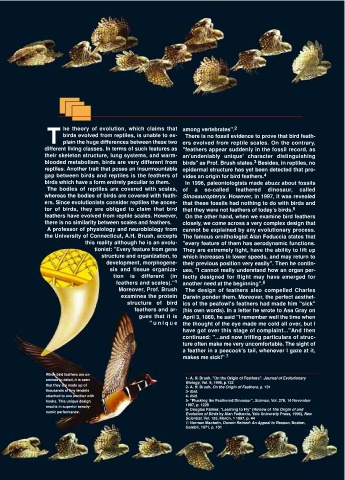
                      When bird feathers are ex-
                                                                                    1- A. H. Brush, "On the Origin of Feathers". Journal of Evolutionary
                      amined in detail, it is seen
                                                                                    Biology, Vol. 9, 1996, p.132
                      that they are made up of
                                                                                    2- A. H. Brush, On the Origin of Feathers, p. 131
                      thousands of tiny tendrils                                    3- Ibid.
                      attached to one another with                                  4- Ibid.
                      hooks. This unique design                                     5- "Plucking the Feathered Dinosaur", Science, Vol. 278, 14 November
                                                                                    1997, p. 1229
                      results in superior aerody-
                                                                                    6- Douglas Palmer, "Learning to Fly" (Review of The Origin of and
                      namic performance.
                                                                                    Evolution of Birds by Alan Feduccia, Yale University Press, 1996), New
                                                                                    Scientist, Vol. 153, March, 1 1997, p. 44
                                                                                    7- Norman Macbeth, Darwin Retried: An Appeal to Reason, Boston,
                                                                                    Gambit, 1971, p. 101

