


Page 769 - Atlas of Creation Volume 1
P. 769
What Is the Origin of Flies?


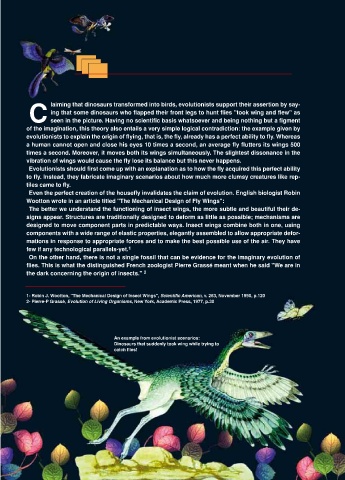
                        laiming that dinosaurs transformed into birds, evolutionists support their assertion by say-

                        ing that some dinosaurs who flapped their front legs to hunt flies "took wing and flew" as
              C seen in the picture. Having no scientific basis whatsoever and being nothing but a figment
             of the imagination, this theory also entails a very simple logical contradiction: the example given by
             evolutionists to explain the origin of flying, that is, the fly, already has a perfect ability to fly. Whereas

             a human cannot open and close his eyes 10 times a second, an average fly flutters its wings 500
             times a second. Moreover, it moves both its wings simultaneously. The slightest dissonance in the
             vibration of wings would cause the fly lose its balance but this never happens.
              Evolutionists should first come up with an explanation as to how the fly acquired this perfect ability

             to fly. Instead, they fabricate imaginary scenarios about how much more clumsy creatures like rep-
             tiles came to fly.
              Even the perfect creation of the housefly invalidates the claim of evolution. English biologist Robin
             Wootton wrote in an article titled "The Mechanical Design of Fly Wings":

              The better we understand the functioning of insect wings, the more subtle and beautiful their de-
             signs appear. Structures are traditionally designed to deform as little as possible; mechanisms are
             designed to move component parts in predictable ways. Insect wings combine both in one, using
             components with a wide range of elastic properties, elegantly assembled to allow appropriate defor-

             mations in response to appropriate forces and to make the best possible use of the air. They have
             few if any technological parallels-yet.       1
              On the other hand, there is not a single fossil that can be evidence for the imaginary evolution of
             flies. This is what the distinguished French zoologist Pierre Grassé meant when he said "We are in

             the dark concerning the origin of insects."          2


             1- Robin J. Wootton, "The Mechanical Design of Insect Wings", Scientific American, v. 263, November 1990, p.120
             2- Pierre-P Grassé, Evolution of Living Organisms, New York, Academic Press, 1977, p.30


                                                    An example from evolutionist scenarios:
                                                    Dinosaurs that suddenly took wing while trying to
                                                    catch flies!

