


Page 770 - Atlas of Creation Volume 1
P. 770
The Origin of Mammals


                       As we have stated before, the theory of evolution proposes that some imaginary creatures that came out of
                  the sea turned into reptiles, and that birds evolved from reptiles. According to the same scenario, reptiles are
                  the ancestors not only of birds but also of mammals. However, there are great differences between these two
                  classes. Mammals are warm-blooded animals (this means they can generate their own heat and maintain it at a

                  steady level), they give live birth, they suckle their young, and their bodies are covered in fur or hair. Reptiles,
                  on the other hand, are cold-blooded (i.e., they cannot generate heat, and their body temperature changes ac-
                  cording to the external temperature), they lay eggs, they do not suckle their young, and their bodies are cov-

                  ered in scales.
                       One example of the structural barriers between reptiles and mammals is their jaw structure. Mammal jaws
                  consist of only one mandibular bone containing the teeth. In reptiles, there are three little bones on both sides
                  of the mandible. Another basic difference is that all mammals have three bones in their middle ear (hammer,
                  anvil, and stirrup). Reptiles have but a single bone in the middle ear. Evolutionists claim that the reptile jaw

                  and middle ear gradually evolved into the mammal jaw and ear. The question of how an ear with a single bone
                  evolved into one with three bones, and how the sense of hearing kept on functioning in the meantime can
                  never be explained. Not surprisingly, not one single fossil linking reptiles and mammals has been found. This

                  is why evolutionist science writer Roger Lewin was forced to say, "The transition to the first mammal, which
                  probably happened in just one or, at most, two lineages, is still an enigma".            59
                       George Gaylord Simpson, one of the most popular evolutionary authorities and a founder of the neo-
                  Darwinist theory, makes the following comment regarding this perplexing difficulty for evolutionists:

                       The most puzzling event in the history of life on earth is the change from the Mesozoic, the Age of Reptiles, to the
                       Age of Mammals. It is as if the curtain were rung down suddenly on the stage where all the leading roles were taken
                       by reptiles, especially dinosaurs, in great numbers and bewildering variety, and rose again immediately to reveal the
                       same setting but an entirely new cast, a cast in which the dinosaurs do not appear at all, other reptiles are supernu-
                       meraries, and all the leading parts are played by mammals of sorts barely hinted at in the preceding acts.   60
                       Furthermore, when mammals suddenly made their appearance, they were already very different from

                  each other. Such dissimilar animals as bats, horses, mice, and whales are all mammals, and they all emerged
                  during the same geological period. Establishing an evolutionary relationship among them is impossible even
                  by the broadest stretch of the imagination. The evolutionist zoologist R. Eric Lombard makes this point in an
                  article that appeared in the leading journal Evolution:

                       Those searching for specific information useful in constructing phylogenies of mammalian taxa will be dis-
                       appointed.  61
                       All of these demonstrate that all living beings appeared on earth suddenly and fully formed, without any
                                                                  Bats
                  evolutionary process. This is concrete evidence of the fact that they were created. Evolutionists, however, try to
                  interpret the fact that living species came into existence in a particular order as an indication of evolution. Yet
                  the sequence by which living things emerged is the "order of creation", since it is not possible to speak of an
                  evolutionary process. With a superior and flawless creation, oceans and then lands were filled with living
                  things and finally man was created.

                       Contrary to the "ape man" story that is imposed on the masses with intense media propaganda, man also
                  emerged on earth suddenly and fully formed.


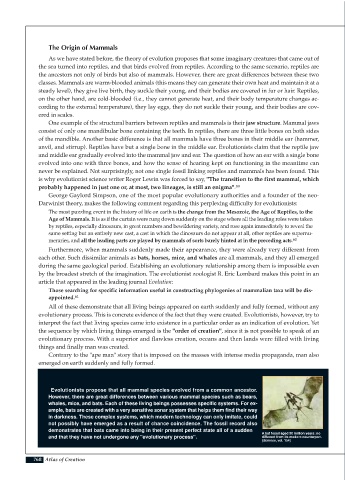
                        Evolutionists propose that all mammal species evolved from a common ancestor.
                       However, there are great differences between various mammal species such as bears,
                       whales, mice, and bats. Each of these living beings possesses specific systems. For ex-
                       ample, bats are created with a very sensitive sonar system that helps them find their way
                       in darkness. These complex systems, which modern technology can only imitate, could
                       not possibly have emerged as a result of chance coincidence. The fossil record also
                       demonstrates that bats came into being in their present perfect state all of a sudden
                                                                                                                       A bat fossil aged 50 million years: no
                       and that they have not undergone any "evolutionary process".                                    different from its modern counterpart.
                                                                                                                       (Science, vol. 154)


                768 Atlas of Creation

