


Page 773 - Atlas of Creation Volume 1
P. 773
e
                                                   TheDent Reconstructions Based   on the Same Skull                               Harun Yahya
                                                   r
                                                    i
                                                    f
                                                    fer


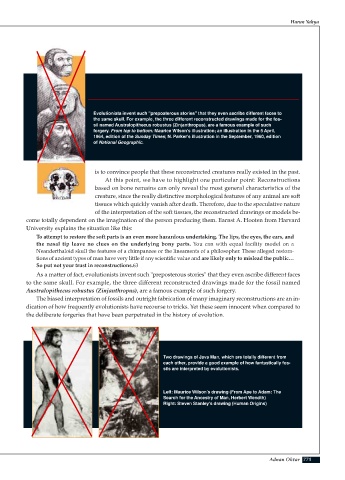
                                           Evolutionists invent such "preposterous stories" that they even ascribe different faces to
                                           the same skull. For example, the three different reconstructed drawings made for the fos-
                                           sil named Australopithecus robustus (Zinjanthropus), are a famous example of such
                                           forgery. From top to bottom: Maurice Wilson's illustration; an illustration in the 5 April,
                                           1964, edition of the Sunday Times; N. Parker's illustration in the September, 1960, edition
                                           of National Geographic.


                                            is to convince people that these reconstructed creatures really existed in the past.
                                                At this point, we have to highlight one particular point: Reconstructions
                                            based on bone remains can only reveal the most general characteristics of the
                                            creature, since the really distinctive morphological features of any animal are soft
                                            tissues which quickly vanish after death. Therefore, due to the speculative nature

                                            of the interpretation of the soft tissues, the reconstructed drawings or models be-
             come totally dependent on the imagination of the person producing them. Earnst A. Hooten from Harvard
             University explains the situation like this:

                 To attempt to restore the soft parts is an even more hazardous undertaking. The lips, the eyes, the ears, and
                 the nasal tip leave no clues on the underlying bony parts. You can with equal facility model on a
                 Neanderthaloid skull the features of a chimpanzee or the lineaments of a philosopher. These alleged restora-
                 tions of ancient types of man have very little if any scientific value and are likely only to mislead the public…
                 So put not your trust in reconstructions.63
                 As a matter of fact, evolutionists invent such "preposterous stories" that they even ascribe different faces
             to the same skull. For example, the three different reconstructed drawings made for the fossil named

             Australopithecus robustus (Zinjanthropus), are a famous example of such forgery.
                 The biased interpretation of fossils and outright fabrication of many imaginary reconstructions are an in-
             dication of how frequently evolutionists have recourse to tricks. Yet these seem innocent when compared to
             the deliberate forgeries that have been perpetrated in the history of evolution.


                                                                          Two drawings of Java Man, which are totally different from
                                                                          each other, provide a good example of how fantastically fos-
                                                                          sils are interpreted by evolutionists.


                                                                          Left: Maurice Wilson's drawing (From Ape to Adam: The
                                                                          Search for the Ancestry of Man, Herbert Wendth)
                                                                          Right: Steven Stanley's drawing (Human Origins)


                                                                                                                          Adnan Oktar    771

