


Page 776 - Atlas of Creation Volume 1
P. 776
was hurriedly removed from the British Museum where it had been displayed
                  for more than 40 years.


                       Nebraska Man: A Pig's Tooth

                       In 1922, Henry Fairfield Osborn, the director of the American
                  Museum of Natural History, declared that he had found a fossil
                  molar tooth belonging to the Pliocene period in western Nebraska

                  near Snake Brook. This tooth allegedly bore common characteris-
                  tics of both man and ape. An extensive scientific debate began sur-
                  rounding this fossil, which came to be called "Nebraska man", in which

                  some interpreted this tooth as belonging to Pithecanthropus erectus, while
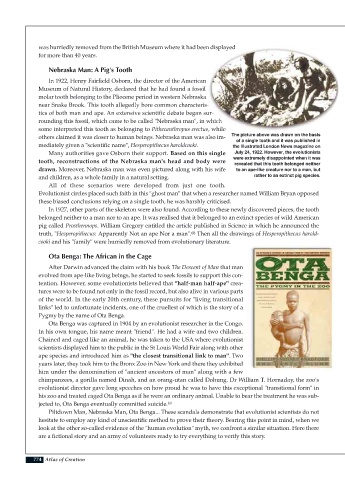
                                                                                                         The picture above was drawn on the basis
                  others claimed it was closer to human beings. Nebraska man was also im-
                                                                                                           of a single tooth and it was published in
                  mediately given a "scientific name", Hesperopithecus haroldcooki.                      the Illustrated London News magazine on
                       Many authorities gave Osborn their support. Based on this single                   July 24, 1922. However, the evolutionists
                                                                                                          were extremely disappointed when it was
                  tooth, reconstructions of the Nebraska man's head and body were
                                                                                                          revealed that this tooth belonged neither
                  drawn. Moreover, Nebraska man was even pictured along with his wife                      to an ape-like creature nor to a man, but
                  and children, as a whole family in a natural setting.                                            rather to an extinct pig species.
                       All of these scenarios were developed from just one tooth.

                  Evolutionist circles placed such faith in this "ghost man" that when a researcher named William Bryan opposed
                  these biased conclusions relying on a single tooth, he was harshly criticised.
                       In 1927, other parts of the skeleton were also found. According to these newly discovered pieces, the tooth
                  belonged neither to a man nor to an ape. It was realised that it belonged to an extinct species of wild American
                  pig called Prosthennops. William Gregory entitled the article published in Science in which he announced the
                  truth, "Hesperopithecus: Apparently Not an ape Nor a man". Then all the drawings of Hesperopithecus harold-
                                                                                       68
                  cooki and his "family" were hurriedly removed from evolutionary literature.


                       Ota Benga: The African in the Cage

                       After Darwin advanced the claim with his book The Descent of Man that man
                  evolved from ape-like living beings, he started to seek fossils to support this con-

                  tention. However, some evolutionists believed that "half-man half-ape" crea-
                  tures were to be found not only in the fossil record, but also alive in various parts
                  of the world. In the early 20th century, these pursuits for "living transitional
                  links" led to unfortunate incidents, one of the cruellest of which is the story of a

                  Pygmy by the name of Ota Benga.
                       Ota Benga was captured in 1904 by an evolutionist researcher in the Congo.
                  In his own tongue, his name meant "friend". He had a wife and two children.
                  Chained and caged like an animal, he was taken to the USA where evolutionist

                  scientists displayed him to the public in the St Louis World Fair along with other
                  ape species and introduced him as "the closest transitional link to man". Two
                  years later, they took him to the Bronx Zoo in New York and there they exhibited
                  him under the denomination of "ancient ancestors of man" along with a few

                  chimpanzees, a gorilla named Dinah, and an orang-utan called Dohung. Dr William T. Hornaday, the zoo's
                  evolutionist director gave long speeches on how proud he was to have this exceptional "transitional form" in
                  his zoo and treated caged Ota Benga as if he were an ordinary animal. Unable to bear the treatment he was sub-
                  jected to, Ota Benga eventually committed suicide.        69

                       Piltdown Man, Nebraska Man, Ota Benga... These scandals demonstrate that evolutionist scientists do not
                  hesitate to employ any kind of unscientific method to prove their theory. Bearing this point in mind, when we
                  look at the other so-called evidence of the "human evolution" myth, we confront a similar situation. Here there
                  are a fictional story and an army of volunteers ready to try everything to verify this story.


                774 Atlas of Creation

