


Page 778 - Atlas of Creation Volume 1
P. 778
there existed some "transitional forms" between today’s man and his ancestors. According to this completely
                  imaginary scenario, the following four basic "categories" are listed:
                       1. Australopithecines (any of the various forms belonging to the genus Australopithecus)
                       2. Homo habilis
                       3. Homo erectus

                       4. Homo sapiens
                       Evolutionists call the genus to which the alleged ape-like ancestors of man belonged "Australopithecus",
                  which means "southern ape". Australopithecus, which is nothing but an old type of ape that has become extinct,

                  is found in various different forms. Some of them are larger and strongly built (robust), while others are smaller
                  and delicate (gracile).
                       Evolutionists classify the next stage of human evolution as the genus Homo, that is "man". According to the
                  evolutionist claim, the living things in the Homo series are more developed than Australopithecus, and not very

                  much different from today’s man. The man of our day, that is, the species Homo sapiens, is said to have formed
                  at the latest stage of the evolution of this genus Homo.
                       Fossils like "Java Man", "Pekin Man", and "Lucy", which appear in the media from time to time and are to
                  be found in evolutionist publications and textbooks, are included in one of the four groups listed above. Each

                  of these groupings is also assumed to branch into species and sub-species, as the case may be.
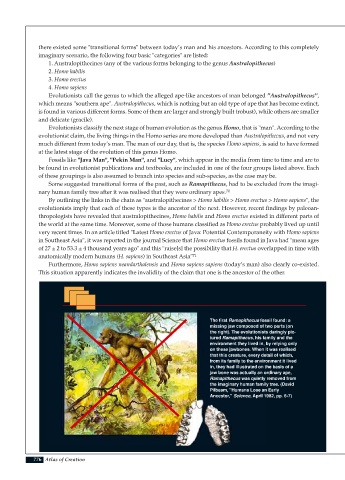
                       Some suggested transitional forms of the past, such as Ramapithecus, had to be excluded from the imagi-
                                             A Single Jawbone as a Spark of Inspiration
                  nary human family tree after it was realised that they were ordinary apes.          70
                       By outlining the links in the chain as "australopithecines > Homo habilis > Homo erectus > Homo sapiens", the

                  evolutionists imply that each of these types is the ancestor of the next. However, recent findings by paleoan-
                  thropologists have revealed that australopithecines, Homo habilis and Homo erectus existed in different parts of
                  the world at the same time. Moreover, some of those humans classified as Homo erectus probably lived up until
                  very recent times. In an article titled "Latest Homo erectus of Java: Potential Contemporaneity with Homo sapiens

                  in Southeast Asia", it was reported in the journal Science that Homo erectus fossils found in Java had "mean ages
                  of 27 ± 2 to 53.3 ± 4 thousand years ago" and this "raise[s] the possibility that H. erectus overlapped in time with
                  anatomically modern humans (H. sapiens) in Southeast Asia"           71
                       Furthermore, Homo sapiens neandarthalensis and Homo sapiens sapiens (today’s man) also clearly co-existed.

                  This situation apparently indicates the invalidity of the claim that one is the ancestor of the other.


                                                                                               The first Ramapithecus fossil found: a
                                                                                               missing jaw composed of two parts (on
                                                                                               the right). The evolutionists daringly pic-
                                                                                               tured Ramapithecus, his family and the
                                                                                               environment they lived in, by relying only
                                                                                               on these jawbones. When it was realised
                                                                                               that this creature, every detail of which,
                                                                                               from its family to the environment it lived
                                                                                               in, they had illustrated on the basis of a
                                                                                               jaw bone was actually an ordinary ape,
                                                                                               Ramapithecus was quietly removed from
                                                                                               the imaginary human family tree. (David
                                                                                               Pilbeam, "Humans Lose an Early
                                                                                               Ancestor," Science, April 1982, pp. 6-7)


                776 Atlas of Creation

