


Page 779 - Atlas of Creation Volume 1
P. 779
Harun Yahya


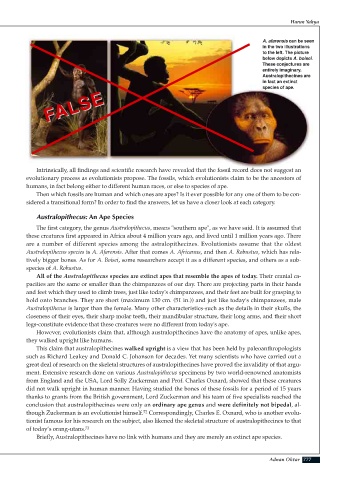
                                                                                                                       A. afarensis can be seen
                                                                                                                       in the two illustrations
                                                                                                                       to the left. The picture
                                                                                                                       below depicts A. boisei.
                                                                                                                       These conjectures are
                                                                                                                       entirely imaginary.
                                                                                                                       Australopithecines are
                                                                                                                       in fact an extinct
                                                                                                                       species of ape.
                      FALSE
                      FALSE


                 Intrinsically, all findings and scientific research have revealed that the fossil record does not suggest an
             evolutionary process as evolutionists propose. The fossils, which evolutionists claim to be the ancestors of

             humans, in fact belong either to different human races, or else to species of ape.
                 Then which fossils are human and which ones are apes? Is it ever possible for any one of them to be con-
             sidered a transitional form? In order to find the answers, let us have a closer look at each category.


                 Australopithecus: An Ape Species

                 The first category, the genus Australopithecus, means "southern ape", as we have said. It is assumed that
             these creatures first appeared in Africa about 4 million years ago, and lived until 1 million years ago. There

             are a number of different species among the astralopithecines. Evolutionists assume that the oldest
             Australopithecus species is A. Afarensis. After that comes A. Africanus, and then A. Robustus, which has rela-
             tively bigger bones. As for A. Boisei, some researchers accept it as a different species, and others as a sub-
             species of A. Robustus.

                 All of the Australopithecus species are extinct apes that resemble the apes of today. Their cranial ca-
             pacities are the same or smaller than the chimpanzees of our day. There are projecting parts in their hands
             and feet which they used to climb trees, just like today's chimpanzees, and their feet are built for grasping to
             hold onto branches. They are short (maximum 130 cm. (51 in.)) and just like today's chimpanzees, male

             Australopithecus is larger than the female. Many other characteristics-such as the details in their skulls, the
             closeness of their eyes, their sharp molar teeth, their mandibular structure, their long arms, and their short
             legs-constitute evidence that these creatures were no different from today's ape.
                 However, evolutionists claim that, although australopithecines have the anatomy of apes, unlike apes,

             they walked upright like humans.
                 This claim that australopithecines walked upright is a view that has been held by paleoanthropologists
             such as Richard Leakey and Donald C. Johanson for decades. Yet many scientists who have carried out a
             great deal of research on the skeletal structures of australopithecines have proved the invalidity of that argu-

             ment. Extensive research done on various Australopithecus specimens by two world-renowned anatomists
             from England and the USA, Lord Solly Zuckerman and Prof. Charles Oxnard, showed that these creatures
             did not walk upright in human manner. Having studied the bones of these fossils for a period of 15 years
             thanks to grants from the British government, Lord Zuckerman and his team of five specialists reached the

             conclusion that australopithecines were only an ordinary ape genus and were definitely not bipedal, al-
             though Zuckerman is an evolutionist himself. Correspondingly, Charles E. Oxnard, who is another evolu-
                                                                 72
             tionist famous for his research on the subject, also likened the skeletal structure of australopithecines to that
             of today’s orang-utans.   73

                 Briefly, Australopithecines have no link with humans and they are merely an extinct ape species.


                                                                                                                          Adnan Oktar    777

