


Page 771 - Atlas of Creation Volume 1
P. 771
The Myth of Horse Evolution


                                                                                                                                   Harun Yahya


                      ntil recently, an imaginary sequence suppos-           North America, and Europe solely in accordance with
                      edly showing the evolution of the horse was            the rich power of evolutionists' imaginations. More
              U advanced as the principal fossil evidence for                than 20 charts of the evolution of the horse, which by
             the theory of evolution. Today, however, many evolu-            the way are totally different from each other, have
             tionists themselves frankly admit that the scenario of          been proposed by various researchers. Thus, it is ob-
             horse evolution is bankrupt. In 1980, a four-day sym-           vious that evolutionists have reached no common
             posium was held at the Field Museum of Natural                  agreement on these family trees. The only common
             History in Chicago, with 150 evolutionists in atten-            feature in these arrangements is the belief that a dog-
             dance, to discuss the problems with gradualistic evo-           sized creature called "Eohippus", which lived in the
             lutionary theory. In addressing the meeting,
             evolutionist Boyce Rensberger noted that the sce-               Eocene Period 55 million years ago, was the ancestor
             nario of the evolution of the horse has no foundation           of the horse (Equus). But, the supposed evolutionary
             in the fossil record, and that no evolutionary proccess         lines from Eohippus to Equus are totally inconsistent.
             has been observed that would account for the gradual             The evolutionist science writer Gordon R. Taylor ex-
             evolution of horses:                                            plains this little-acknowledged truth in his book The
              The popularly told example of horse evolution, sug-            Great Evolution Mystery:
             gesting a gradual sequence of changes from four-                 But perhaps the most serious weakness of
             toed fox-sized creatures living nearly 50 million years         Darwinism is the failure of paleontologists to find con-
             ago to today's much larger one-toed horse, has long             vincing phylogenies or sequences of organisms
             been known to be wrong. Instead of gradual change,              demonstrating major evolutionary change... The
             fossils of each intermediate species appear fully dis-          horse is often cited as the only fully worked-out exam-
             tinct, persist unchanged, and then become extinct.              ple. But the fact is that the line from Eohippus to

             Transitional forms are unknown.      1                          Equus is very erratic. It is alleged to show a continual
              Dr. Niles Eldredge said the following about the "evo-          increase in size, but the truth is that some variants
             lution of the horse" diagrams:                                  were smaller than Eohippus, not larger. Specimens
              There have been an awful lot of stories, some more             from different sources can be brought together in a
             imaginative than others, about what the nature of that          convincing-looking sequence, but there is no evi-
             history [of life] really is. The most famous example,           dence that they were actually ranged in this order in
             still on exhibit downstairs, is the exhibit on horse evo-       time. 3

             lution prepared perhaps fifty years ago. That has been           All these facts are strong evidence that the charts of
             presented as the literal truth in textbook after text-          horse evolution, which are presented as one of the
             book. Now I think that is lamentable, particularly when         most solid pieces of evidence for Darwinism, are
             the people who propose those kinds of stories may               nothing but fantastic and implausible tales.
             themselves be aware of the speculative nature of
             some of that stuff.  2
              Then what is the basis for the scenario of the evolu-
             tion of the horse? This scenario was formulated by
             means of the deceitful charts devised by the sequen-

             tial arrangement of fossils of distinct species that
                                                                             1- Boyce Rensberger, Houston Chronicle, November 5, 1980, p.15
             lived at vastly different periods in India, South Africa,       2- Niles Eldredge, quoted in Darwin's Enigma by Luther D.
                                                                             Sunderland, Santee, CA, Master Books, 1988, p. 78
                                                                             3- Gordon Rattray Taylor, The Great Evolution Mystery, Abacus,
                                                                             Sphere Books, London, 1984, p. 230


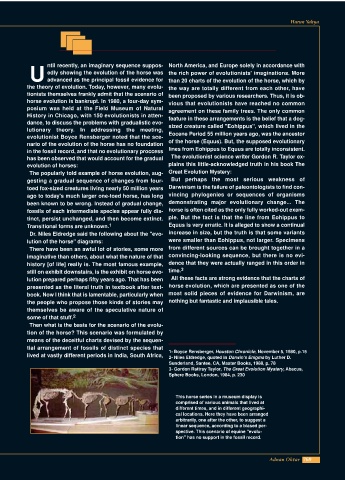
                                                                                This horse series in a museum display is
                                                                                comprised of various animals that lived at
                                                                                different times, and in different geographi-
                                                                                cal locations. Here they have been arranged
                                                                                arbitrarily, one after the other, to suggest a
                                                                                linear sequence, according to a biased per-
                                                                                spective. This scenario of equine "evolu-
                                                                                tion" has no support in the fossil record.


                                                                                                                          Adnan Oktar    769

