


Page 766 - Atlas of Creation Volume 1
P. 766
Speculations of Evolutionists: The Teeth and Claws of Archæopteryx


                       Two important points evolutionist biologists rely on when claiming Archæopteryx was a transitional form,
                  are the claws on its wings and its teeth.
                       It is true that Archæopteryx had claws on its wings and teeth in its mouth, but these traits do not imply that
                  the creature bore any kind of relationship to reptiles. Besides, two bird species living today, Taouraco and

                  Hoatzin, have claws which allow them to hold onto branches. These creatures are fully birds, with no reptilian
                  characteristics. That is why it is completely groundless to assert that Archæopteryx is a transitional form just be-
                  cause of the claws on its wings.

                       Neither do the teeth in Archæopteryx's beak imply that it is a transitional form. Evolutionists make a pur-
                  poseful trickery by saying that these teeth are reptile characteristics, since teeth are not a typical feature of rep-
                  tiles. Today, some reptiles have teeth while others do not. Moreover, Archæopteryx is not the only bird species to
                  possess teeth. It is true that there are no toothed birds in existence today, but when we look at the fossil record,
                  we see that both during the time of Archæopteryx and afterwards, and even until fairly recently, a distinct bird

                  genus existed that could be categorised as "birds with teeth".
                       The most important point is that the tooth structure of Archæopteryx and other birds with teeth is totally
                  different from that of their alleged ancestors, the dinosaurs. The well-known ornithologists L. D. Martin, J. D.

                  Steward, and K. N. Whetstone observed that Archæopteryx and other similar birds have teeth with flat-topped
                  surfaces and large roots. Yet the teeth of theropod dinosaurs, the alleged ancestors of these birds, are protuber-
                  ant like saws and have narrow roots.      48
                       These researchers also compared the wrist bones of Archæopteryx and their alleged ancestors, the di-
                  nosaurs, and observed no similarity between them.          49

                       Studies by anatomists like S. Tarsitano, M. K. Hecht, and A.D. Walker have revealed that some of the simi-
                  larities that John Ostrom and other have seen between Archæopteryx and dinosaurs were in reality misinterpre-
                  tations. 50

                       All these findings indicate that Archæopteryx was not a transitional link but only a bird that fell into a cate-
                  gory that can be called "toothed birds".


                       Archæopteryx and Other Bird Fossils

                       While evolutionists have for decades been proclaiming Archæopteryx to be the greatest evidence for their
                  scenario concerning the evolution of birds, some recently-found fossils invalidate that scenario in other re-
                                              spects.

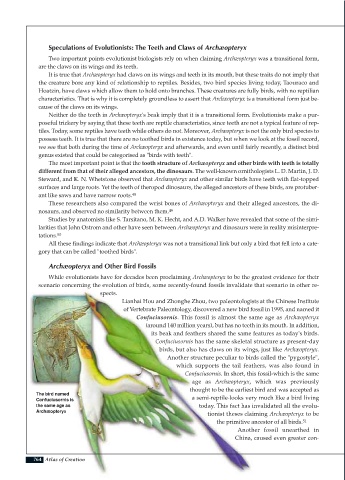
                                                        Lianhai Hou and Zhonghe Zhou, two paleontologists at the Chinese Institute
                                                        of Vertebrate Paleontology, discovered a new bird fossil in 1995, and named it
                                                              Confuciusornis. This fossil is almost the same age as Archæopteryx
                                                                  (around 140 million years), but has no teeth in its mouth. In addition,

                                                                     its beak and feathers shared the same features as today's birds.
                                                                       Confuciusornis has the same skeletal structure as present-day
                                                                        birds, but also has claws on its wings, just like Archæopteryx.
                                                                            Another structure peculiar to birds called the "pygostyle",

                                                                                which supports the tail feathers, was also found in
                                                                                    Confuciusornis. In short, this fossil-which is the same
                                                                                       age as  Archæopteryx, which was previously
                                                                                      thought to be the earliest bird and was accepted as
                 The bird named
                 Confuciusornis is                                                     a semi-reptile-looks very much like a bird living
                 the same age as                                                          today. This fact has invalidated all the evolu-
                 Archæopteryx
                                                                                              tionist theses claiming Archæopteryx to be
                                                                                                  the primitive ancestor of all birds.   51

                                                                                                            Another fossil unearthed in
                                                                                                           China, caused even greater con-


                764 Atlas of Creation

