


Page 765 - Atlas of Creation Volume 1
P. 765
Harun Yahya


                 Another Alleged Transitional Form: Archæopteryx


                 Evolutionists pronounce the name of one single creature in response. This is the fossil of a bird called
             Archæopteryx, one of the most widely-known so-called transitional forms among the very few that evolu-
             tionists still defend. Archæopteryx, the so-called ancestor of present-day birds according to evolutionists,
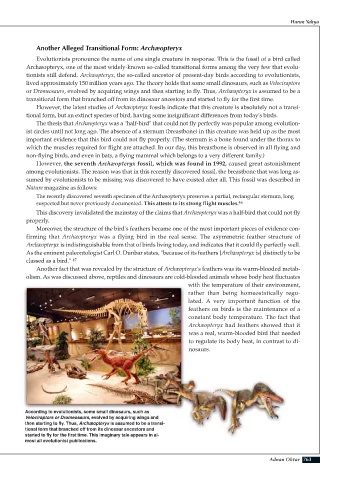
             lived approximately 150 million years ago. The theory holds that some small dinosaurs, such as Velociraptors

             or Dromeosaurs, evolved by acquiring wings and then starting to fly. Thus, Archæopteryx is assumed to be a
             transitional form that branched off from its dinosaur ancestors and started to fly for the first time.
                 However, the latest studies of Archæopteryx fossils indicate that this creature is absolutely not a transi-

             tional form, but an extinct species of bird, having some insignificant differences from today's birds.
                 The thesis that Archæopteryx was a "half-bird" that could not fly perfectly was popular among evolution-
             ist circles until not long ago. The absence of a sternum (breastbone) in this creature was held up as the most
             important evidence that this bird could not fly properly. (The sternum is a bone found under the thorax to

             which the muscles required for flight are attached. In our day, this breastbone is observed in all flying and
             non-flying birds, and even in bats, a flying mammal which belongs to a very different family.)
                 However, the seventh Archæopteryx fossil, which was found in 1992, caused great astonishment
             among evolutionists. The reason was that in this recently discovered fossil, the breastbone that was long as-

             sumed by evolutionists to be missing was discovered to have existed after all. This fossil was described in
             Nature magazine as follows:
                 The recently discovered seventh specimen of the Archæopteryx preserves a partial, rectangular sternum, long
                 suspected but never previously documented. This attests to its strong flight muscles.      46

                 This discovery invalidated the mainstay of the claims that Archæopteryx was a half-bird that could not fly
             properly.
                 Moreover, the structure of the bird's feathers became one of the most important pieces of evidence con-

             firming that  Archæopteryx was a flying bird in the real sense. The asymmetric feather structure of
             Archæopteryx is indistinguishable from that of birds living today, and indicates that it could fly perfectly well.
             As the eminent paleontologist Carl O. Dunbar states, "because of its feathers [Archæopteryx is] distinctly to be
             classed as a bird."  47

                 Another fact that was revealed by the structure of Archæopteryx's feathers was its warm-blooded metab-
             olism. As was discussed above, reptiles and dinosaurs are cold-blooded animals whose body heat fluctuates
                                                                                     with the temperature of their environment,
                                                                                     rather than being homeostatically regu-

                                                                                     lated.  A very important function of the
                                                                                      feathers on birds is the maintenance of a
                                                                                      constant body temperature. The fact that
                                                                                      Archæopteryx had feathers showed that it

                                                                                      was a real, warm-blooded bird that needed
                                                                                      to regulate its body heat, in contrast to di-
                                                                                      nosaurs.


            According to evolutionists, some small dinosaurs, such as
            Velociraptors or Dromeosaurs, evolved by acquiring wings and
            then starting to fly. Thus, Archæopteryx is assumed to be a transi-
            tional form that branched off from its dinosaur ancestors and
            started to fly for the first time. This imaginary tale appears in al-
            most all evolutionist publications.


                                                                                                                          Adnan Oktar    763

